The YouTube Shorts Algorithm: Your 2026 Guide
The YouTube Shorts algorithm is now a separate recommendation system from long-form YouTube, built for vertical videos under 3 minutes and driven mainly by swipe-away rate, average percentage viewed, and viewer satisfaction. That matters because Shorts hit 200 billion daily views in 2026, up from 70 billion daily views in early 2024, while YouTube also split Shorts ranking away from long-form recommendations in late 2025, changing how creators need to package clips for reach (BlitzCut AI’s 2026 overview).
Most advice about Shorts stops at “make a strong hook.” That’s not enough. Teams need to understand the system: what gets tested first, what threshold moves a Short forward, what metrics are inflated, and why repurposed clips often fail unless they’re rebuilt for the feed.
If you manage content for a creator brand, podcast, SaaS company, or B2B marketing team, the practical takeaway is simple. A good Short isn’t a chopped-down long video. It’s a standalone asset designed to win the first seconds, hold retention, and satisfy the viewer after the watch.
Table of Contents
- How the YouTube Shorts Algorithm Ranks Content
- The Lifecycle of a Short From Upload to Viral
- Common Myths About the Shorts Algorithm Debunked
- Actionable Strategies to Optimize Your Shorts
- Analyzing Your Shorts Data to Improve Reach
- YouTube Shorts Algorithm FAQ
How the YouTube Shorts Algorithm Ranks Content
YouTube Shorts now serves an audience measured in the hundreds of billions of daily views, which is why ranking logic matters more than channel size. The key shift is structural: Shorts are evaluated in a recommendation system that operates separately from long-form distribution, so a strong clip can scale without long-form momentum, and long-form authority will not rescue a weak Short.
Shorts and long-form no longer boost each other by default
This changes how teams should plan content.
A Short is not a trimmed version of a standard video with a vertical crop. It is a separate asset with its own job, its own audience behavior, and its own performance test. If the opening frame fails to stop the scroll, the rest of the clip never gets enough distribution to matter.
Practical rule: Treat every Short as its own campaign asset, not as a trailer for a longer video.
That separation affects production and publishing. Topic alignment with your broader channel still helps build a coherent audience, and a strong YouTube SEO workflow is still important for your channel ecosystem. But Shorts ranking depends on short-form feed performance first. If your team needs a cleaner publishing process before optimization starts, use this guide on how to post YouTube Shorts correctly.
The ranking signals that matter
The easiest way to read the system is in sequence. YouTube tests whether viewers stop, whether they stay, and whether the clip creates enough satisfaction to earn wider distribution. That order matters because later signals do not help much if the Short fails the first screen-level test.
The main signals are:
-
Swipe-away rate
This is the first filter. If viewers skip in the opening moments, distribution slows fast. -
Average percentage watched
For Shorts, this usually matters more than raw watch time. Completion behavior is the primary hold signal. -
Re-watch rate
Replays can strengthen retention quality when the loop is intentional and the content gives viewers a reason to watch again. -
Share rate
Shares signal a higher level of satisfaction than passive viewing because the viewer is willing to attach their identity to the content. -
Click-through to long-form content
This can support broader channel value, but it sits below feed performance in the ranking stack.
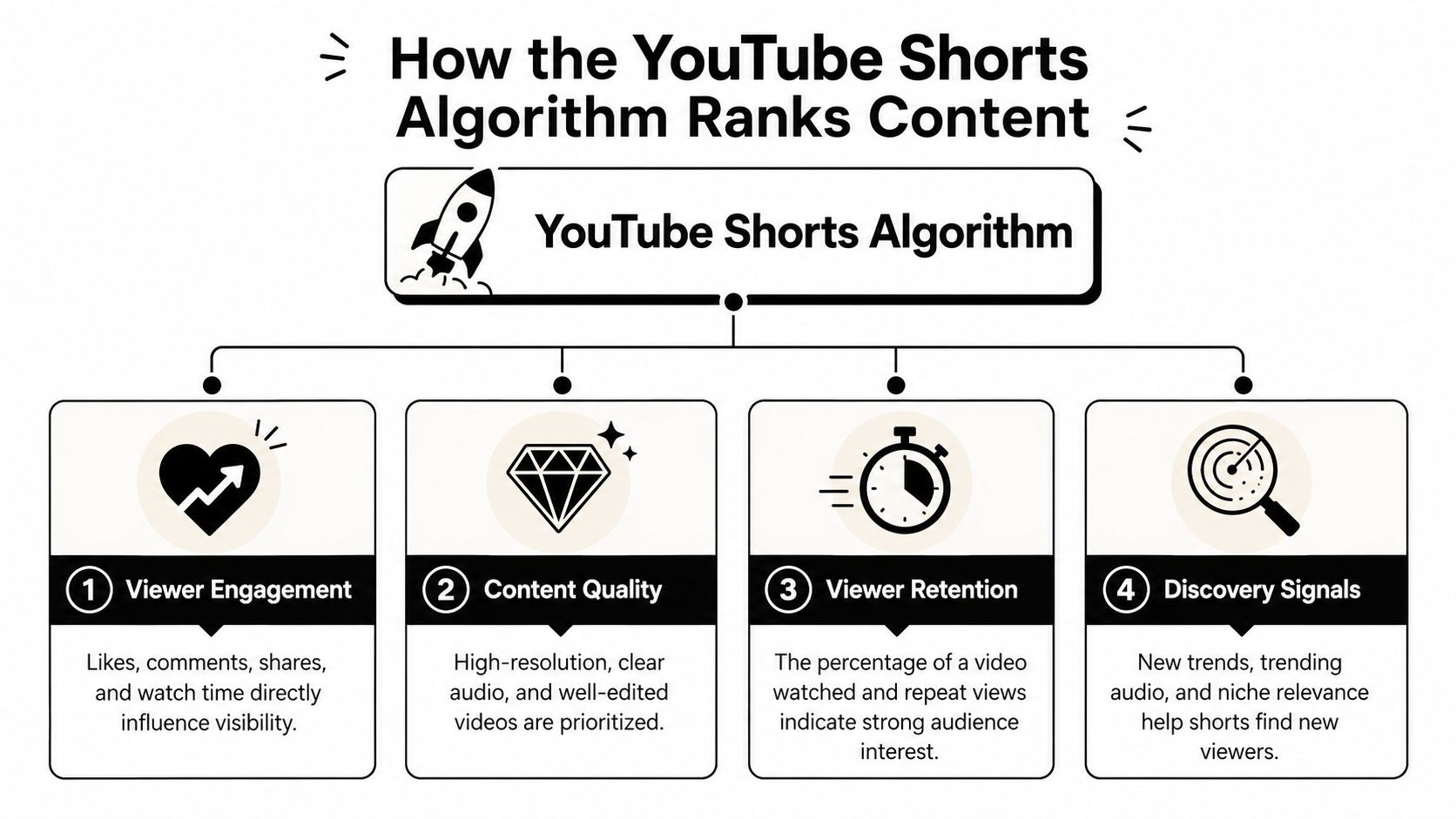
Early retention carries disproportionate weight because the system is making fast distribution decisions. The first two seconds often decide whether a Short gets enough viewed traffic to reach the next test pool. Packaging errors hurt here more than many teams expect. Horizontal repurposes with black bars waste screen space, weaken visual clarity, and reduce the chance of an immediate stop. Clear on-screen captions can help hold sound-off viewers, especially in education, commentary, and interview clips.
Repurposing is frequently misinterpreted. Repurposed content can perform well, but only after it is rebuilt for the Shorts feed. Cut the setup. Start on the payoff, tension, claim, or visual change. Write captions for speed, not transcript accuracy. The algorithm is not rewarding the origin of the clip. It is rewarding how viewers respond in sequence.
The Lifecycle of a Short From Upload to Viral
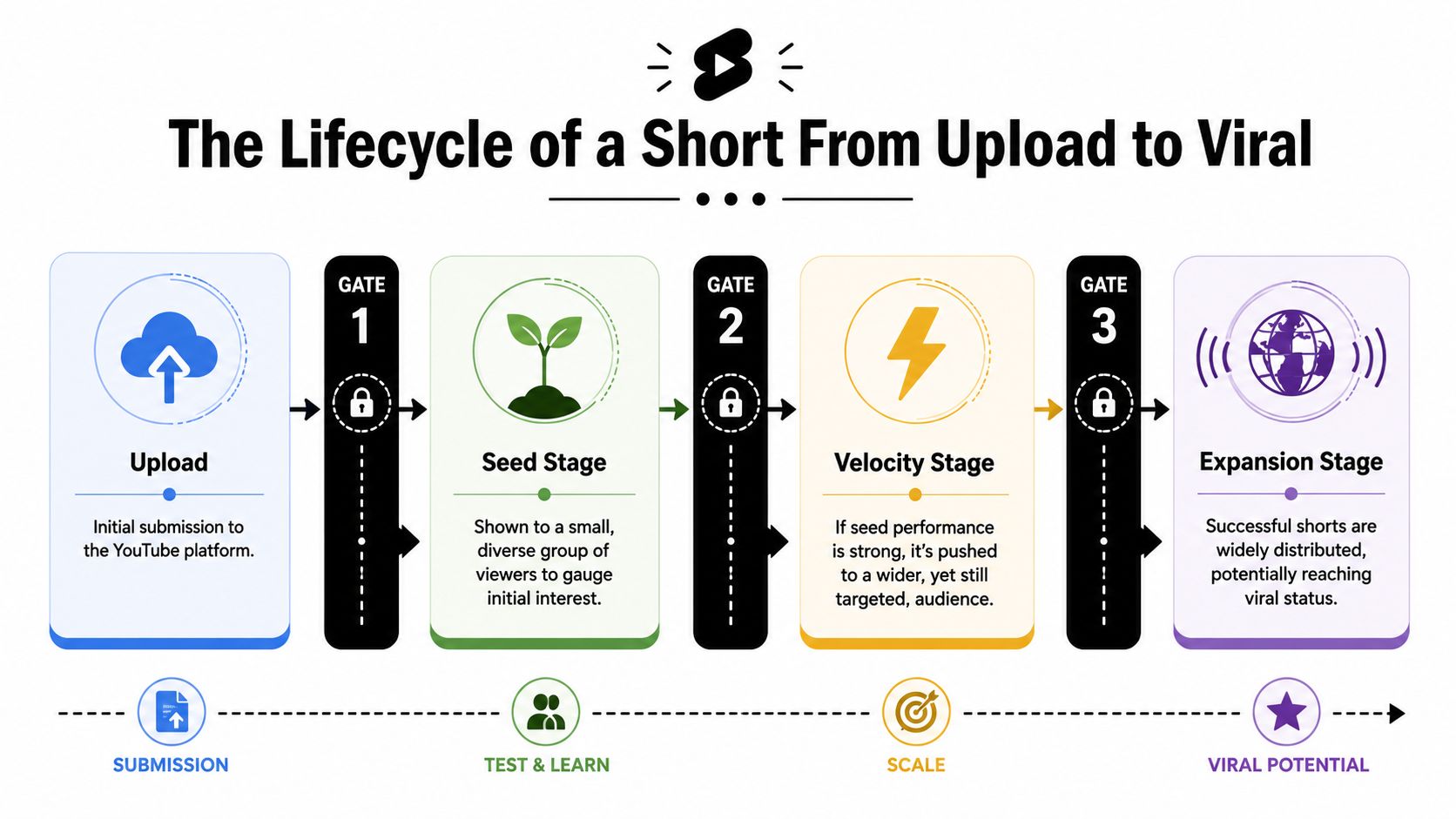
Shorts usually earn their reach in steps, not in one spike. Early distribution is a controlled test, and the algorithm keeps widening that test only when the clip clears the next threshold.
According to ReelForge AI’s 2026 guide, YouTube uses a three-gate sequential distribution system: a small seed batch, a velocity check, then broader expansion across other surfaces if performance holds.
What happens right after upload
The first viewers are not your audience at scale. They are a performance test.
YouTube gives a new Short a small pool of impressions and watches for immediate feed behavior. Did viewers stop? Did they keep watching instead of swiping? Did enough of them reach the end, rewatch, or generate other satisfaction signals? If those answers are strong, the system sends the Short into a larger pool. If not, distribution slows before the clip ever gets a real chance to spread broadly.
One benchmark matters here. Shorts that clear roughly a 70% viewed rate instead of getting swiped can move into the next velocity gate, as noted earlier from ReelForge AI. That does not guarantee broad reach, but it usually determines whether the video gets another meaningful round of testing.
Teams often miss the larger point. Shorts ranking is not just about isolated signals. It is about sequence. A clip has to prove itself in a small sample before it earns access to the next one, and each gate has less patience for weak openings.
If your team needs to tighten the publishing process before testing creative changes, this guide on how to post YouTube Shorts correctly is useful.
Why some Shorts stall fast
A Short usually stalls because it fails the first gate.
Three patterns show up repeatedly:
-
The opening frame arrives too late
The topic is not clear fast enough, so viewers swipe before the idea registers. -
The promise and payoff do not line up
The hook creates one expectation, then the clip delivers something else. -
The edit still follows long-form pacing
Context, pauses, and scene-setting reduce feed performance because the value comes too late.
A useful video can still lose distribution if it asks for patience before it delivers a reason to stay.
That is the trade-off with repurposing. A strong idea from a podcast, webinar, or interview can work in Shorts, but only if the clip is rebuilt for this gated system. Teams that treat Shorts as a simple export from long-form usually misdiagnose the result. The topic was not always the problem. The video failed the first test pool, so the algorithm never gave it a larger one.
Common Myths About the Shorts Algorithm Debunked
Shorts advice gets noisy fast. Most of the bad advice comes from creators trying to explain inconsistent results with superstition.
Myth one captions hurt reach
They don’t automatically hurt reach. If anything, well-paced captions can help retention when they’re readable and synced to the spoken audio.
Based on analysis of 170K+ posts across 1,100+ creators, captions that align with audio pacing often increase average view duration by 15% in the 20–40 second range, which feeds directly into retention priority (True Future Media’s data-backed guide).
That doesn’t mean you should flood the screen with text. It means clean, timed captions can help viewers stay with the clip, especially in sound-off environments. For teams working on inclusive distribution, this guide on video accessibility best practices is a useful companion.
Myth two repurposed clips cannot work
Repurposed clips can work. Lazy repurposing usually doesn’t.
The mistake is assuming the best moment from a podcast or webinar is automatically the best Short. Long-form moments often need a new first line, a tighter setup, and more aggressive trimming to fit feed behavior. The underlying idea can be strong. The short-form wrapper is what determines whether the audience watches.
Myth three views tell you the whole story
They don’t, especially after YouTube changed Shorts view counting on March 31, 2025 so that any Short that starts playing or replays counts as a view with no minimum watch time required (YouTube analysis video on Shorts metrics).
That means passive loops can inflate headline views. So when a team says, “This one got a lot of views,” the follow-up question should be: did people actually watch, stay, and engage?
If a metric can rise without stronger audience intent, it isn’t the metric you optimize to.
Actionable Strategies to Optimize Your Shorts
Shorts usually win or lose before the viewer reaches the five-second mark. Treat optimization as a distribution problem, not an editing exercise. The system tests a Short in stages, so the job is to clear the early gates first, then protect retention through the middle, then earn enough satisfaction signals to keep getting shown.
Near the start of your workflow, it helps to see what an efficient clipping setup looks like:
Build for the first distribution gate
YouTube evaluates Shorts independently from long-form performance, and early feed exposure is limited. That changes the production brief. A Short does not need more context. It needs a clear reason to stop the swipe.
Use a tighter opening standard:
-
Lead with the result or tension Put the payoff, claim, or conflict in the first line.
-
Make frame one readable without audio The subject, speaker, or visual proof should be obvious immediately.
-
Cut throat-clearing Remove greetings, scene-setting, and any version of “today I want to talk about.”
-
Show proof early If the claim depends on evidence, put the evidence near the front instead of saving it for later.
For B2B teams, this often means rewriting the clip, not just trimming it. A webinar excerpt may contain a strong idea, but feed behavior rewards a rebuilt opening, faster pacing, and a payoff that arrives much sooner than it would in long-form.
Edit for retention thresholds, not topic completeness
The common mistake is protecting every nuance from the source material. The algorithm rewards watch behavior, so completeness comes second.
A practical structure works better:
- Hook with a concrete claim, outcome, or problem
- Evidence with a fast example, screen, stat, or demonstration
- Payoff with the answer before interest drops
- Next step only if it fits naturally and does not slow the clip
That trade-off matters. If one extra explanation improves clarity, keep it. If it only preserves completeness for internal stakeholders, cut it.
For teams also thinking about discoverability beyond platform-native feeds, these actionable GEO strategies are useful for aligning content structure with how answer engines and search systems surface short-form information.
Here’s a useful visual explainer on pacing and format decisions:
Use captions and framing to reduce friction
Captions help retention because many Shorts are watched with sound low or off. Placement matters just as much as accuracy.
Keep text away from the outer edges where the Shorts interface competes for space. Protect the lower third, avoid the top-right area, and do not stack too many words on screen at once. Repurposed clips fail here all the time. The edit is fine, but the UI covers the key phrase or the text density makes the frame harder to process.
A few production rules consistently improve watchability:
- Burn in readable captions with strong contrast
- Use native 1080×1920 vertical framing
- Keep one visual focal point on screen at a time
- Cut dead air aggressively between lines
- Resize repurposed footage manually instead of relying on auto-crop alone
If you need a cleaner subtitle workflow, this guide on how to add subtitles to YouTube Shorts covers the mechanics.
Analyzing Your Shorts Data to Improve Reach
A Short can collect views and still fail the next distribution gate. The useful question is whether the first test audience watched, stayed, and signaled satisfaction strongly enough for YouTube to keep expanding reach.
Start with three metrics together, not in isolation. Viewed vs. Swiped Away shows whether the opening frame and first line earned attention. Engaged views shows whether people did more than passively consume. Average percentage viewed shows whether the structure held up after the hook.
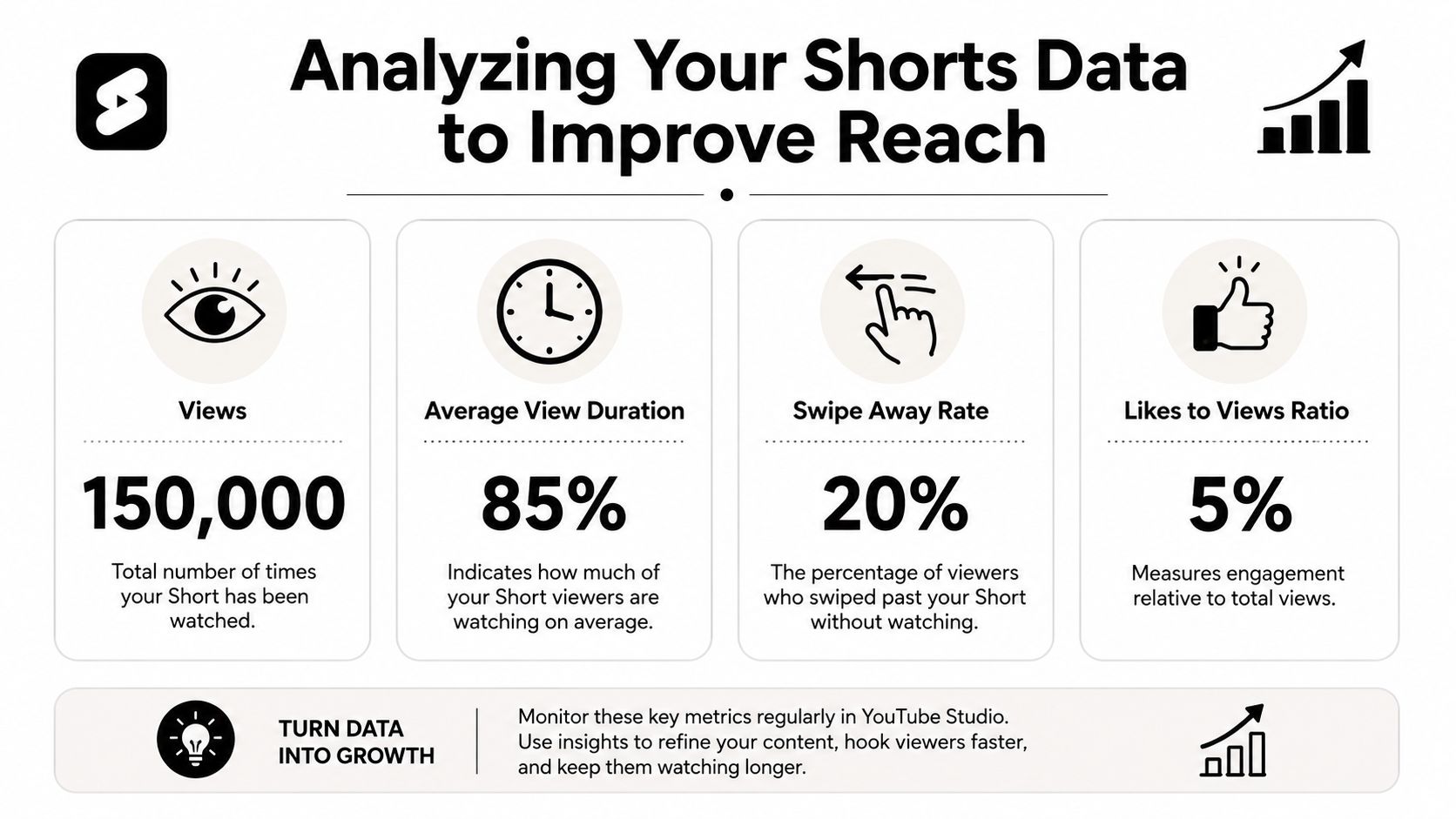
Read those signals like an operator:
| Metric | What it usually means | What to fix |
|---|---|---|
| Viewed vs. Swiped Away | Your opening frame and hook strength | Rewrite the first line, change the opening visual, front-load the payoff |
| Engaged views | Whether viewers stayed long enough to care | Tighten pacing, cut low-value setup, make the point clearer sooner |
| Average percentage viewed | Whether the full structure earns completion | Trim the middle, remove repetition, shorten sections that drop energy |
One pattern shows up constantly in team reviews. Low swipe performance is usually a packaging problem. Low average percentage viewed is usually a structure problem. Those require different fixes, and treating them as the same issue slows iteration.
Track results by batch, not post by post. Group Shorts by hook style, topic, length, and edit format so you can see which variables affect outcomes. A simple social media analytics tracking workflow makes that process easier and stops teams from drawing conclusions from one outlier.
Context also affects early distribution, especially on newer or less established channels. As noted earlier, YouTube has explained that personalization and watch history shape who sees a Short first. That means niche alignment is part of the system, not a side note. If a channel posts across unrelated topics, early testing gets noisier because the platform has weaker audience priors.
Use that trade-off carefully. Broad experimentation can help with ideation, but mixed signals at the channel level can make Shorts harder to classify in the first wave. For brands and marketing teams, the cleaner approach is to test multiple angles inside one topic cluster before jumping to a new category entirely.
YouTube Shorts Algorithm FAQ
Shorts do not spread in one burst. They move through small audience tests, then expand if the response stays strong. That system changes how teams should read common ranking questions.
| Question | Answer |
|---|---|
| Does posting time matter for YouTube Shorts? | Yes, but it is a distribution assist, not a ranking shortcut. Publishing when your audience is active can help the first test group fill faster. If the opening fails to hold attention, the Short still stalls at the first gate. |
| Do hashtags help the YouTube Shorts algorithm? | They help with topic clarity, but they are a weak signal compared with viewer response. Clear language in the title, on-screen text, and spoken audio gives YouTube stronger classification cues than a stack of hashtags. |
| Can copyrighted music hurt Shorts performance? | Yes. Rights restrictions can limit how a Short is used and create avoidable risk for brands, agencies, and client accounts. Licensed audio or platform-safe tracks keep distribution and monetization decisions cleaner. |
| How long does it take for a Short to get picked up? | There is no fixed timeline. Some Shorts clear the first distribution gate quickly, while others get limited testing and stop. If a video stalls, review the first second, caption clarity, and early retention before changing the topic strategy. |
| Is there an ideal length for YouTube Shorts? | There is no universal best length. Shorter videos often have an easier path to high completion, while longer Shorts can win if every second earns attention. The better rule is to match length to idea density. Cut anything that does not improve payoff, clarity, or momentum. |
If your team repurposes podcasts, webinars, interviews, or long-form YouTube videos into Shorts, quso.ai is built for that workflow. It helps teams repurpose long video into short clips, add auto-captions, and schedule distribution without rebuilding every asset by hand.