TikTok Engagement Rate: Formula, Benchmarks & Tips 2026

TikTok engagement rate is calculated by views, not followers: ER = (Likes + Comments + Shares + Saves) / Views × 100. Recent benchmark data puts the average brand-level TikTok engagement rate at 3.85%, which is the right baseline to use when you’re judging whether a post connected with viewers.
Most guides still get this wrong. They use follower-based math borrowed from Instagram, then wonder why TikTok numbers feel inconsistent. On TikTok, distribution starts with views, watch time, and retention. If you want a metric that matches how the platform works, you need a view-based formula and benchmarks that reflect discovery, not audience size.
That matters even more if you’re turning long videos into clips. A repurposed interview, webinar, or podcast segment can look weak on a follower-based sheet and still perform well in TikTok’s feed because new viewers engaged with it. That’s why this metric is worth getting right from the start.
Table of Contents
- What Is TikTok Engagement Rate
- How to Calculate Your TikTok Engagement Rate The Right Way
- TikTok Engagement Rate Benchmarks for 2026
- Key Factors That Influence Your Engagement Rate
- 5 Data-Driven Tactics to Boost Your TikTok Engagement
- How to Track Engagement in TikTok Analytics
- FAQ About TikTok Engagement Rate
What Is TikTok Engagement Rate
TikTok engagement rate measures how many people interacted with a video after seeing it. The cleanest definition is simple: it tells you how often viewers turned into active participants through likes, comments, shares, and in many calculations, saves.
That’s why TikTok’s view-based model matters more than follower count. The platform is built around distribution to viewers, not just delivery to followers. A video can reach far beyond your existing audience, so a follower-based percentage often tells you less than you think.
According to Socialinsider benchmark reporting summarized here, TikTok’s average engagement rate surged 49% year over year to 3.70% in 2025, which made it more than seven times higher than Instagram’s 0.48% and nearly 25 times Facebook’s 0.15%.
Why this metric matters more than follower count
A follower total is a lagging indicator. Engagement rate is a performance indicator.
If you manage content for a creator, coach, or B2B brand, engagement rate tells you whether the post itself worked. It answers questions that follower count can’t:
- Did the hook land: People stayed long enough to respond.
- Was the topic relevant: Comments and shares usually reveal that fast.
- Did the video earn distribution: Strong interaction tends to support further reach.
- Is the content format worth repeating: Good engagement usually points to a repeatable angle.
Practical rule: Use engagement rate to judge content quality. Use follower count to judge account scale. They’re not the same thing.
There’s also a practical growth angle here. Smaller teams often assume they need a huge audience before they can boost TikTok engagement. In reality, format, relevance, and viewer response usually matter more than raw account size.
How to Calculate Your TikTok Engagement Rate The Right Way
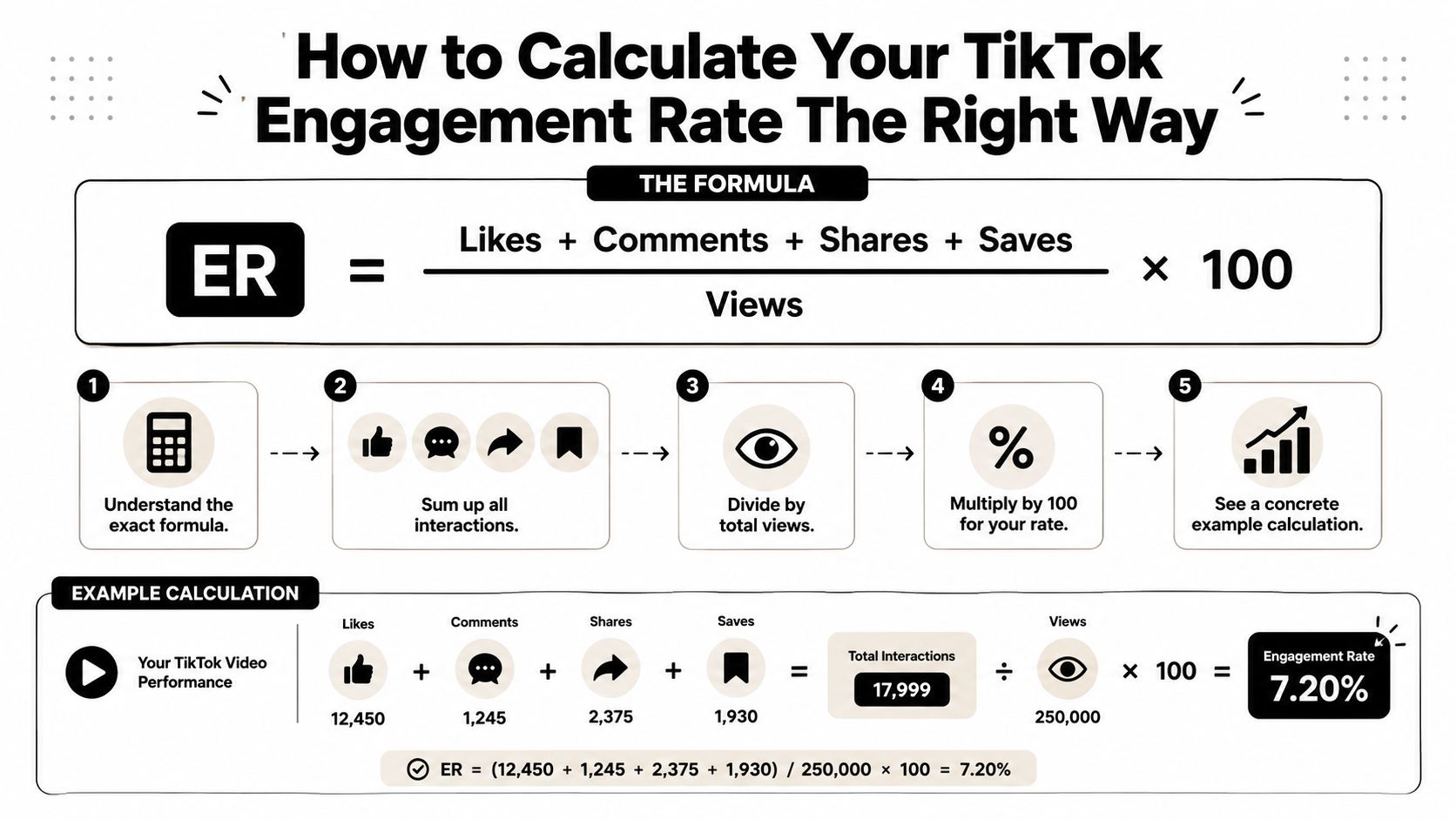
The correct formula is ER = (Likes + Comments + Shares + Saves) / Views × 100. That’s the industry-standard technical definition because views are the platform’s core distribution metric, as explained by Elev8or’s TikTok engagement rate calculator guide.
The formula in plain English
Use this process for any single video:
- Add up all interactions.
- Divide that total by the video’s views.
- Multiply by 100.
Written out:
Engagement Rate = (Likes + Comments + Shares + Saves) / Views × 100
A simple example
Say a post gets:
- 500 likes
- 40 comments
- 30 shares
- 20 saves
- 10,000 views
The math looks like this:
(500 + 40 + 30 + 20) / 10,000 × 100 = 5.9%
That gives you a 5.9% TikTok engagement rate for that video.
A view-based rate tells you how strongly the content connected with the people who actually watched it. That’s the number worth optimizing.
Why follower-based math is the wrong benchmark
Follower-based engagement formulas came from older social platforms where audience delivery was tied more closely to the follow graph. TikTok doesn’t work that way. Discovery is central to how posts spread.
If you divide by followers, you can underrate breakout posts and overrate weak ones. A clip that reaches a fresh audience through the For You feed may look “low” against follower count even when viewer response is strong. That pushes teams toward bad decisions, like chasing audience size instead of improving retention, readability, and shareability.
The cleaner approach is to measure post performance against views, then compare it to view-based benchmarks. That keeps your reporting aligned with how TikTok distributes content.
TikTok Engagement Rate Benchmarks for 2026
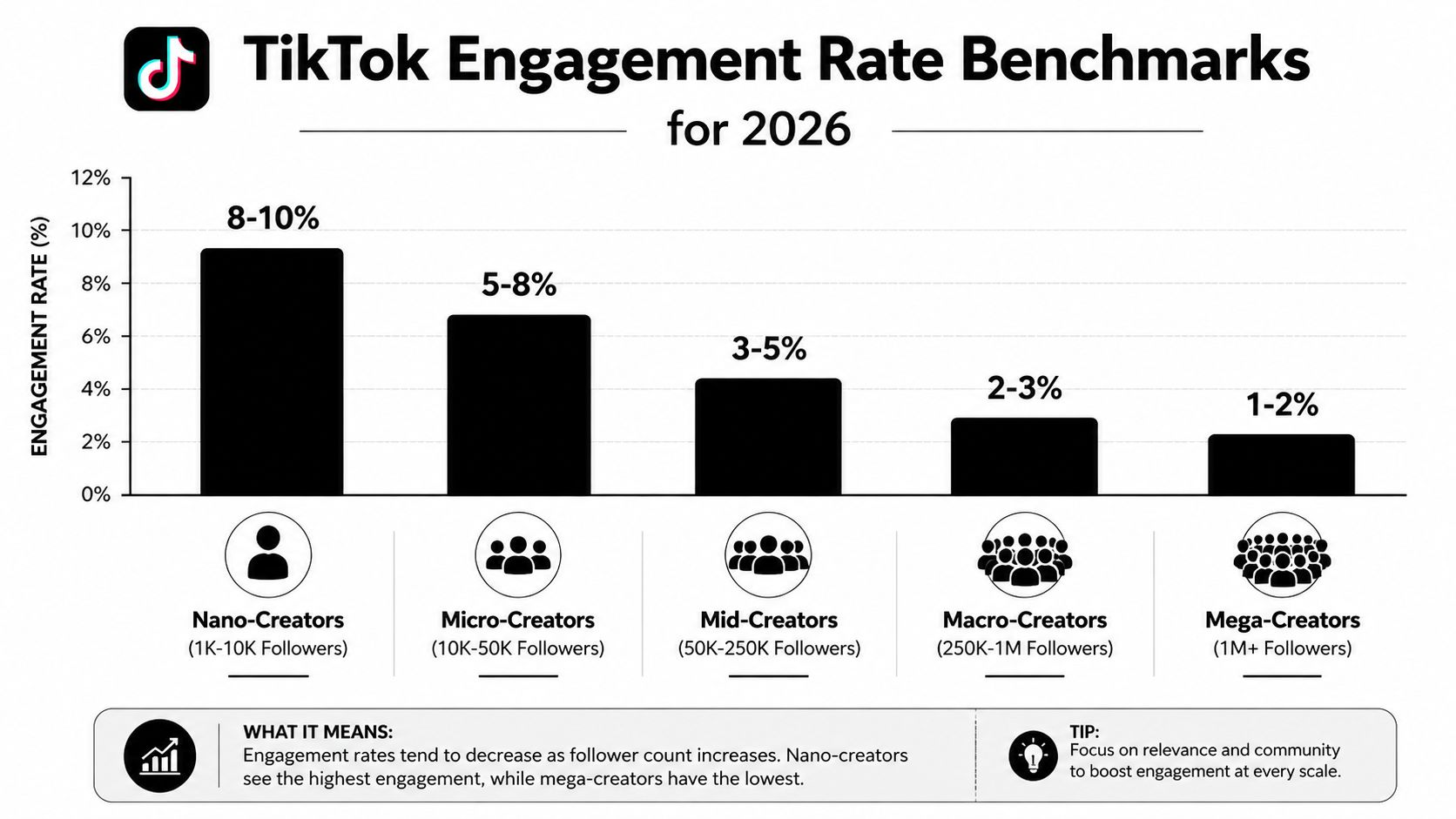
Benchmarks only help if they’re tier-aware. A smaller niche account and a massive creator account shouldn’t expect the same engagement rate.
Recent benchmark data compiled by Emplicit’s TikTok engagement rate analysis shows that accounts under 100,000 followers achieve 7.50% engagement, while mega accounts over 10 million followers drop to 2.88%. The same source notes that Higher Education reaches 7.36% engagement.
What these benchmarks actually mean
The important pattern is the inverse relationship between scale and engagement. As audiences get broader, relevance gets diluted. That doesn’t mean large accounts are failing. It means smaller accounts often have tighter audience fit.
A few useful takeaways:
- Smaller accounts have an opening: If you’re under 100,000 followers, strong niche content can compete.
- Mega accounts play a different game: Reach is bigger, but proportionate interaction tends to be lower.
- Industry matters: Educational content often performs well because viewers comment, save, and share when they get something useful.
A practical way to benchmark yourself
Use a benchmark in context, not as a vanity target.
| Account context | Better question to ask |
|---|---|
| Small creator or niche brand | Are my recent videos creating consistent viewer interaction? |
| Mid-size account | Which topics keep engagement stable as reach grows? |
| Large brand account | Which formats protect relevance across a wider audience? |
| Education-focused team | Are saves and comments showing real utility? |
If you’re a niche creator, coach, or B2B marketer, don’t benchmark yourself against celebrity-scale accounts. Benchmark against relevance.
Key Factors That Influence Your Engagement Rate
TikTok rewards content that holds attention long enough for viewers to act. That means your engagement rate usually rises or falls based on retention, not on surface-level polish.

Completion rate and watch time drive distribution
A useful way to think about TikTok is that engagement follows attention. If viewers leave early, they don’t comment, share, or save. If they stay, interaction becomes much more likely.
The platform’s logic is straightforward. Strong completion and retention increase the odds of broader distribution. Weak retention limits it. That’s why the opening seconds matter so much, and why pacing problems hurt performance even when the topic is good.
For teams working with clips, editing choices are paramount. Tight openings, visible captions, and quick context all help hold viewers long enough to respond. If you’re refining clip strategy, this guide on best video length for TikTok is a useful companion read.
Relevance beats broadness
The fastest way to depress engagement is to make content that’s technically fine but loosely targeted. Broad topics invite casual views. Specific topics invite stronger reactions.
What usually helps:
- Clear audience framing: Speak to one type of viewer, not everyone.
- Strong promise early: State the problem, lesson, or payoff fast.
- Comment-worthy angle: Give people something to add, debate, or save.
- Shareable utility: Posts that help someone else tend to travel further.
Safe zones and caption readability matter more than people think
A lot of otherwise solid TikToks underperform because text gets buried under the interface. Captions near the bottom edge can collide with UI elements. Text pushed too far to the sides can also become harder to read quickly.
Keep key on-screen text in the central safe area. Don’t place essential words where buttons, captions, or profile overlays compete for attention. If people have to work to read the setup, they swipe.
Good TikTok editing isn’t just about cuts. It’s about making the message readable before the interface gets in the way.
5 Data-Driven Tactics to Boost Your TikTok Engagement
The clearest shift in current benchmarks is that longer short-form is working. According to ElectroIQ’s TikTok engagement statistics roundup, TikToks over 54 seconds achieve a 6.7% engagement rate, which is higher than shorter clips.
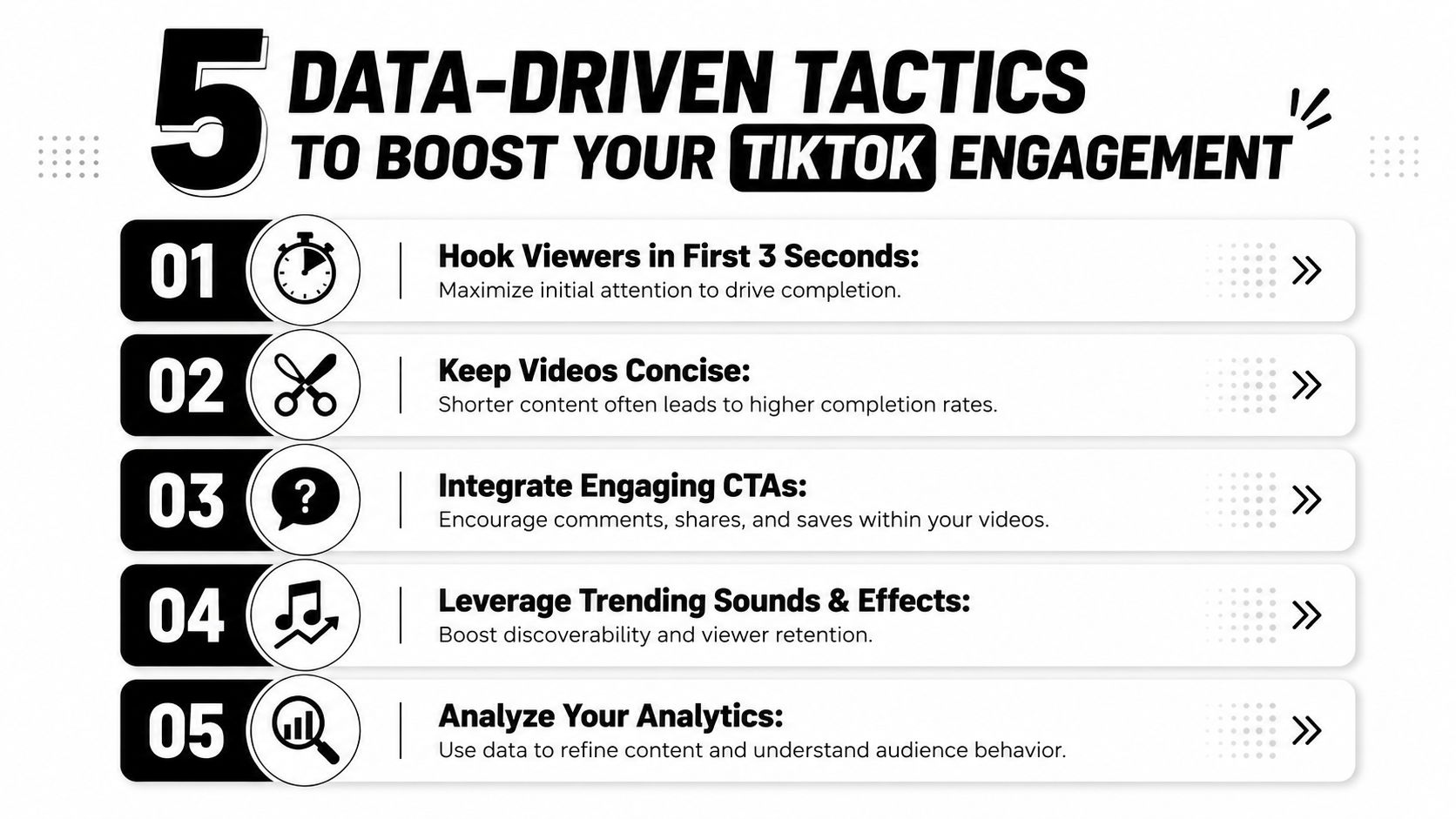
That changes the playbook. The old advice was to compress everything into ultra-short clips. That still works for some formats, but it’s not the only route anymore.
1. Build for retention, not just the click
The first seconds still matter. But the goal isn’t just to force a pause. It’s to set up a payoff that makes viewers stay.
A good hook usually does one of three things:
- States a sharp problem
- Promises a concrete takeaway
- Opens a curiosity gap without getting vague
What doesn’t work is generic hype. If the viewer can’t tell what they’ll get, they leave.
2. Test longer clips when the idea can carry them
If the content has a real narrative arc, don’t cut it down just to satisfy outdated advice. Educational breakdowns, contrarian takes, founder stories, and podcast clips often need more room.
That’s where repurposing helps. Instead of forcing one long video into random fragments, tools like quso.ai can turn webinars, podcasts, and recorded talks into shorter clips with auto-captions and scheduling, which makes it easier to test both concise edits and longer 60 to 90 second segments.
3. Make captions readable inside the frame
This is one of the easiest wins.
Keep subtitles large enough to scan instantly. Place them inside platform-safe zones so interface overlays don’t block key words. Break long lines into smaller chunks. If your captions are dense, low, or crowded, viewers drop before the point lands.
For more practical growth patterns, this guide on how to grow on TikTok covers the broader system around content consistency and packaging.
4. Prompt comments and saves without sounding desperate
The best CTAs feel like a continuation of the content, not an interruption.
Examples that usually work better:
- Ask for experience: “Have you seen this happen in your niche?”
- Ask for a choice: “Which version would you test first?”
- Prompt a save: “Save this if you’ll use the framework later.”
Weak CTAs usually beg for engagement without adding value.
5. Use engagement signals to support downstream goals
If you’re in B2B, engagement isn’t just vanity. Strong comments and shares often reveal which topics deserve follow-up content, lead magnets, or outreach.
Teams that want to connect content response with pipeline work can pair TikTok performance tracking with tools like HarvestMyData for social media B2B leads, especially when social content is part of a broader demand capture process.
Here’s a useful walkthrough on clip strategy and packaging:
How to Track Engagement in TikTok Analytics
Native TikTok Analytics gives you enough to build a simple reporting habit. You don’t need a giant dashboard to spot what’s working. You need consistency.
Start at the video level. For each post, check views, likes, comments, shares, and watch-time behavior. Then calculate engagement rate using the view-based formula covered earlier. That gives you a cleaner read than relying on a top-line account average alone.
A simple workflow that’s easy to maintain
Use a repeatable cadence:
- Review new posts early: Check initial viewer response soon after publish.
- Compare posts weekly: Look for recurring topics, hooks, and formats.
- Tag patterns: Note what kind of clips trigger comments, shares, or saves.
- Adjust the next batch: Keep the winners, cut the weak patterns.
If you manage several channels or clients, don’t rely on memory. Document what happened and why you think it happened. That’s how you move from random posting to actual strategy.
What to look for in the numbers
Focus on signals you can act on:
- High views, low engagement: The hook worked, but the content or pacing didn’t.
- Moderate views, strong engagement: Strong audience fit. Consider repeating the angle.
- Strong comments and saves: Utility is landing.
- Shares rising: The topic likely has broader relevance.
If you want a cleaner process for organizing reporting across platforms, this guide on how to track social media analytics is a practical next step.
FAQ About TikTok Engagement Rate
What is a good TikTok engagement rate?
A useful baseline is 3.85% for brand accounts using the view-based model, based on Elev8or’s benchmark summary. Small niche accounts can perform above that, while large accounts often benchmark lower.
Is engagement rate more important than follower count on TikTok?
For content decisions, yes. Engagement rate tells you how well a video connected with actual viewers. Follower count tells you scale, not post quality.
Do longer TikToks get better engagement?
They can. Recent benchmark reporting found that videos over 54 seconds reached 6.7% engagement, which suggests some topics perform better with more breathing room.
How often should I check TikTok engagement?
Check each post shortly after publishing, then review your content as a group on a weekly basis. The goal is pattern recognition, not constant refreshing.
Does buying followers help engagement rate?
No. It usually makes reporting less useful because the account scale stops matching real audience interest and interaction.
If you’re repurposing podcasts, webinars, interviews, or creator footage into TikTok clips, quso.ai is worth trying for the practical workflow alone. It helps turn long video into short-form content with captions and scheduling, which makes it easier to test the hooks, lengths, and formats that move engagement.