How to Grow on TikTok: A Practical Playbook for 2026
Grow on TikTok by building a repeatable system, not by chasing random trends. Accounts that post at least two times per day gain significantly more followers than those posting less, and creators posting 3 to 7 times daily saw the highest follower increases in a 2025 Metrial analysis, while videos with hooks under 3 seconds had a 3.2x higher completion rate than slower openings.
The key to learning how to grow on TikTok isn’t just trends. It’s a repeatable system: optimize your profile for your niche, create content with a strong 3-second hook, post consistently using a batch-and-repurpose workflow, engage with your community daily, and analyze your data to double down on what works.
Most TikTok advice breaks because it assumes you can invent fresh original content every day forever. That isn’t how operators win. Sustainable growth comes from turning one strong idea into multiple posts, reusing proven formats, and building a publishing system you can keep running when motivation drops.
Table of Contents
- Your TikTok Growth Playbook for 2026
- Build Your Foundation for Growth
- Master the High-Performing Content Formula
- Create a System for Consistent Posting
- Amplify Your Reach with Trends and Engagement
- Measure and Iterate with TikTok Analytics
- Frequently Asked Questions About TikTok Growth
Your TikTok Growth Playbook for 2026
TikTok growth is an operating system problem. If your profile is unclear, your hook is weak, your posting is inconsistent, and you ignore comments, your results will stay inconsistent too.
A practical playbook looks like this:
- Clarify your niche so the right audience knows why to follow.
- Open strong so people don’t swipe before your point lands.
- Publish on a system so output doesn’t depend on daily inspiration.
- Engage like a participant so TikTok sees community value, not just uploads.
- Review performance weekly so you repeat winners instead of guessing.
One thing most creators miss is that efficiency matters as much as originality. Data from viral content analysis shows that repurposing proven angles with simple formats can achieve over 7 million views without deep niche expertise, which is why operators should study reusable formats, not just one-off ideas from creators with natural on-camera talent. If you want another useful perspective on structuring content for distribution, these AI video growth strategies for creators are worth reviewing alongside your own testing.
Practical rule: Don’t build a TikTok strategy around your best creative day. Build it around what you can repeat every week.
Build Your Foundation for Growth

Pick a niche people can recognize fast
If someone lands on your profile and can’t tell what you talk about, they won’t follow. TikTok gives you a chance to reach strangers quickly, but your profile still has to convert that attention into audience.
For creators, social media managers, and B2B marketers, that usually means choosing a niche that sits at the intersection of:
- What you know well like paid social, podcast growth, SaaS onboarding, or creator monetization
- What you can explain clearly on camera without sounding scripted
- What has repeatable angles such as myths, mistakes, frameworks, reactions, and case breakdowns
A weak niche is broad and generic. “Marketing tips” is weak. “TikTok content systems for B2B founders” is much stronger because it creates an immediate expectation.
Fix your profile before chasing reach
Most underperforming profiles have the same problem. The bio is vague, the username is forgettable, and the profile image doesn’t signal credibility.
Use this before-and-after lens:
| Profile element | Weak version | Strong version |
|---|---|---|
| Username | @alexmediaofficial1 | @alexsaascontent |
| Bio | Helping you grow online | TikTok content systems for SaaS teams |
| Profile image | Dark casual selfie | Clear headshot or brand-consistent image |
| Link | No clear destination | One relevant offer, resource, or hub |
Keep your bio specific. Tell people what kind of content they’ll get. If you’re a consultant, say who you help. If you’re a creator, say what problem you solve.
A simple profile structure works well:
- Who you help with one audience label
- What you help them do in plain language
- Why your content is useful with a clear angle
- One next step through a focused link
If you haven’t defined recurring themes yet, map your niche into three or four content buckets first. This guide on content pillars for social media is the right place to tighten that up before you scale output.
A strong profile doesn’t try to impress everyone. It helps the right person decide, fast.
Master the High-Performing Content Formula
Win the first 3 seconds
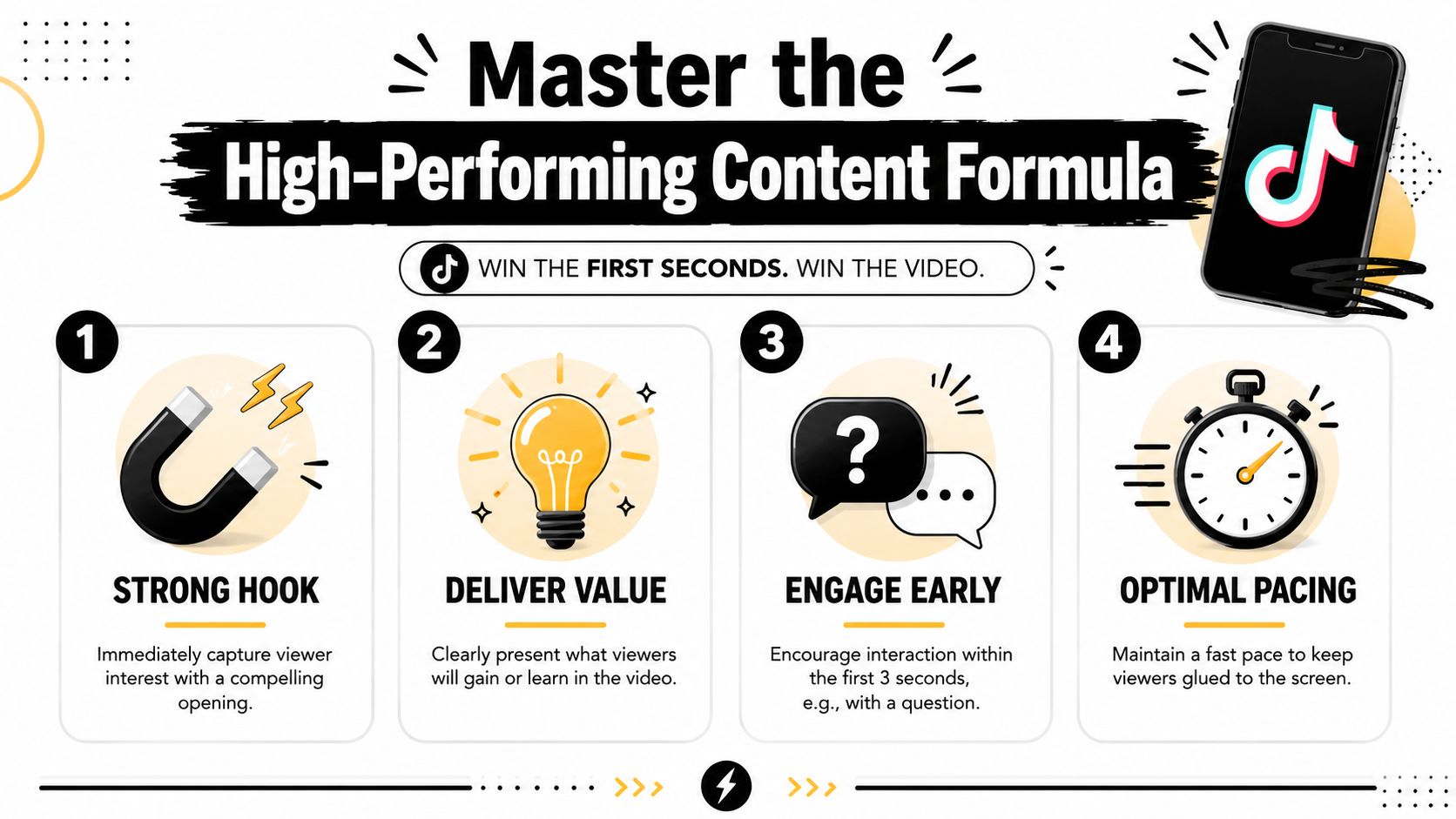
The first three seconds decide whether your idea gets a chance. Based on analysis of 170K+ posts across 1,100+ creators, videos with hooks under 3 seconds had a 3.2x higher completion rate than videos with longer intros, which makes the opening the most impactful part of the video (Reddit analysis of TikTok growth lessons).
That means no greeting, no throat-clearing, and no slow setup.
Bad opening: “I wanted to talk today about something I’ve been noticing in content marketing…”
Better opening: “Most B2B TikTok videos fail before the first sentence ends.”
Use hook templates you can repeat
You don’t need a new style for every post. You need a few templates that fit your niche.
Try these:
- Contrarian hook
“Stop doing this if you want more qualified followers.” - Mistake hook
“The reason your TikToks stall is simpler than you think.” - Audience callout
“If you’re a coach posting every day and still not growing, fix this first.” - Process hook
“Here’s the content workflow that keeps a weekly posting schedule alive.” - Proof-led hook
“This format kept showing up in high-performing videos, so I rebuilt it for B2B.” - Story hook
“I changed one part of the opening and the video finally held attention.” - Question hook
“Why do some useful videos die while average ones keep getting pushed?”
After the hook, deliver one clear promise. Then move fast. Short beats long when the video drifts.
If you want more examples for structuring openings and retention beats, this piece on creative video content engagement adds useful format ideas you can adapt to TikTok.
Keep captions inside safe zones
Many good videos look sloppy because text sits where TikTok’s interface covers it. That’s a practical mistake, not a creative one.
Follow these placement rules:
- Keep key text away from the bottom edge because captions, descriptions, and UI controls compete for that space
- Avoid the far right side where icons and interaction buttons stack
- Place your main headline in the upper-middle area where it’s readable without blocking your face
- Don’t crowd the frame with dense text blocks that force people to choose between reading and watching
Use jump cuts, on-screen text, and visual resets to maintain pacing. But every edit should support the idea, not distract from it.
Fast pacing doesn’t mean chaotic editing. It means removing every second that doesn’t earn attention.
For deeper scripting ideas, a dedicated post on writing viral video hooks would complement this step well.
Create a System for Consistent Posting
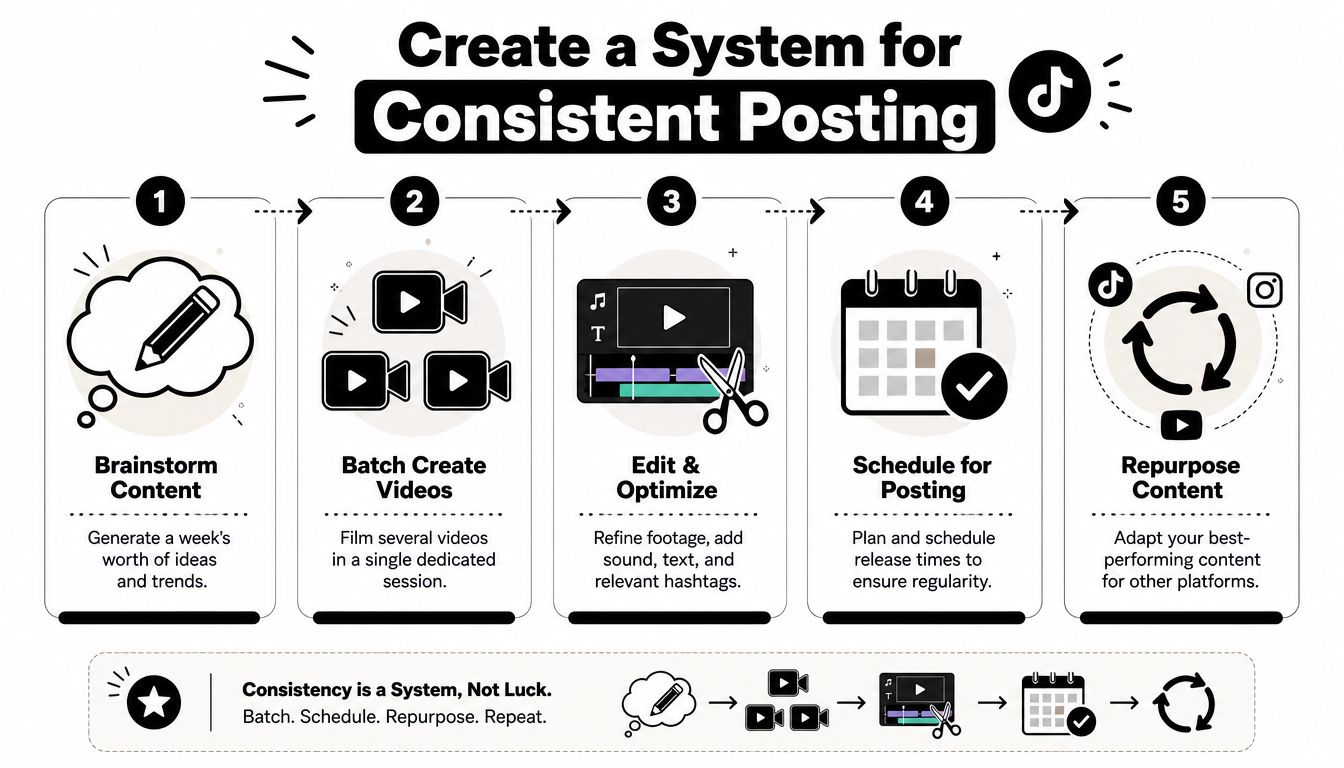
Daily posting advice breaks down fast if every video starts from a blank page. TikTok growth lasts longer when content runs through a repeatable pipeline: collect ideas, batch production, repurpose source material, and schedule distribution before the week starts.
Batching beats daily scrambling
Posting frequency helps, but only if you can maintain quality and recover your time. A creator who publishes one strong post every day for six months will usually outperform someone who posts heavily for ten days, burns out, and disappears.
The fix is operational, not motivational.
Separate the work into stages so each session does one job well:
- Batch ideation by saving hooks, objections, customer questions, and proven formats in one running document
- Batch recording by filming several videos in one setup, with the same lighting, framing, and talking points nearby
- Batch editing so captions, pacing, and visual style stay consistent across posts
- Batch scheduling so distribution happens even when you’re in meetings, traveling, or recording the next set
This is also where repurposing does real work. One webinar, podcast episode, product demo, or client Q&A can produce a week or two of TikTok clips if you cut it by topic, hook, and audience pain point.
Tools can speed that up. quso.ai can turn long-form video into short clips, add captions, and queue posts for later. If you need the setup process, this guide on how to schedule TikTok posts walks through it.
Build a weekly publishing workflow
A simple weekly system is enough for most accounts. The goal is to reduce decision fatigue, not create a complicated content calendar you stop using after one week.
| Day or block | Focus |
|---|---|
| One planning block | Pull ideas from comments, customer calls, search prompts, and competitor formats |
| One recording block | Film multiple videos in one sitting |
| One editing block | Tighten hooks, add captions, check safe zones |
| One scheduling block | Spread posts across the week |
| Daily short block | Reply to comments and capture new ideas |
That rhythm creates two advantages. First, it protects posting consistency. Second, it gives you enough volume to test angles without rebuilding your process every day.
This short walkthrough shows the workflow mindset in action:
Start with a publishing pace you can hold for 8 to 12 weeks. For many accounts, that means one post per day. Add a second daily post when you already have source material, a clean workflow, and enough editing capacity to keep standards high.
The trade-off is straightforward. Higher volume gives you more shots at distribution, but sloppy output trains you to publish filler. Strong systems solve that by making consistency repeatable.
Amplify Your Reach with Trends and Engagement
TikTok growth usually stalls when creators treat trends as the plan. Trends are distribution vehicles. The system still depends on having a repeatable point of view, a bank of reusable ideas, and a fast way to turn audience response into the next post.
Use trends to improve distribution fit
A good trend gives a strong idea better odds of getting picked up. A bad trend buries your message under borrowed format.
Use trends with a filter:
- Use trending audio only if it supports the pacing or tone of the video
- Use trend formats when the structure is already proven and you can swap in a niche-specific insight
- Use hashtags to clarify topic and audience, not to chase reach with irrelevant tags
- Use sub-community references when they make the post feel native to the corner of TikTok you want to own
The trade-off is simple. Trend alignment can increase initial distribution, but it also raises the risk of blending in with everyone else using the same format. Accounts that grow steadily use trends as packaging, then repeat the underlying content angles that already perform.
Prioritize engagement that turns into the next asset
The best engagement work is not busywork. It creates another post, another hook, or another test.
Prioritize these actions in order:
- Reply to comments with a video when the question exposes confusion, objection, or buying intent
- Stitch or duet relevant posts when you can add a useful correction, example, or stronger framing
- Turn repeated comments into standalone videos so one audience question becomes a searchable content asset
- Leave specific comments on adjacent creators’ posts to attract the right viewers back to your profile
Engagement on TikTok is also research. Comments tell you what people misunderstood, what they want next, and which phrasing gets attention. If you already track those signals in a simple weekly review, this guide on how to track social media analytics helps connect engagement patterns to content decisions.
Speed matters here. If you respond to comments three days late, the moment is gone. I prefer a lightweight production setup where response videos can be recorded, captioned, and queued in one pass. If you’re publishing that way often, quso.ai can support the captioning part without adding manual editing time.
Done well, trends and engagement stop being random promotion tactics. They become inputs in a system that produces more content from the audience you already have.
Measure and Iterate with TikTok Analytics

Analytics matter when they change what you make next. If a dashboard doesn’t affect your next recording session, it’s just trivia.
Watch the metrics that change decisions
Focus on a short list:
- Watch time tells you if people stay long enough for the idea to land
- Completion rate tells you if the structure holds attention
- Profile views tell you if the content creates enough curiosity to learn more
- Comment quality tells you whether the message connected with the right audience
For a month-one brand account, one framework suggests posting 3 to 5 times per week with goals around 5 to 10% weekly follower growth and views at 1.5x the follower count as an awareness benchmark (brand TikTok growth framework).
Run simple tests, not random experiments
Don’t test five variables at once. Change one thing.
Examples:
- Same topic, different hook
- Same hook, different pacing
- Same structure, different CTA placement
- Same format, different audience framing
Track patterns weekly. Keep a simple log of topic, hook, format, and result. If one category consistently drives stronger watch behavior or profile visits, make three more versions before moving on.
A broader process for reviewing channel data is covered in how to track social media analytics.
The goal of analytics isn’t to explain every result. It’s to make the next decision sharper.
Frequently Asked Questions About TikTok Growth
How often should I post on TikTok to grow?
If you’re aiming for growth, at least two posts per day is the stronger benchmark based on the posting-frequency data cited earlier. If that isn’t sustainable yet, start with one post per day and build a workflow that lets you increase output without sacrificing quality.
What’s a good 30-day TikTok plan?
A proven method starts with posting 3 to 5 times daily in week one, with 50% of posts focused on iterating previous content and 30% focused on outlier videos from niche competitors. By week four, shift to 70% nurture content like storytelling, Q&A, and behind-the-scenes while moving to 2 posts per day (30-day TikTok sprint method).
How long does it take to grow on TikTok?
It depends on your niche clarity, hook quality, posting consistency, and how quickly you iterate. Some accounts see traction fast. Others need weeks of testing before patterns emerge. The wrong way to judge progress is by one post. The right way is by whether your last ten posts are improving.
Should I delete TikToks that underperform?
Usually, no. Leave them up unless they’re off-brand, inaccurate, or likely to confuse your audience. Older posts can still get discovered, and keeping them live gives you a cleaner record of what topics and formats failed.
What should I do if my views suddenly drop?
Check the basics first. Did your hooks get slower? Did you drift off niche? Did your pacing loosen? Did you stop engaging in comments? Don’t react by changing everything at once. Review recent posts, identify the first point where performance started slipping, and test one correction at a time.
If you already have long videos, webinars, podcasts, demos, or talking-head recordings, quso.ai can help turn them into short clips with captions and a scheduling-ready workflow so TikTok growth feels like an operating system, not a daily scramble.