Short Form Content Strategy That Turns One Video Into Many
Short form content strategy means using one long piece of content to produce multiple short clips, add captions that hold attention, and schedule them in a steady publishing rhythm. That’s the practical version. If you’re a creator, social media manager, or B2B marketer, the goal isn’t just to “make shorts.” It’s to build a repeatable system that turns webinars, podcasts, demos, interviews, and talking-head videos into assets people will finish.
That shift matters because short-form video now takes about 58% of social media time, videos under one minute reach a 52% engagement rate, and short-form content produces roughly 2.5x more engagement than long-form video according to Vidico’s roundup of 2026 short-form video statistics. So the strategy question isn’t whether to post short clips. It’s how to cut them without killing the point.
If you need a broader framework for where short clips fit in your publishing mix, start with a proven video playbook from quso.ai.
Table of Contents
- Introduction to Short Form Content Strategy
- Why Short Form Wins Attention Right Now
- How to Turn One Long Video Into Multiple Short Clips
- Captions Hooks and Safe Zones That Keep Viewers Watching
- Distribution Cadence and Scheduling Across Platforms
- Measuring What Works and Improving Your Next Batch
- Frequently Asked Questions About Short Form Content Strategy
Introduction to Short Form Content Strategy
A strong short form content strategy is a production system, not a format preference. You repurpose one source video into several clips, write hooks people understand instantly, burn in captions for silent viewing, and publish on a schedule you can maintain.
Treating every clip like a separate project creates inconsistency fast. You end up posting randomly, re-editing the same footage three times, and guessing which version belongs on Shorts, Reels, or TikTok.
A better model is simpler:
- Repurpose one source asset: Start with a webinar, podcast, customer call, product demo, or lesson.
- Caption for silent viewing: Assume many viewers won’t turn sound on.
- Schedule as a series: Publish in batches so one recording feeds multiple posts.
Practical rule: If you can’t explain the clip’s payoff in one sentence, you don’t have a short yet. You have a trimmed long video.
This approach works especially well for educators, consultants, podcasters, and SaaS teams because long-form content already contains the raw material. The job is to extract the moments that can stand alone, then package them so they still make sense in a feed.
Why Short Form Wins Attention Right Now
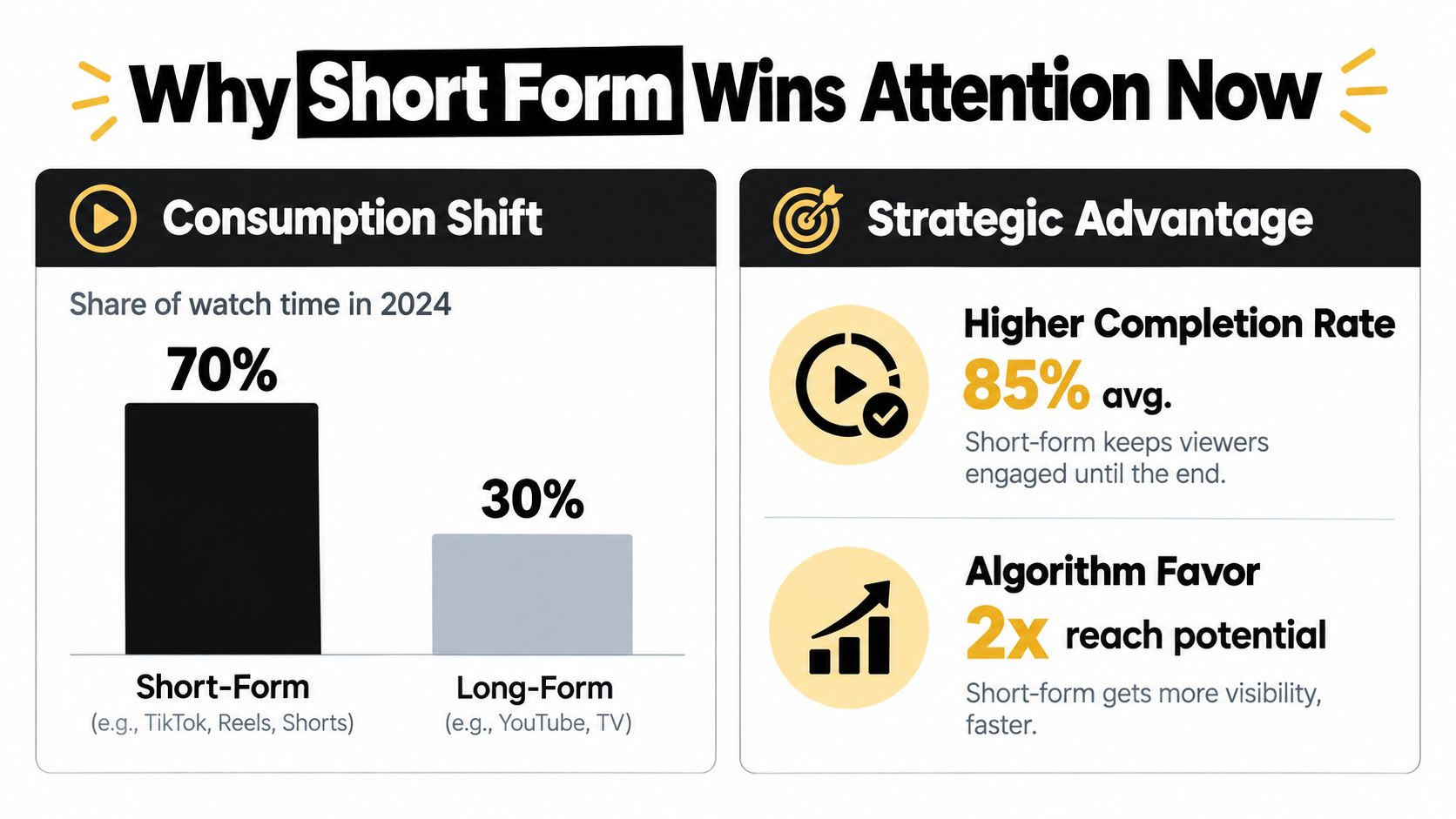
Short video now pulls hundreds of billions of daily views across major platforms. Analysts cited in Yaguara’s short-form video statistics roundup reported about 200 billion daily views on YouTube Shorts by 2026, with Instagram Reels and Facebook Reels also reaching more than 200 billion plays per day combined. That scale matters because attention is now sorted in feeds first, not on homepages, channels, or blog indexes.
Platform scale changed the job
Short form wins attention because the feed rewards speed of understanding. A viewer gives you a second or two, then keeps scrolling or stays. That makes a clip less like a miniature documentary and more like a storefront window. If the promise is clear at a glance, people step in.
For operators, this changes the job description. You are not just filming short videos. You are cutting discovery assets from a larger source, then shaping each one so it fits the rules of the platform where it will appear.
Audience behavior favors short clips for discovery
Short clips also match how people screen information. They check one idea, one answer, one takeaway at a time. Product questions, mistakes to avoid, bold opinions, before-and-after examples, and single-step tutorials all fit that behavior better than a full-length explanation.
A 2024 report from Wyzowl’s video marketing statistics research found that people often prefer video to learn about products and services. That preference helps explain why short clips perform so well at the discovery stage. They lower the commitment. A viewer can test your thinking in 20 seconds before deciding whether you are worth 20 minutes.
That is the advantage. Short form gets sampled.
Attention goes to clips that survive the first scroll
Format alone is not what wins. Packaging wins. A weak 25-second clip dies fast, and a sharp 45-second clip can keep people watching if the payoff is clear and the pacing holds.
This is why short form works better as a repurposing system than as a format choice. One long video gives you raw material. Then you build native clips from it with three jobs in mind:
- Hook fast: the first line must state the tension, mistake, claim, or outcome
- Hold attention: each sentence needs to earn the next one
- Fit the feed: captions, framing, and on-screen text have to stay readable inside platform safe zones
That process keeps the message intact while changing the packaging. You are not flattening a full lesson into noise. You are cutting clean entry points into the lesson.
Series beat one-off posts
Single clips can spike. Series build familiarity.
If one webinar gives you five clips on the same theme, viewers start to recognize the pattern: part one explains the problem, part two shows the mistake, part three gives the fix. That sequence is easier to schedule, easier to repurpose, and easier for an audience to follow than random isolated posts.
Short form wins attention right now because it fits how distribution works, how viewers sample ideas, and how smart teams turn one source asset into many chances to be understood.
How to Turn One Long Video Into Multiple Short Clips
Most long videos contain far more usable short moments than people think. The mistake is trying to summarize the whole thing in one clip. Don’t compress the entire meal into one bite. Cut different bites for different reasons.
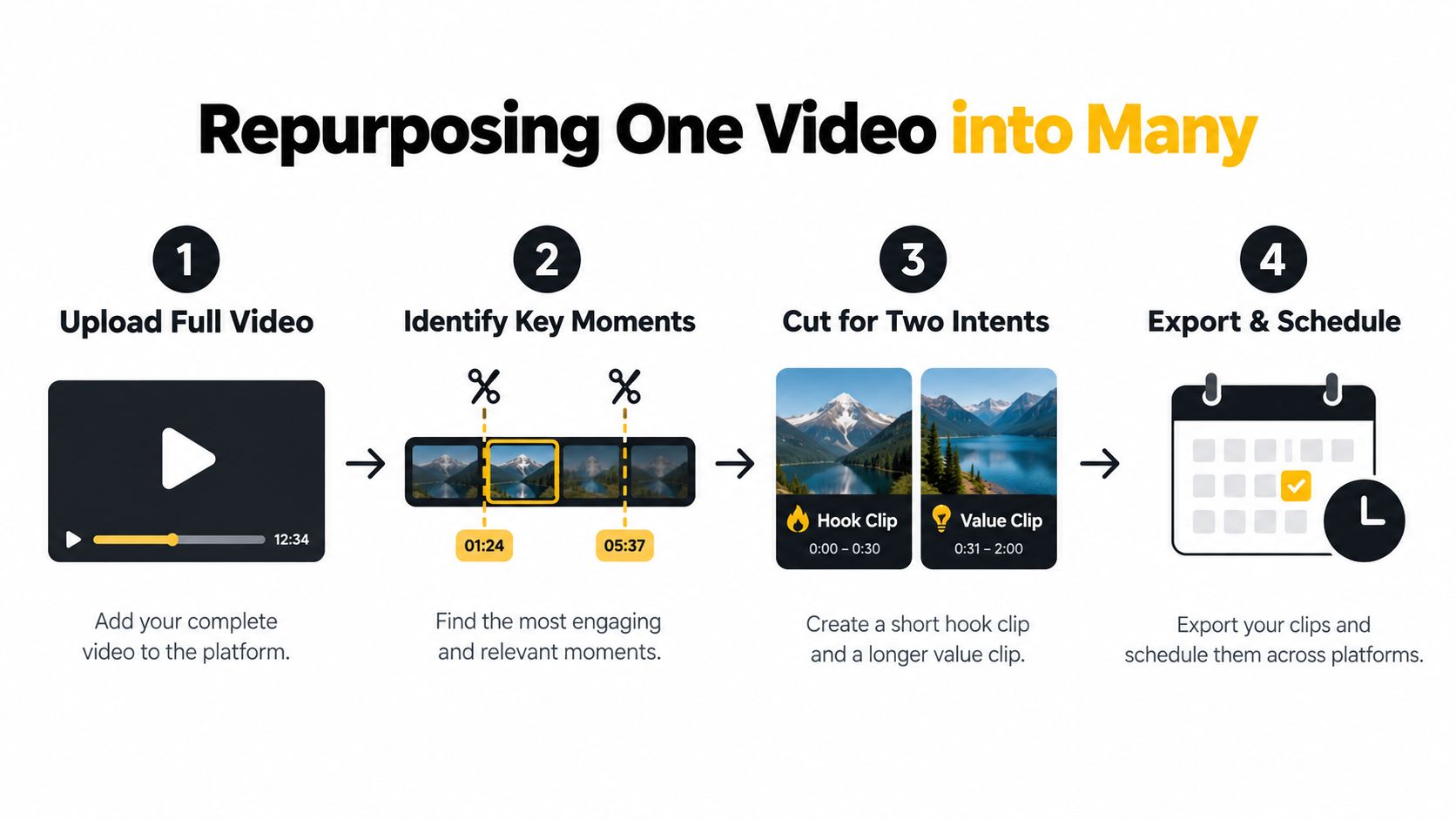
Cut for two intents
A 2026 cross-platform analysis of more than 6 million TikTok videos found that 15 to 30 second clips produced the highest engagement rate at 6.00%, while 120 to 180 second clips generated the most median views at 11,136, or about 11 times the median of the shortest clips, according to Fastlane’s short-form benchmark summary.
That gives you two useful edit types:
-
Hook clip Use this when the moment has a sharp opinion, surprise, mistake, or contrarian point. Keep only the setup needed to make the line land.
-
Value clip Use this when the explanation itself is the product. A framework, teardown, mini-lesson, or answer can support a longer cut.
You’re not choosing one “perfect” length. You’re making variants for different outcomes.
What to pull from the source video
Look for moments that already have internal tension. Good candidates include:
- A strong disagreement: “Teams often measure the wrong thing.”
- A visible transformation: before and after, mistake and fix, problem and example.
- A self-contained lesson: one tactic, one objection, one myth, one answer.
- A useful line out of context: something a viewer can understand without watching the full episode.
If you need more prompt ideas for what to clip from long videos, the LesFM Shorts ideas guide is a useful brainstorming resource.
Keep context without dragging the intro
Most weak shorts start too early. The speaker says hello, thanks the audience, explains the background, and only then gets to the point. Cut all of that.
Instead, open on the sentence that creates tension, then add only enough context to prevent confusion. If the original line is “This is why that launch failed,” your next beat should explain which launch and what failed. Not the full backstory.
For teams doing this repeatedly, one practical option is quso.ai, which repurposes long video into short clips, adds auto-captions, and lets you schedule the finished assets. If your current workflow involves manually recutting every variant, quso.ai repurposing strategy tips are a good place to tighten the process.
Don’t flatten the message to make it shorter. Remove the delay, keep the payoff.
Simple repeatable checklist
- Mark 5 to 10 moments in the source recording
- Cut one short hook version and one longer value version
- Write on-screen text that clarifies the promise
- Export platform-native crops
- Queue the batch instead of posting one by one
Captions Hooks and Safe Zones That Keep Viewers Watching
The cut gets you into the feed. Retention keeps you there.
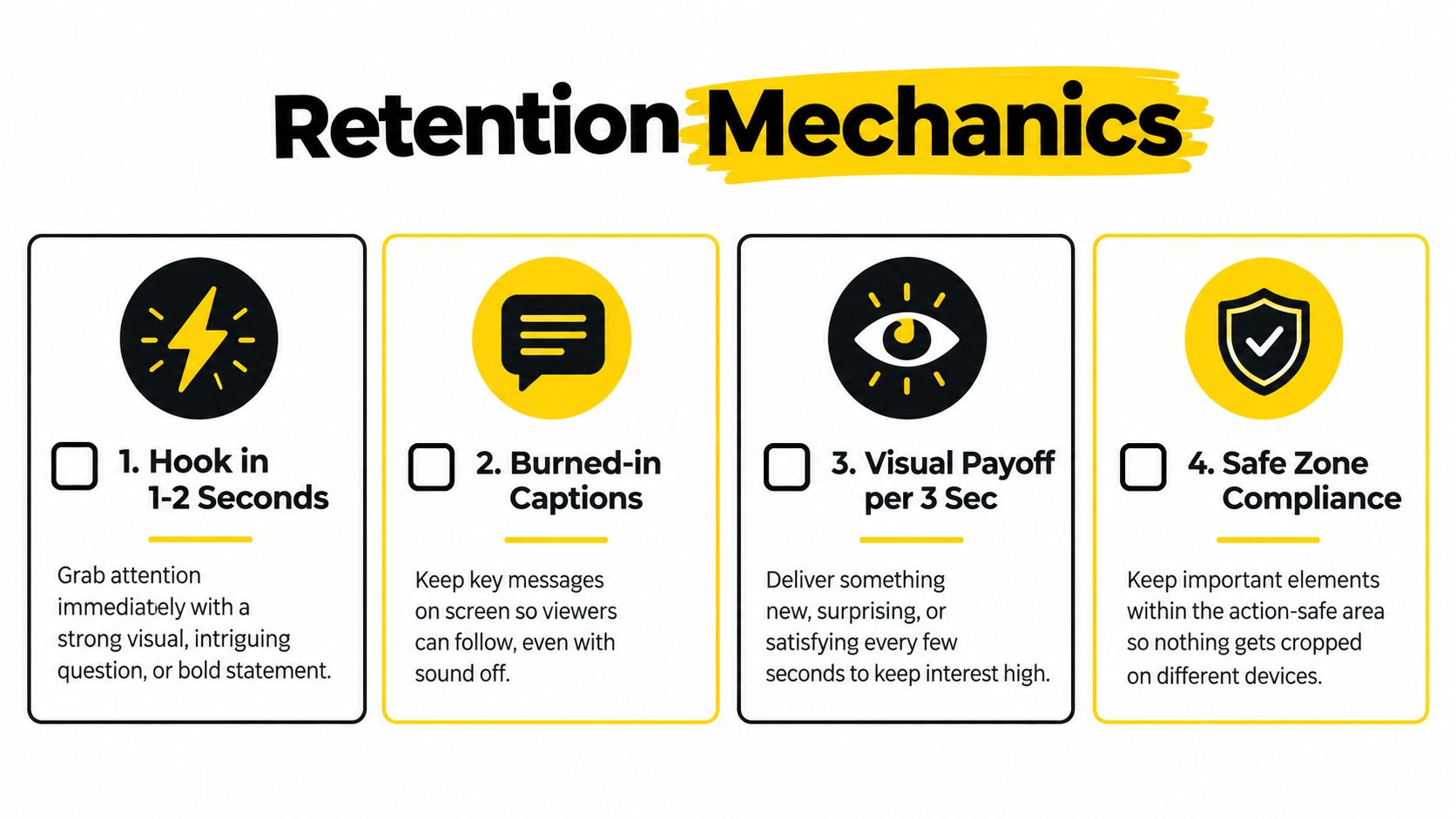
Recent benchmark summaries report that videos under 90 seconds retain about 50% of viewers on average, and YouTube Shorts performance appears to hinge on retention above roughly 65% for sub-30-second clips and about 50% for 30 to 60 second clips, as summarized by Marketing LTB’s short-form statistics page. That’s why the first one to two seconds matter so much. Viewers need to know the topic, the visual context, and the payoff immediately.
Build the hook visually, not just verbally
A hook isn’t just the first sentence. It’s the first readable frame.
Good openings do at least two of these things fast:
- State the problem: “Your clips lose viewers before the point.”
- Show the object: dashboard, slide, product, face reaction, result.
- Signal the payoff: what the viewer will learn, avoid, or get.
Bad hooks ask for patience. Good hooks pay immediately.
A quick visual example helps here:
Captions are retention equipment
A widely cited review of social video research states that about 85% of Facebook videos are watched without sound, and captioned videos are 80% more likely to be watched all the way through, according to the Nguyen review PDF.
A separate study of 4,027 TikTok and Douyin brand videos across 54 brands and 13 industries found that captions and video title length both significantly affected engagement, based on this Dalhousie University research record.
Use captions like design, not decoration:
- Keep lines short: viewers should read them in one glance.
- Match speech tightly: late captions feel broken.
- Highlight key words: one emphasis point is enough.
- Leave breathing room: don’t cover the speaker’s mouth or product demo.
The 2023 caption experiment with 203 participants also found that subtitles can reduce misunderstandings caused by accents and signal creator effort, which can increase engagement behaviors, according to the ICEDBC proceedings paper.
Safe zones prevent avoidable damage
A lot of shorts fail. Text sits too low, the platform UI covers it, and the most important words disappear behind buttons, captions, or profile elements.
Treat the frame like a poster with blocked edges:
- Top area: leave space for platform labels and account UI
- Bottom area: avoid placing text where captions, buttons, or descriptions can overlap
- Side edges: don’t push text flush to the margins
Keep your headline and key subtitle in the center-safe area. If the clip only works when text sits at the very bottom, the layout is wrong.
If you need a practical walkthrough for designing readable on-screen copy, this guide to text overlay for social media is worth keeping nearby.
Distribution Cadence and Scheduling Across Platforms
Publishing short clips well is an operations job. You need a cadence you can keep, not a burst of effort followed by silence.
There’s also no single universal best posting time. An analysis from the London School of Economics concluded that posting-time performance varies by audience and platform, so scheduling should follow channel-specific behavior rather than a fixed global hour, as explained in the LSE post on social media timing.
Standalone clips and series play different roles
Some clips should stand alone. Others work better as recurring formats.
Deloitte projects in-app micro-series revenue will more than double from US$3.8 billion in 2025 to US$7.8 billion in 2026, according to Kapwing’s 2026 short-form statistics roundup. That projection matters because it points toward episodic packaging, not just one-off posting.
| Decision Factor | Standalone Clip | Micro-Series |
|---|---|---|
| Topic type | One sharp point or reaction | A repeatable lesson, teardown, or themed sequence |
| Viewer expectation | Works with no prior context | Gets stronger when viewers recognize the format |
| Production load | Faster to publish individually | Easier to batch once the structure is set |
| Best use | Timely insights, clips from events, quick answers | Education, product walkthroughs, recurring objections |
Build a weekly rhythm you can sustain
A simple operating model works well:
- One source recording: webinar, podcast, demo, interview
- One editing session: pull multiple clip candidates at once
- One review pass: check hooks, captions, and safe zones
- One scheduling block: queue the week across channels
A cadence like this reduces random posting and helps you compare similar clips over time. It also forces you to think in batches, which is how repurposing pays off.
Measuring What Works and Improving Your Next Batch
Roughly the first second decides whether a short gets a chance to work at all. That is why review matters more than volume once your posting rhythm is in place.
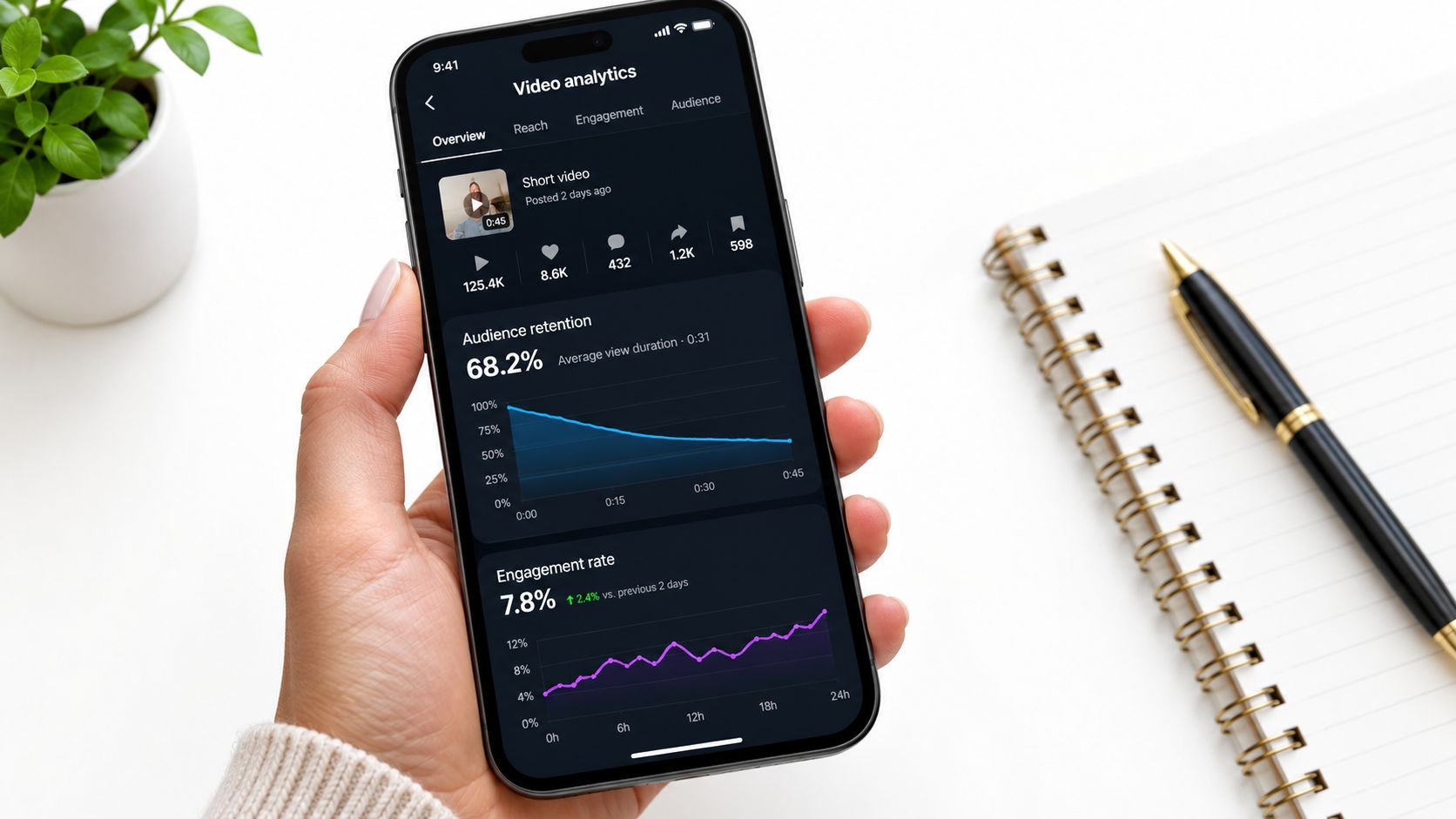
Treat measurement like clip grading, not score collecting. You are not just asking, “Did this post do well?” You are asking which part of the repurposing system held up, the hook, the cut point, the caption placement, or the topic itself.
Start with three checks across a batch made from the same long video:
- Hold: which clips keep attention through the opening beat
- Clarity: which clips still make sense with captions and cropped framing
- Carryover: which clips send viewers to the next related post, profile, or offer
This is the easiest way to avoid random edits. If three clips from one webinar all lose viewers at the same point, the problem is usually structural. The setup is too long, the payoff comes too late, or the clip starts before the sentence begins. If one clip holds attention but gets weak reach, the idea may be good while the packaging is off. Test a stronger first frame, a tighter title line, or a cleaner crop.
A long video works like raw lumber. Each short is a cut from the same board. Measuring the batch shows whether your cuts are improving or whether you are wasting good source material with weak openings.
As noted earlier, engagement and reach do not always rise together. Some shorts get strong reactions from a smaller group. Others travel wider but earn weaker completion. That difference matters because it tells you what to fix next. Keep the idea. Change the packaging.
For teams that need a business view after platform metrics, the Cometly ROI measurement guide helps connect clips to outcomes beyond views.
Review clips in batches from the same source video. Patterns show up faster when the topic stays constant and only the packaging changes.
Frequently Asked Questions About Short Form Content Strategy
How long should short-form content be?
It depends on the job. Use tighter cuts when the point is sharp and emotional. Use longer cuts when the explanation itself carries the value.
Should every short clip come from long-form content?
No. But repurposing long-form usually gives you better raw material because the ideas are already developed. It’s easier to extract a strong moment than invent one from scratch every day.
Do captions really matter if my audience watches with sound on?
Yes. Captions improve clarity, help with accents, and make the clip understandable in silent environments. They also make weak hooks easier to follow.
Should I post standalone clips or a series?
Use standalone clips for timely reactions or isolated insights. Use a series when you can repeat the angle, format, or promise without confusing the viewer.
What should I fix first if retention is weak?
Start with the first frame. Then check the opening sentence, on-screen text placement, and whether the clip takes too long to reveal the payoff.
If you’re turning webinars, podcasts, demos, or lessons into shorts every week, quso.ai helps with the parts that usually slow teams down: repurposing long video into short clips, adding captions, and scheduling across platforms. It’s a practical way to build a repeatable short-form workflow without flattening the original message.