What Is Posting Cadence and How to Get It Right
Posting cadence is the repeatable rhythm that controls how often content goes out on each platform. Practical benchmarks range from Instagram at 3–5 posts per week and TikTok at 2–5 per week to X at 3–4 posts per day and Pinterest at 15–25 pins per day, so there isn’t one universal answer.
The popular advice, “post as much as possible,” is incomplete. More publishing can help when your audience expects frequent updates and your team can protect quality. It can also create fatigue, weaken per-post efficiency, and turn your calendar into a production emergency. The operators who sustain growth don’t guess at a number each morning. They build a repeatable system that matches platform norms, audience behavior, content format, and available capacity.
Table of Contents
- What Posting Cadence Actually Means
- Why Consistency Drives More Engagement Than Volume
- Platform-Specific Posting Benchmarks for 2026
- How to Choose the Right Cadence for Your Audience
- Making Cadence Sustainable with Repurposing and Scheduling
- When Posting More Hurts Engagement
- Frequently Asked Questions About Posting Cadence
What Posting Cadence Actually Means
Posting cadence is the regularity and frequency at which an account publishes content, usually tracked daily or weekly. It answers a practical question: how often will your audience reliably receive something from you?
That definition matters because cadence isn’t a single number applied everywhere. A creator might publish a long YouTube video weekly, share several TikTok clips during the same period, and post on LinkedIn only a few times. Each channel has a different audience expectation, content lifespan, and distribution pattern.
Random posting is different. You publish when an idea appears, when a client asks for something, or when you suddenly have time. That approach may produce occasional strong content, but it makes output difficult to forecast and gives your team no dependable production rhythm.
Cadence is an operating system
Treat cadence as a calendar decision, not a daily creativity test. Start by defining:
- The platforms you can support: Choose channels where your audience spends time.
- The content units you can repeat: These might include short clips, text posts, carousels, newsletters, or videos.
- The publishing frequency: Set a target that your team can maintain without lowering standards.
- The review cycle: Check performance periodically, then adjust deliberately rather than reacting to one weak post.
A useful cadence turns one source asset into a planned sequence. A podcast recording can supply educational clips, opinion-led excerpts, captions, and supporting posts. The source material gives the team a production base, while the calendar determines how those outputs reach each audience.
Practical rule: Choose the lowest cadence you can sustain consistently, then increase it only when your workflow and quality are stable.
Why Consistency Drives More Engagement Than Volume
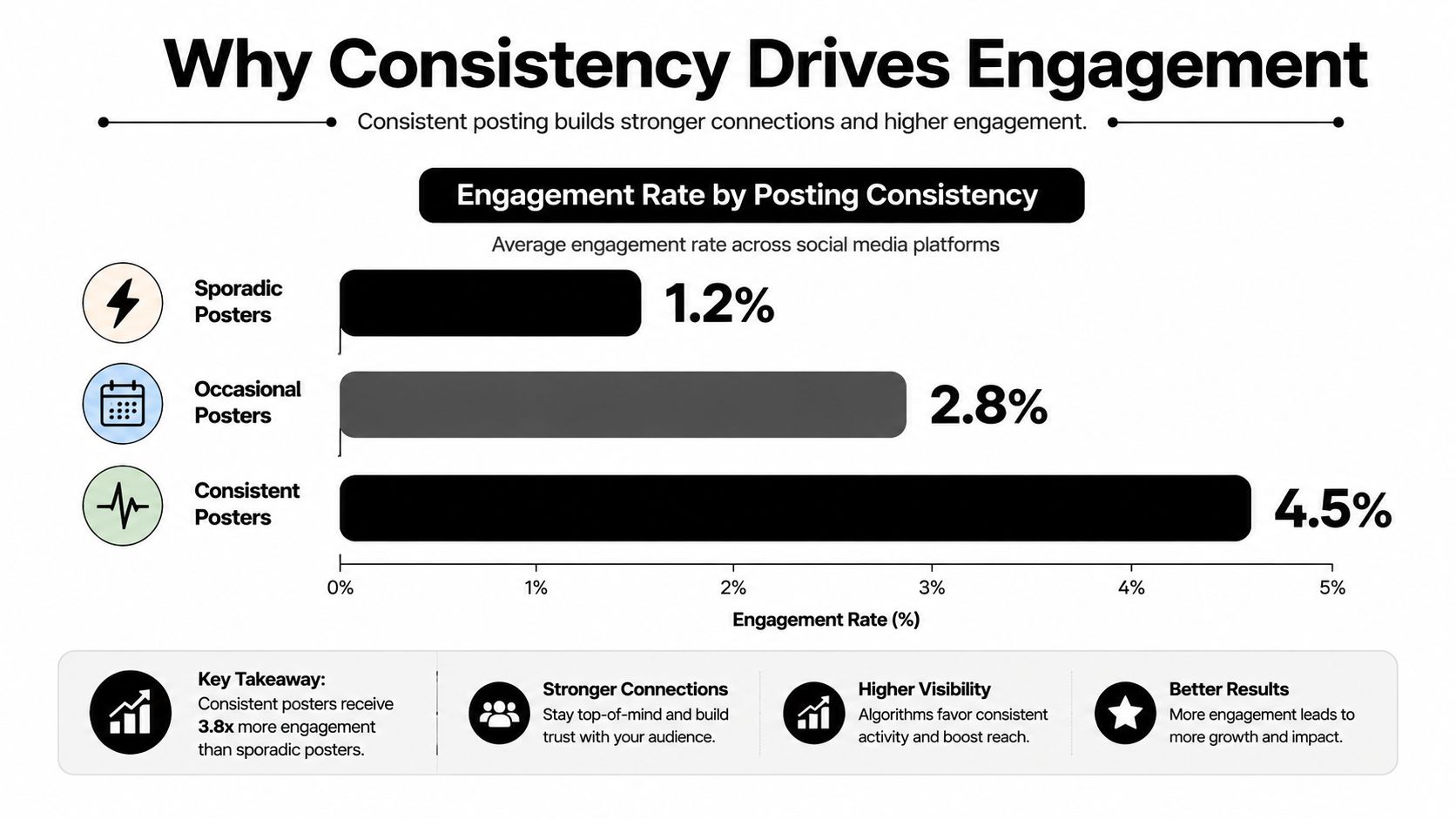
A burst of frequent publishing can create activity without building a dependable audience habit. A steady cadence gives followers a clear reason to return and gives the team a repeatable operating rhythm.
A creator study from Buffer found that the strongest posters earned about 5x more engagement per post than inconsistent posters, measured on a weekly cadence over a window longer than 20 weeks. The value of the finding is its focus on sustained behavior rather than a short publishing sprint. Buffer’s consistency study points to a practical conclusion: dependable output can outperform occasional volume.
Why steady output works
Audiences form habits around reliable creators. Regular analysis, clips, or teaching posts make an account easier to recognize in the feed and clarify the value followers can expect.
Consistency also improves execution. A calendar gives editors, writers, and approvers a shared target. They can work from a prepared queue, repurpose source material, and spend time refining hooks, captions, and platform fit instead of inventing a post from scratch each day.
Engagement does not rise forever with publishing frequency. A peer-reviewed study summary describes an inverted U-shaped relationship between posting frequency and engagement. Engagement increased up to about 6–7 posts per week, while publishing beyond that point reduced engagement and positive brand mentions. The study summary on posting frequency and engagement makes the trade-off clear: consistency helps until extra posts begin competing for attention.
For broader comparison, use these social media engagement rate benchmarks alongside your own reach, saves, replies, and conversions. Platform averages can guide planning, but they cannot replace account-level testing.
The operational question is not how much a team can publish in a strong week. It is which rhythm preserves useful content, audience attention, and production capacity over time. Repurposing and scheduling make that rhythm possible without requiring daily content creation.
Platform-Specific Posting Benchmarks for 2026
Platform norms set different operating rhythms. Benchmark guidance ranges from weekly video publishing to several daily updates, so use these figures as planning inputs rather than fixed quotas.
| Platform | Weekly Frequency | Daily Equivalent |
|---|---|---|
| 3–5 posts per week | Less than 1 per day | |
| TikTok | 2–5 posts per week | Less than 1 per day |
| 2–5 posts per week | Less than 1 per day | |
| 7–14 posts per week | 1–2 posts per day | |
| X | 21–28 posts per week | 3–4 posts per day |
| 105–175 pins per week | 15–25 pins per day | |
| YouTube | 1 video per week | Not applicable |
| YouTube Shorts | 1–3 videos per week | Not applicable |
These ranges come from Buffer’s social media frequency guide. Another benchmark set reports average business publishing rates of 18.1 posts per week on X, 14.2 on Facebook, 9.3 on Instagram, 5.5 on LinkedIn, and 3.7 on TikTok. HeyOrca’s 2026 platform frequency benchmarks shows why one schedule across every channel leads to poor planning.
Why the ranges diverge
X supports rapid conversations and short-lived updates, allowing several daily posts without requiring the same production model as LinkedIn. LinkedIn operates at a slower professional pace, while YouTube usually depends on the usefulness and production quality of each video rather than daily uploads.
Format changes the workload. A short clip can come from an existing conversation, recording, or longer video. A research-led thought leadership post may require interviews, review, and approval before publication. A single source asset can therefore support different cadences across channels when teams adapt its length, hook, caption, and call to action.
Pinterest’s high pin volume reflects distribution, not the need to create that many original ideas. Teams can organize variations, product images, articles, and older evergreen assets into a searchable stream. That model makes scheduling and repurposing more important than producing a new concept for every pin.
For professional network activity, Upvote Club’s LinkedIn resource offers further context on LinkedIn participation. For short-form video planning, quso.ai’s TikTok posting research provides a focused reference.
Start with the channels that match your audience and production capacity. Then build a queue from reusable source material, adapting each asset to the platform’s expected pace and format.
How to Choose the Right Cadence for Your Audience
Benchmarks tell you what’s common. They don’t tell you what your audience will tolerate, remember, or act on. Choose cadence by weighing three inputs: audience rhythm, production capacity, and platform norms.
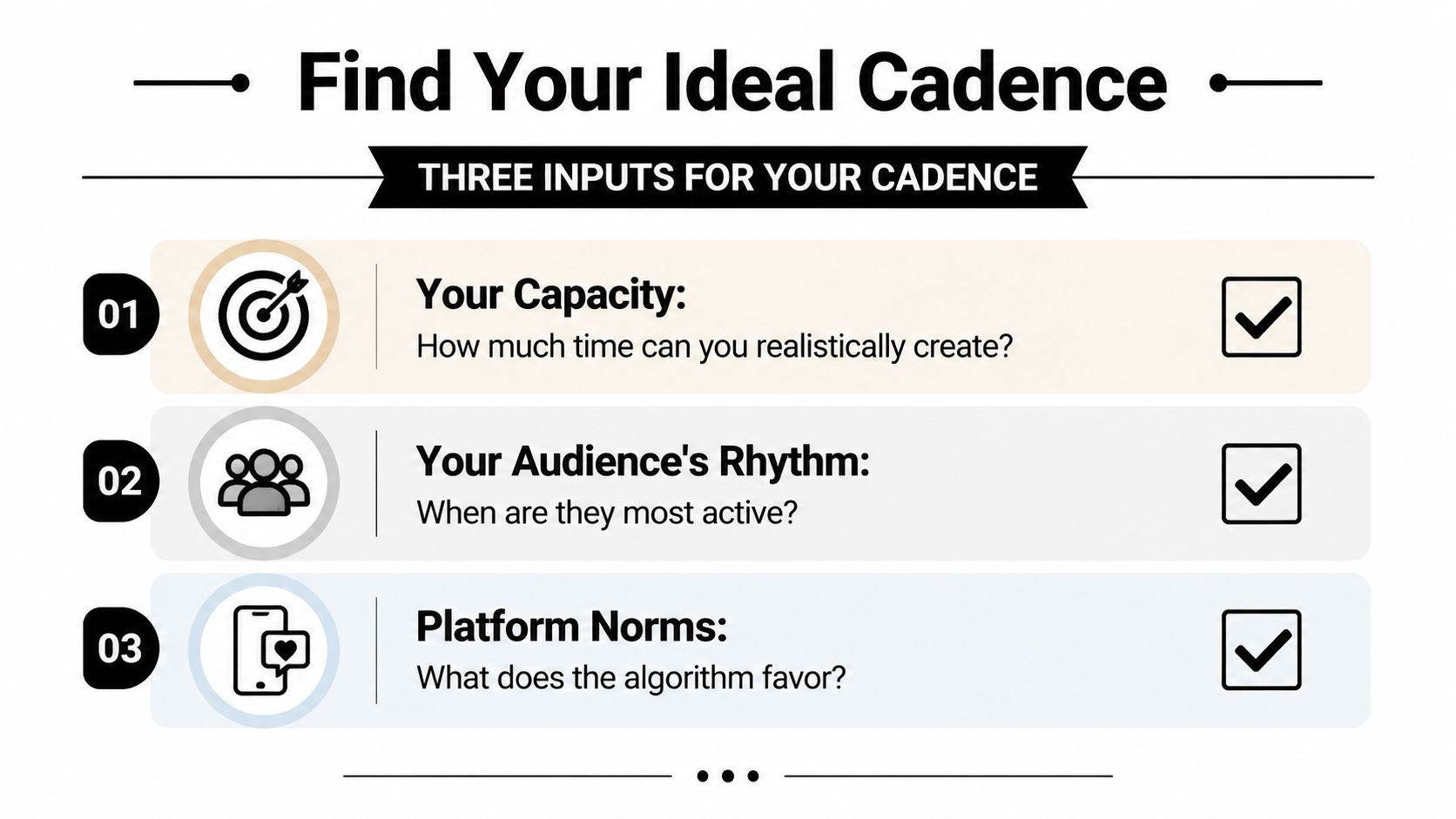
Start with audience behavior
Ask how often your audience consumes this category of content. A B2B audience may not want multiple daily posts from the same company, especially when the content requires thought. An analysis of 700 professionals found that 32% interact with B2B content weekly and 26% interact multiple times per week, supporting a practical rhythm of 2–3 posts per week for many B2B audiences. Neil Patel’s B2B content interaction analysis provides a useful reference point for that decision.
Then consider the job your content performs. A SaaS marketer sharing product education may need a dependable weekly sequence, while a podcaster can distribute several short insights from one episode. A coach or educator may use a mix of teaching clips, objections, and proof-oriented explanations rather than repeating the same promotional message.
Measure capacity honestly
Your sustainable cadence is the one your team can produce without rushed editing, weak captions, or repetitive ideas. Map your available time against the entire workflow, including recording, clipping, review, writing, approvals, scheduling, and community responses.
A simple test works well:
- Pick a realistic baseline for each active platform.
- Maintain it long enough to observe patterns rather than one-off reactions.
- Review engagement quality, audience responses, and production strain.
- Increase frequency only if quality and team capacity remain intact.
The embedded explainer offers another way to think about the relationship between audience rhythm, platform behavior, and available production effort.
Your calendar should make the next publishable asset obvious. If every post starts from a blank page, the planned cadence is probably higher than your process can support.
Making Cadence Sustainable with Repurposing and Scheduling
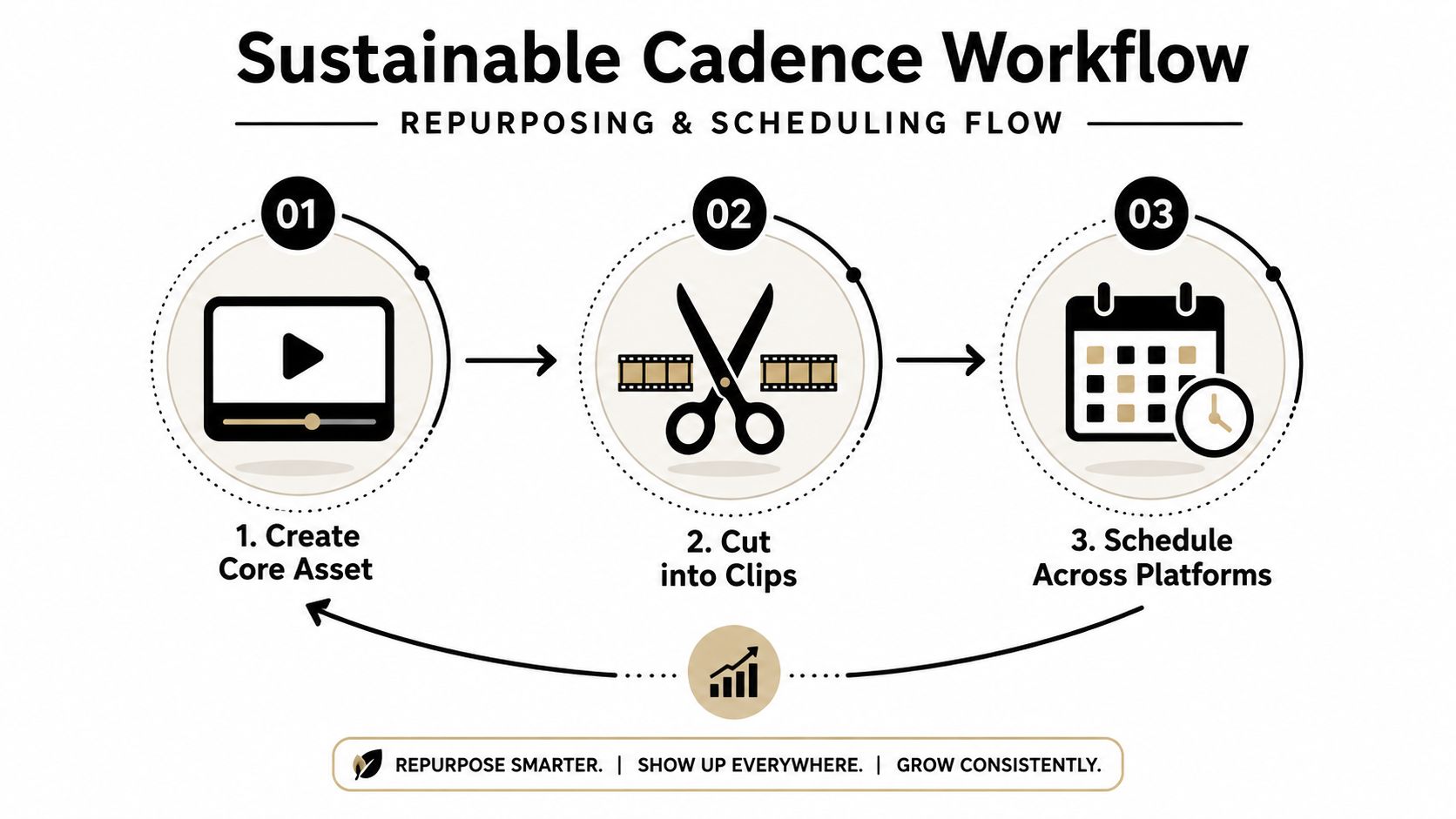
Sustainable cadence starts with a core asset, not a pile of unrelated post ideas. Record one useful podcast, webinar, interview, or product conversation. Then identify the strongest moments and assign each output to a platform and purpose.
Build from one source
A practical repurposing workflow looks like this:
- Extract the teaching moments: Find clear answers, strong opinions, useful examples, and concise explanations.
- Create short-form versions: Cut clips around one idea rather than compressing the entire recording into a rushed summary.
- Add readable captions: Captions should support comprehension without covering faces, key visuals, or interface elements.
- Write platform-specific copy: The same clip can use a different opening on TikTok, LinkedIn, and Instagram.
- Queue the assets: Schedule the finished posts against the cadence you selected.
Captions need practical placement discipline. Keep important text away from the top and bottom areas where platform interfaces can overlap the frame, and check the preview on each destination before publishing. A caption that looks fine in an editor can become unreadable once buttons, descriptions, usernames, or calls to action appear over it.
Schedule the system, not just the posts
Scheduling works best when the calendar shows the relationship between source content and downstream assets. Label each clip by topic, audience, platform, and status. That makes it easier to avoid publishing five versions of the same idea too close together.
For creators and B2B teams, quso.ai can turn long-form video into short clips, generate captions, and schedule outputs across social platforms in one workflow. This guide to scheduling social media posts covers the planning side of that process.
The point isn’t to automate judgment. Review every clip for context, accuracy, pacing, caption placement, and brand fit. Automation should remove repetitive handling so your team can spend its attention on selection and quality.
When Posting More Hurts Engagement
Higher volume can expand reach, but it can also reduce the value of every post. Audience fatigue starts when followers cannot keep up, while production fatigue appears when the team fills open calendar slots with weaker material.
The practical warning is not a single engagement threshold. Watch whether each post earns less attention, whether followers respond less often, and whether the team has enough time to review what goes live. A busy calendar can hide declining relevance.
Facebook offers a clear example of the risk. Accounts publishing 10 or more times per day saw engagement per post fall by almost two-thirds in the analysis. This Facebook posting frequency analysis shows why volume is not an automatic growth lever.
Watch for operational and audience signals
Reduce or restructure cadence when:
- Per-post interaction weakens: Total output rises, but each post receives less attention.
- Topics become repetitive: Followers keep seeing the same point in slightly different packaging.
- Production quality slips: Captions contain errors, hooks feel rushed, or clips lack context.
- Community response declines: Comments, replies, shares, and useful feedback become less frequent.
- Review time disappears: Scheduling turns into a way to publish material nobody checked properly.
- Audience fatigue becomes visible: Followers mute, unfollow, or stop returning to conversations.
These signals also affect planning. A team that cannot review posts carefully will struggle to maintain a reliable brand voice, respond to comments, or adapt content when audience interests change. Repurposing can protect output, but only when each version has a clear purpose for its platform.
A short publishing sprint can suit a launch or defined series, provided it has a clear end and a review point. Stimulead’s AI social media guide offers broader guidance on using AI without turning social publishing into uncontrolled volume.
The best cadence maximizes useful attention per post while preserving the team’s ability to keep publishing. If lowering frequency improves relevance, quality, and response, it is a stronger operating decision.
Frequently Asked Questions About Posting Cadence
Is daily posting necessary?
No. Daily publishing is optional and depends on the platform, audience, format, and capacity. A consistent weekly rhythm is better than an ambitious schedule you abandon.
Should cadence be the same on every platform?
No. Platform benchmarks vary significantly. Adapt the frequency, format, caption style, and timing to each network.
What should I do if engagement drops?
Check content relevance, repetition, quality, and audience response before increasing volume. A temporary reduction can help you restore stronger posts.
How can I test a new cadence?
Change one variable at a time, document the schedule, and review results after a meaningful operating period. Don’t react to a single post.
How can one team support several channels?
Start with one strong long-form asset, repurpose it into focused clips and captioned posts, then schedule each output according to the platform’s rhythm.
Use quso.ai to turn long-form recordings into short clips, add auto-captions, and schedule the resulting posts across your selected platforms. Build a cadence around one repeatable source-to-calendar workflow instead of creating every asset from scratch.