Social Media Plan and Strategy: A Practical Workflow
Most social media advice starts with a calendar. That’s backwards. A strong social media plan and strategy starts with a searchable audience problem, one useful long-form asset, and a system for adapting that asset to the platforms where people discover content.
At the start of April 2026, 5.79 billion people used social media worldwide, and the typical user spent 18 hours and 36 minutes per week across social and video feeds, according to Forbes Advisor’s social media statistics. Users also spread their attention across an average of 6.5 platforms each month, so publishing one version of a post on one network is no longer a complete distribution plan.
The practical answer is a search-first repurposing system. Create a strong source recording, identify the moments that answer specific questions, turn those moments into captioned short-form clips, and schedule platform-specific versions with a clear measurement loop.
Table of Contents
- Why Most Social Media Plans Fail Before They Start
- Defining Goals and Audience with Real Benchmarks
- Building Content Pillars and a Repurposing Workflow
- Scheduling Strategy Based on Timing Data
- Measuring Performance and Scaling the Workflow
- Frequently Asked Questions About Social Media Planning
Why Most Social Media Plans Fail Before They Start
The popular advice says to choose platforms, decide how often to post, fill a calendar, and stay consistent. That process can keep a team busy while producing very little learning. A calendar tells you when something will be published, but it doesn’t explain why a person would search for it, watch it, save it, or share it.
People now use social platforms to find answers, compare products, learn from communities, and validate buying decisions. Hootsuite’s 2026 social trends research identifies search-first behavior, social intelligence, and micro-behavior as important shifts. National University also describes platforms becoming primary search engines and community becoming more important than virality.
That changes the unit of planning. The unit isn’t the individual post. It’s the content source and its distribution system.
Practical rule: Don’t ask, “What should we post today?” Ask, “What useful idea can we package for the different ways our audience searches and participates?”
The calendar-first model creates waste
A traditional calendar often produces separate assignments for every channel. One person writes a LinkedIn post, another edits a TikTok, and someone else prepares an Instagram caption, even though all three assets could come from the same webinar, podcast episode, product demonstration, or expert interview.
That approach creates two problems. First, production time grows with every channel. Second, the message drifts because each version is created independently. A repurposing-driven plan keeps the central idea consistent while changing the hook, pacing, caption style, framing, and call to action for each platform.
Short-form video makes this more practical. In 2026, 91% of businesses used video as a marketing tool, and 93% said video was important to their strategy, while Instagram and Facebook were each used by roughly 70% of marketers, according to HubSpot’s marketing statistics. The strategic question is no longer whether video belongs in the plan. It’s how efficiently your team can adapt it without making every post feel duplicated.
For broader examples of channel planning and positioning, see social media strategy ideas, but apply them through a search-first lens. A good plan connects audience questions to reusable source material, not just to a list of posting slots.
Defining Goals and Audience with Real Benchmarks
A search-first social strategy starts with the audience question and the business action behind it, not with a list of publishing slots. Review current performance, then set a goal specific enough to shape the source video, the clip, and the call to action.
Start with three inputs:
- Business outcome: leads, qualified conversations, product education, community participation, or creator growth.
- Audience action: watch, save, comment, share, click, subscribe, or visit a profile.
- Platform benchmark: a reference point for judging performance in context.
Hootsuite defines engagement rate as likes + comments + shares divided by followers × 100. Its analysis of more than one million social posts reports these platform benchmarks: Instagram 3%, Instagram Reels 2.7%, LinkedIn 2%, X 1.8%, TikTok 1.5%, and Facebook 0.8%, as summarized by Emplifi’s social media benchmarks.
Use different KPIs for different jobs
A single KPI can hide a weak result. A clip may perform acceptably on a lower-baseline platform while falling short on a channel where audiences usually engage more actively. Compare equivalent formats, and connect each metric to the behavior the content should create.
| Platform | Engagement Rate | Best Content Format |
|---|---|---|
| 3% | Reels and visual carousels | |
| Instagram Reels | 2.7% | Short-form video |
| 2% | Expert clips and discussion-led posts | |
| X | 1.8% | Concise commentary and conversation |
| TikTok | 1.5% | Short-form educational or entertaining video |
| 0.8% | Shareable video and community content |
These figures provide a starting comparison, not a guaranteed result. Track your own baseline over a consistent review period. A creator may prioritize qualified comments and profile visits, while a B2B marketer may focus on decision-maker clicks and assisted conversions.
Audience planning must account for fragmented behavior. Users spread their attention across an average of 6.5 platforms each month. Define the question each platform helps answer, then set a platform-specific target. One long video can support several answers when its clips, captions, and titles match search intent on each channel.
Document the person’s role, recurring questions, buying context, objections, and preferred proof. A practical starting point is this buyer persona templates guide. Use the persona to choose the topic, language, clip length, and caption angle. If it cannot guide those decisions, it is documentation without a workflow.
Building Content Pillars and a Repurposing Workflow
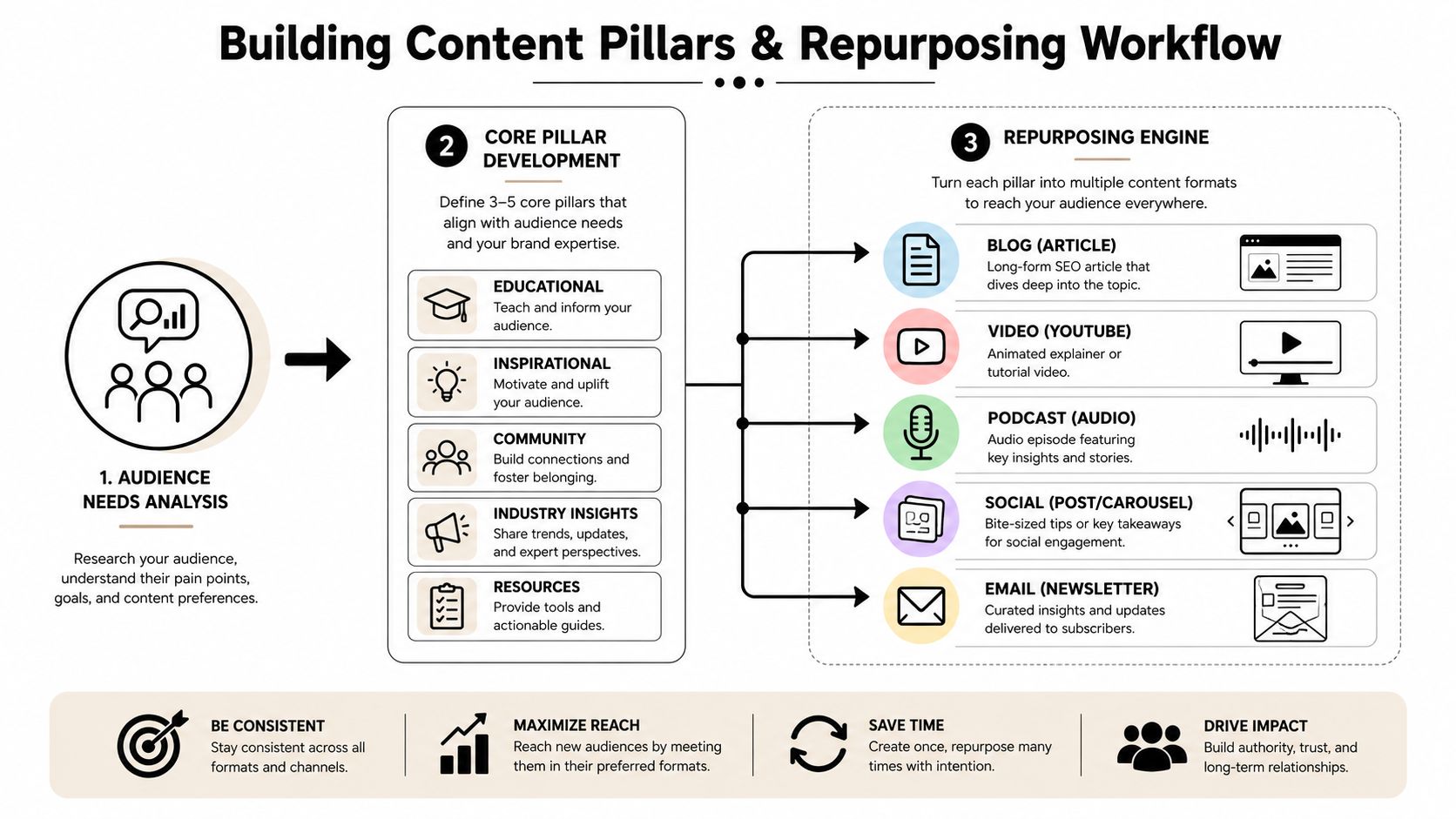
Content pillars should sit where three things overlap: what your audience searches for, what your team can explain credibly, and what your business needs to be known for. For a B2B SaaS team, pillars might include workflow education, customer objections, product use cases, and industry interpretation. For a podcaster, they might be expert insights, practical lessons, strong opinions, and community questions.
The pillar is not the post. It’s the editorial territory that gives repeated recordings a coherent purpose.
Start with one source recording
Choose a source asset that contains enough substance to answer multiple questions. A webinar, podcast conversation, tutorial, founder interview, or talking-head recording works well because it includes complete explanations rather than isolated promotional lines.
Review the recording for moments with four qualities:
- A clear answer: The speaker resolves a specific question quickly.
- A strong point of view: The clip contains a useful distinction, disagreement, or decision.
- A complete thought: The viewer doesn’t need the full recording to understand the point.
- A natural hook: The opening can become a searchable question or a compelling claim.
Then create different versions instead of exporting the same file everywhere. One cut might open with the audience’s problem. Another might lead with the surprising conclusion. A third might become a response to a common objection.
Let AI handle mechanics, not judgment
AI is useful for finding candidate moments, creating captions, preparing variations, and organizing a publishing queue. It shouldn’t decide the brand’s point of view without review. The human editor still needs to check whether the opening is accurate, whether the clip makes sense without context, and whether the language sounds like the actual speaker.
Captions are part of the content, not a finishing touch. They support silent viewing and make the spoken argument easier to scan, but captions must remain readable within the platform interface. Keep critical text away from areas where buttons, descriptions, profile details, or other interface elements overlap the frame. Test the finished video on a phone before scheduling it.
Section 508 requires federal information and communication technology, including social media content, to be accessible to people with disabilities. Federal guidance says video uploads should include closed or open captions, and closed captions on X must use SRT because X accepts that caption file type, according to SocialPilot’s accessibility guidance.
A workable system looks like this:
- Record one source video.
- Mark clips by audience question and content pillar.
- Generate captions and review wording manually.
- Adjust framing, hook, length, and caption treatment by platform.
- Add searchable descriptions and relevant terms.
- Schedule the approved versions.
- Record results against the original pillar and audience question.
For a deeper operating model, use this content repurposing strategy as a reference. The objective isn’t to flood channels. It’s to turn one thoughtful recording into a set of useful entry points.
Scheduling Strategy Based on Timing Data
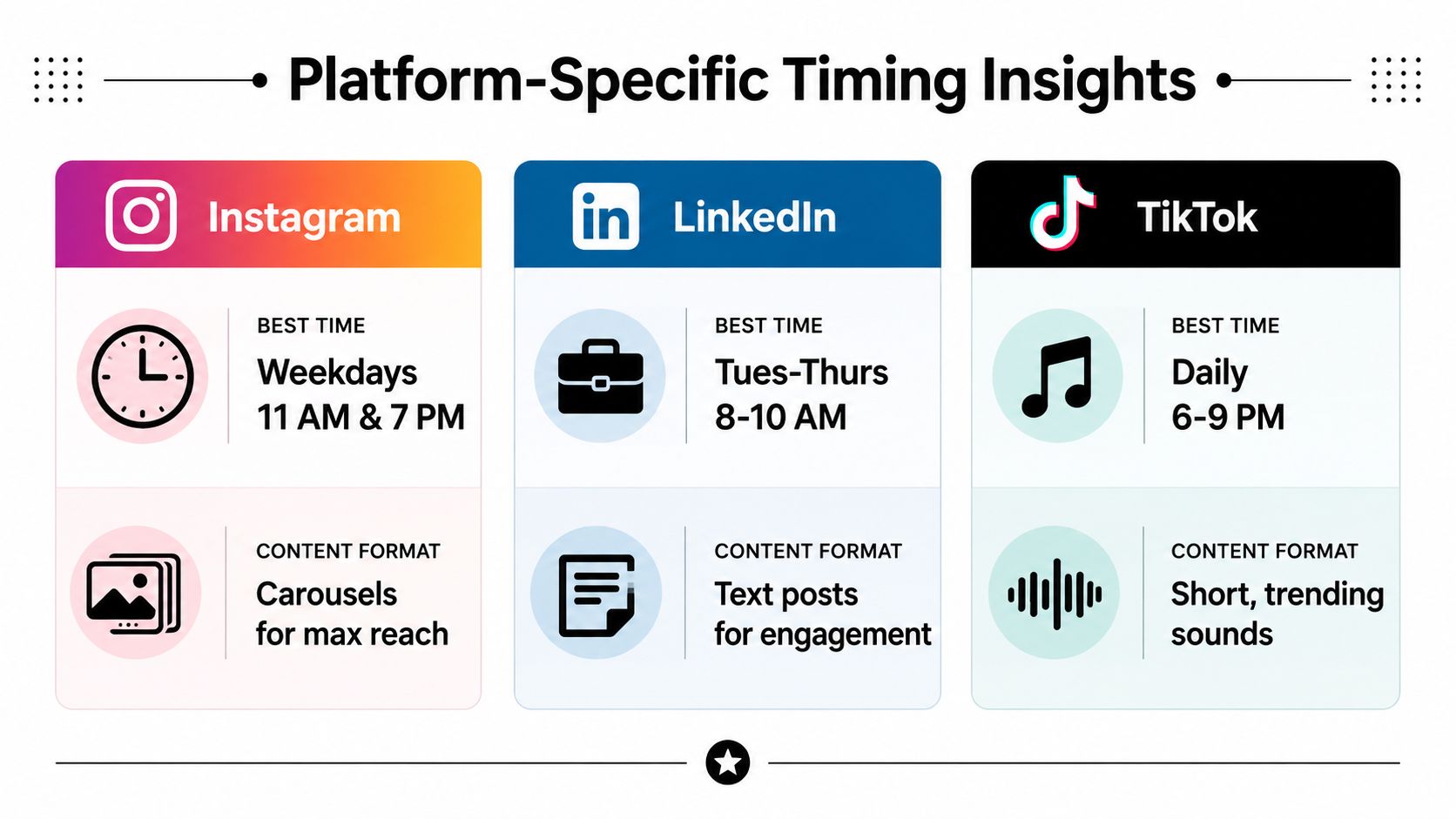
Scheduling is a distribution decision, not a ritual. There isn’t one universal best time for every account, format, or promotion type. Your starting windows should come from broad timing evidence, then move toward the times your own audience responds.
Emplifi’s analysis of 399 million social posts found the strongest engagement during midweek mornings and weekend evenings. Tuesday through Thursday from 9 a.m. to 1 p.m. local time outperformed other weekday-morning slots across nearly every platform, while Saturday and Sunday from 9 p.m. to midnight produced the highest weekend engagement on Instagram, Facebook, and YouTube, as reported by Hootsuite’s social media benchmarks.
Separate organic and paid timing
Morning and afternoon performance can differ depending on distribution. Baylor research cited in the same Hootsuite analysis found non-boosted posts performed 8.8% higher in the morning, while boosted posts received 21% more clicks in the afternoon than in the morning.
That distinction matters. Don’t schedule organic and boosted versions as if they serve the same audience behavior. Organic posts need an opening that earns attention in the feed. Boosted posts need a clear destination and enough context for someone who encounters the content outside your existing audience.
Platform-specific research can narrow the starting point further. Metricool’s 2026 TikTok study covered more than 2 million posts from more than 92,000 accounts and found the strongest posting window was 6:00 PM to 8:00 PM. Its LinkedIn study covered 673,658 posts from 63,108 accounts and found that the best time falls during the working day, with the ideal window varying by day, according to Metricool’s platform timing research.
Use those windows as test conditions, not permanent rules. Schedule one repurposed clip in different relevant windows, keep the creative treatment controlled, and compare results by platform. Include captions on every version so timing tests don’t accidentally become tests of whether people can understand muted video.
Measuring Performance and Scaling the Workflow
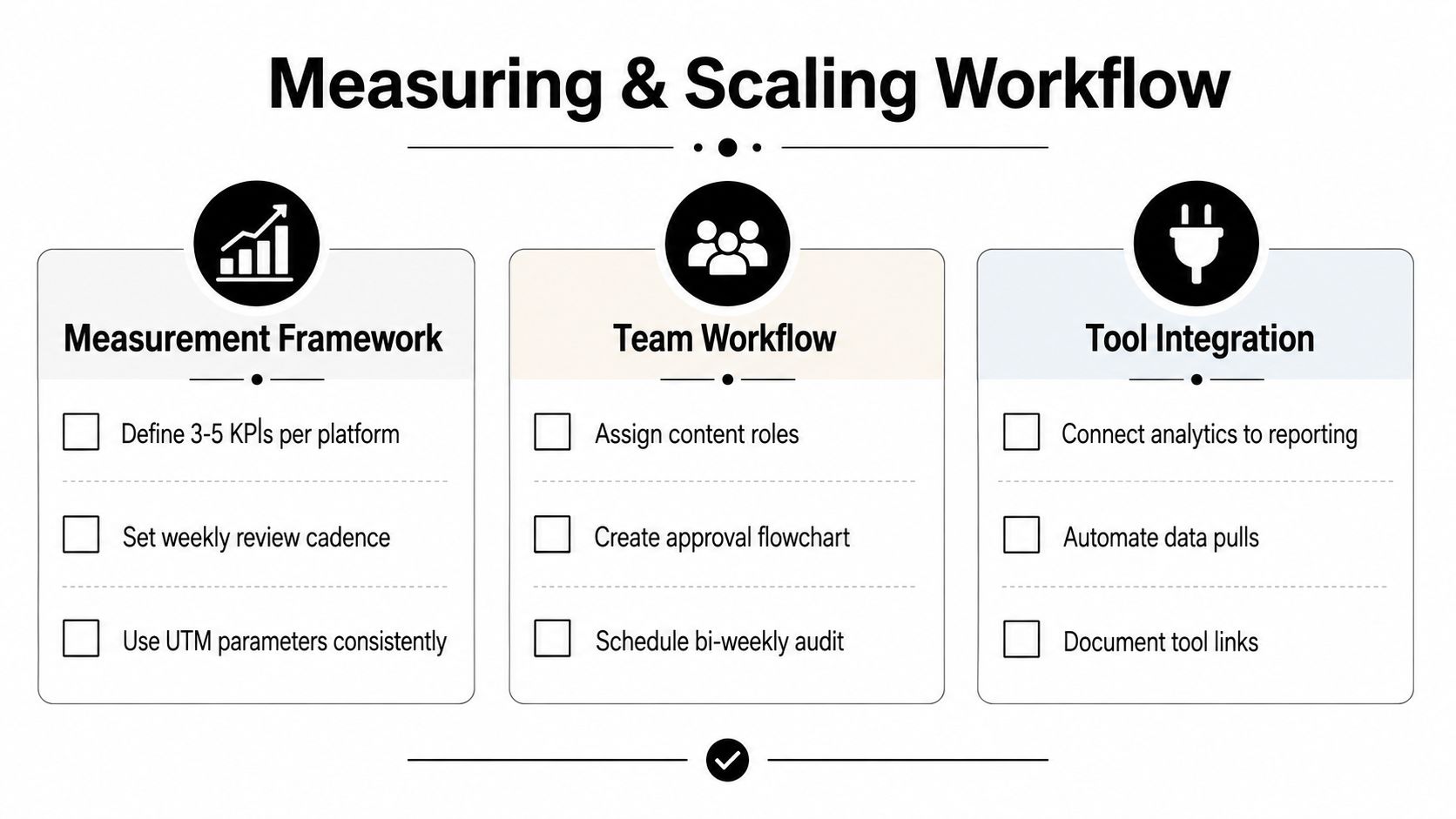
A social media system scales when measurement, ownership, and production are connected. If the reporting dashboard sits apart from the content workflow, the team learns too late which topics deserve another cut, a stronger hook, or a complete rewrite.
Track performance at three levels:
- Asset level: retention, views, shares, saves, comments, and clicks.
- Pillar level: which recurring topic consistently creates useful audience action.
- Business level: qualified traffic, leads, conversations, or conversions influenced by social.
Use the platform benchmarks above as context, then compare clips with similar objectives. A search-led educational clip shouldn’t be judged by the same standard as a community prompt. Record the hook, pillar, format, caption style, platform, timing window, and result so your review identifies patterns rather than producing a list of isolated winners.
Put human review around AI speed
AI can reduce mechanical work, but audience trust depends on editorial judgment. Sprout Social says consumers ranked human-generated content as their top priority in 2026, while Hootsuite and HubSpot describe AI as a standard part of marketing workflows. HubSpot also reports that 77% of marketers believe authenticity beats production value, according to HubSpot’s social media marketing report.
That creates a useful division of labor. Let software identify clips, generate subtitles, resize or format content, and prepare scheduling. Keep voice, claims, hooks, context, approvals, and final quality control with a person who understands the brand.
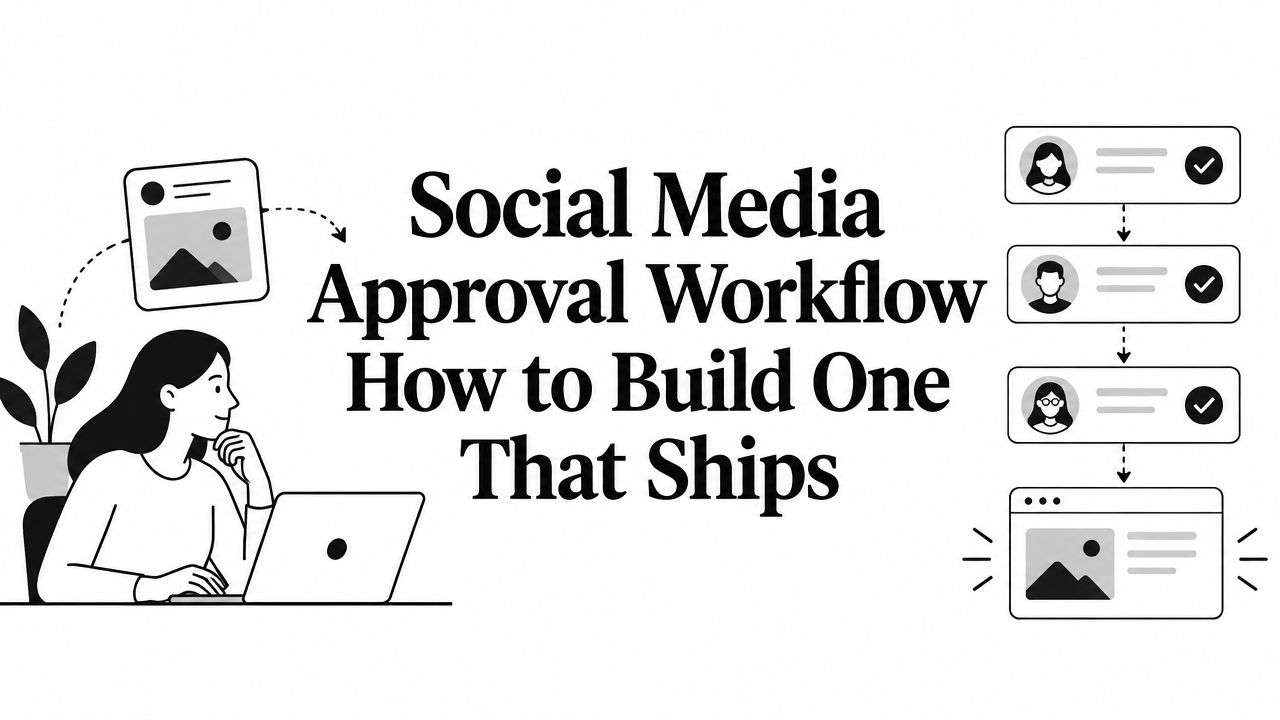
Assign clear roles even on a small team:
- Subject owner: confirms the idea and factual accuracy.
- Editor: selects the strongest moment and checks pacing.
- Channel owner: adapts the hook, caption, and call to action.
- Approver: checks brand, accessibility, and compliance.
- Analyst: records results and proposes the next experiment.
Build a review cadence that is frequent enough to catch problems but not so frequent that the team chases noise. A weekly production check can protect the queue, while a broader performance review can decide which pillars, hooks, and formats deserve more attention.
Use this guide to tracking social media analytics to structure the reporting layer. If your team also needs to monitor conversations outside its publishing queue, compare options that support social listening with Telegram. The key is integration. Insights should change the next batch of clips, not sit in a report nobody opens.
Frequently Asked Questions About Social Media Planning
How often should you update a social media plan and strategy?
Review content performance regularly and revise the strategic assumptions when the evidence changes. Don’t rebuild the entire plan every time one post underperforms. Update pillars, hooks, timing windows, and platform priorities when repeated results show a pattern.
Should a small team focus on one platform or several?
Start where your audience has a clear reason to discover and discuss your subject. One strong source recording can support several platform versions, but each version still needs a native hook, readable captions, and a reason to exist on that channel. Broad coverage without adaptation usually creates thin execution.
What should you do when a repurposed clip underperforms?
Diagnose the asset before blaming the platform. Check whether the opening answers a real question, whether the clip works without the original context, whether captions are readable within the safe zone, and whether the call to action matches the viewer’s intent. Then test a new opening or tighter cut before discarding the underlying idea.
How should a social media strategy respond to algorithm changes?
Keep the audience problem and content pillars stable while testing packaging. Searchable language, useful answers, community participation, and clear human perspective give you durable inputs, while hooks, formats, and timing can change as platform behavior changes.
How much AI should be used in social media planning?
Use AI for repeatable production tasks such as clipping, captioning, formatting, and scheduling. Keep editorial taste, voice, factual review, and final approval human. Speed matters only when the output still sounds like someone worth following.
quso.ai turns long video into short-form clips, generates auto-captions, and helps schedule platform-specific posts from a repeatable content workflow. Visit quso.ai to turn your next webinar, podcast, or talking-head recording into a searchable social media plan and strategy.