What Is the Most Viewed YouTube Short? the 2026 Answer
Most advice on what is the most viewed YouTube Short gets one important detail wrong. People repeat the most commonly cited viral example, then stop there. That's useful if you want trivia. It's not useful if you want a correct answer and a strategy you can apply.
The confusion comes from two different kinds of sources. One is a broad statistics roundup that reflects what was widely reported at the time. The other is the official record keeper. If you care about the definitive answer, you should trust the official record. If you care about how viral Shorts spread, it helps to look at both.
Creators also make a second mistake. They treat the top Short like a lottery ticket instead of a blueprint. The better question isn't only which video holds the record. It's why a very small number of Shorts break through language, geography, and niche boundaries while most stall out. If you understand that, you can make stronger creative decisions and avoid copying surface-level trends that don't travel.
Table of Contents
- What the Short actually is
- Why Guinness is the deciding source
- What creators should notice immediately
- It communicates before the viewer thinks
- It rewards the rewatch
- It avoids dead space
- It creates a share trigger
- It scales beyond fandom
- Build the first seconds with intent
- Use audio as discovery, not decoration
- Tighten for watch-through, not completeness
- What tends not to work
What Is the Most Viewed YouTube Short in 2026
If you search for what is the most viewed YouTube Short, you'll usually see one of two answers. That's not because the record is unclear. It's because people mix up “widely reported” with “officially verified.”
One commonly cited answer is Daniel LaBelle's “If Cleaning Was a Timed Sport. Part 2,” which was widely reported at about 1.5 billion views in a 2026 roundup. That same roundup noted the view count was roughly one-fifth of the global population, which tells you how rare billion-view Shorts are in the first place. But that isn't the official record holder. You can see how these kinds of claims circulate in broader YouTube trend roundups such as YouTube stats and platform benchmarks.
The definitive answer in 2026 comes from Guinness World Records, not from a secondary roundup.
The practical rule is simple. When multiple viral rankings conflict, use the source that verifies records rather than the source that summarizes the ecosystem.
That distinction matters because creators often build the wrong takeaway from the wrong example. If you think the top Short is a comedy skit, you may over-index on relatability and character performance. If the actual record holder is a trick-shot Short with near-universal visual appeal, your lessons change fast.
Why the confusion keeps happening
Short-form video moves faster than static articles do. A roundup can be accurate at one moment and outdated later. Record verification also has a higher bar than “most sources seem to agree.”
The useful takeaway
The answer to the query is straightforward once you separate official verification from popular repetition. The more valuable lesson is that different Shorts can reach massive scale for different reasons. One wins through global visual simplicity. Another wins through exaggerated everyday comedy. Both matter, but only one holds the record.
Unveiling the Official Most Viewed Short
The official most viewed YouTube Short is “BEST Duo Trick Shots” by @ColinAmazing. Guinness World Records lists it at 4.66 billion views as of 10 March 2026, making it the current global record holder for the format, according to Guinness World Records' verified listing for the most viewed YouTube Shorts video.
That number changes the conversation. We're not talking about a strong Short or even a breakout Short. We're talking about a piece of content that crossed into multi-billion-view territory, which is a different category of distribution entirely.
What the Short actually is
“BEST Duo Trick Shots” is built around satisfying visual execution. You don't need setup. You don't need language. You don't need context about the creator's channel history to understand what's happening.
That matters more than many creators admit. A lot of Shorts fail before the payoff because they require explanation. This one doesn't.
Why Guinness is the deciding source
When people ask what is the most viewed YouTube Short, they usually want certainty. Guinness gives you that because it verifies a category-specific world record. Secondary articles are useful for spotting patterns and trends, but they aren't the final authority when titles conflict.
Here's the cleaner way to understand it:
- If you want the official answer: Use Guinness.
- If you want context on other giant Shorts: Use broader stats roundups and rankings.
- If you want creative lessons: Study the structure of the content, not just the headline number.
Don't confuse popularity of a claim with accuracy of a claim. Viral content reporting often lags behind the latest verified record.
What creators should notice immediately
The title is simple. The concept is instantly legible. The action is visual. The result is satisfying even if the viewer has the sound off. Those are not small details. They're the foundation of broad distribution on Shorts.
The Anatomy of a Multi-Billion View Short
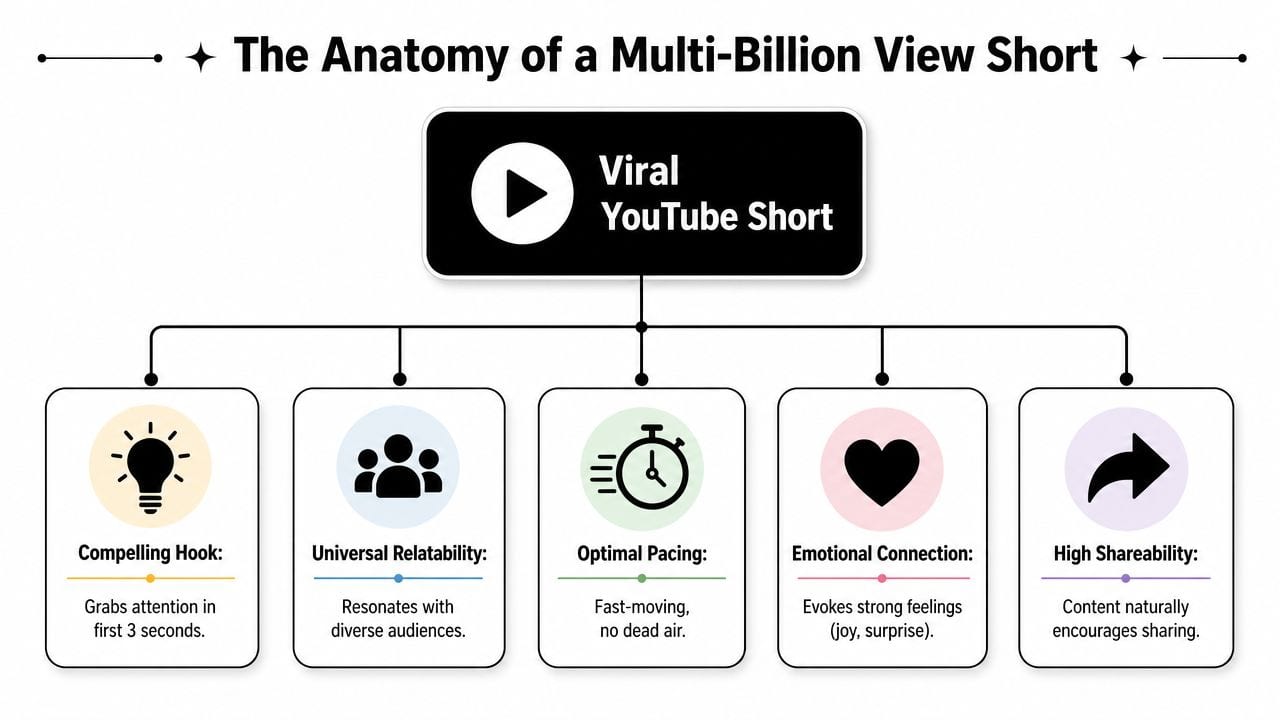
A multi-billion-view Short doesn't win because it checks one optimization box. It wins because several impactful traits work together at the same time.
It communicates before the viewer thinks
The strongest Shorts remove interpretation friction. Trick shots do that well because the viewer understands the challenge and the payoff almost instantly. No exposition. No “wait for it” voiceover. No niche vocabulary.
That's one reason they travel globally. They don't depend on cultural references or spoken language to land.
It rewards the rewatch
Shorts that loop cleanly often outperform more complicated ideas because the viewer doesn't feel the end as a hard stop. A satisfying sequence can trigger an immediate replay, whether the viewer wants to see how the shot worked or just wants the feeling again.
If you're studying patterns for influencers to go viral, this is one of the most transferable ones. Rewatchability usually beats cleverness that only pays off once.
It avoids dead space
A record-level Short doesn't waste motion. Every second either builds anticipation or delivers payoff. That pacing discipline is where many creators lose momentum. They keep in the setup they enjoyed filming instead of the setup the audience needs.
For production basics that support this style, creators should also understand YouTube Shorts dimensions, durations, and common mistakes. A clean visual frame and properly built vertical edit won't make an idea viral, but poor execution can absolutely suppress a good idea.
It creates a share trigger
People share Shorts for a handful of reasons. Surprise is one. Skill is another. Satisfaction is a third. Trick-shot content often combines all three, which makes it easy to send to a friend without explanation.
Practical rule: If someone can share your Short with “watch this” and nothing else, you've reduced friction in exactly the right way.
It scales beyond fandom
Some creators can get strong results from personality-led Shorts because their audience already knows them. That's different from world-record scale. To reach that kind of ceiling, the content usually needs to work for strangers first and subscribers second.
That's the key lesson from the record holder. The Short isn't asking viewers to know the creator. It's asking them to react.
Exploring Other Top Performing YouTube Shorts
The record holder is clear. The larger picture is still worth studying because it shows there isn't only one path to massive viewership.
Daniel LaBelle's “If Cleaning Was a Timed Sport. Part 2” is the most common alternative answer. It was widely reported at about 1.5 billion views in a 2026 statistics roundup, and that source described the figure as roughly one-fifth of the global population in scale, according to this YouTube Shorts statistics roundup. That's not the official record, but it is absolutely part of the billion-view conversation.
Top YouTube Shorts comparison
| Creator | Short Title | Estimated Views (Billions) | Primary Viral Trigger |
|---|---|---|---|
| @ColinAmazing | BEST Duo Trick Shots | 4.66 | Visual satisfaction and surprise |
| @DanielLaBelle | If Cleaning Was a Timed Sport. Part 2 | About 1.5 | Relatability and physical comedy |
That comparison is useful because the two Shorts rely on different engines.
Two different formulas that both travel
ColinAmazing's Short is almost frictionless. It's visual first, language-light, and built around outcome. Daniel LaBelle's Short leans harder on exaggerated human behavior. It still travels well because the premise is easy to understand and the comedy is physical, not dialogue-dependent.
If you make educational, coaching, or business content, this matters. You probably won't make trick shots. You probably shouldn't mimic sketch comedy unless that fits your style. But you can still borrow the underlying triggers:
- Immediate clarity: The viewer should know the premise fast.
- Visible payoff: Something should happen on screen, not only in the caption.
- Broad accessibility: The idea should survive without heavy context.
Viral mechanics repeat more often than viral formats do. That's why studying different examples helps.
The wrong takeaway is “I need to make a trick-shot Short.” The right takeaway is “I need a concept that lands instantly and rewards attention.”
Key Takeaways for Your Own YouTube Shorts
Most creators don't need a world record. They need a repeatable system for making stronger Shorts. That starts with editing for retention, not for self-expression alone.
A useful benchmark comes from a large-scale analysis cited by LoopEx Digital. It found that 50–60 second Shorts achieved a 76% watch-through rate, while trending audio used in the first 5 seconds increased reach by 21%, according to LoopEx Digital's YouTube Shorts statistics summary. Those numbers don't guarantee virality, but they do point to two practical levers: hold attention early and use audio strategically.
Build the first seconds with intent
The opening can't be throat-clearing. It needs one of these jobs:
- Show the result first: Start with the payoff or the hardest moment.
- Pose a visual problem: Make the audience want the resolution.
- Use motion immediately: Static openings often lose the swipe battle.
A lot of creators write hooks like copywriters and edit like documentarians. Shorts usually need the reverse. Start with something happening, then earn the explanation.
Use audio as discovery, not decoration
Trending audio works best when it supports the idea instead of masking a weak concept. If the sound cue enters early, it can help the Short align with current viewing behavior. But if the visual isn't compelling, audio won't save it.
For creators working from webinars, podcasts, or talking-head videos, tools can speed up the repurposing side. One option is quso.ai, which can turn longer videos into short clips, add subtitles, and package them for short-form distribution. If your workflow also depends on captions or repurposed transcripts, this guide on how to transcribe video is also useful for tightening scripts and on-screen text.
Tighten for watch-through, not completeness
Many Shorts often weaken during revision. Creators keep context that belongs in a long-form video. A better edit usually removes the second-best explanation, not the best one.
A simple check helps:
- Cut the intro line if the visual already explains the premise.
- Trim pauses that don't add tension.
- End on the strongest frame so the loop feels natural.
A strong Short often feels slightly abrupt to the creator and perfectly paced to the viewer.
Here's a practical example of the style and pacing creators should study more closely:
What tends not to work
Shorts usually underperform when they rely on one of these habits:
- Over-explaining the setup: viewers leave before the point arrives.
- Weak visual framing: the idea may be good, but the execution feels disposable.
- Trend-chasing without fit: borrowed formats often look borrowed.
The fastest improvement usually comes from stripping away friction, not adding more effects.
Moving Beyond Views to Grow Your Channel
A huge Short can bring attention. It doesn't automatically build a channel.
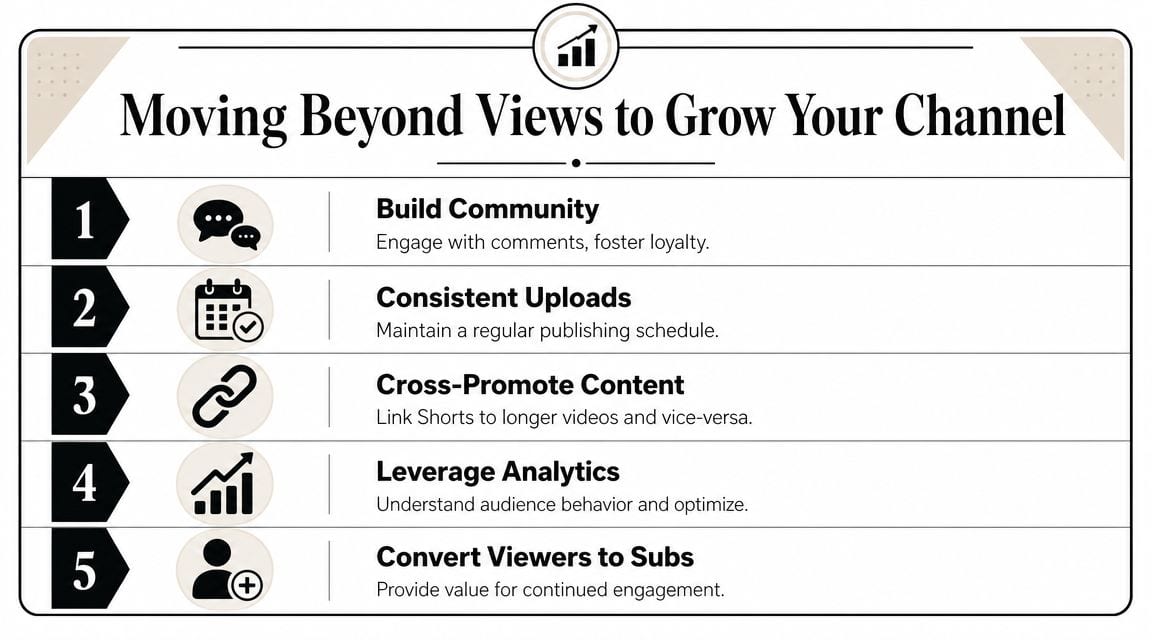
The creators who benefit most from virality treat views as the entry point, not the outcome. They use Shorts to create recognition, then connect that attention to a broader content system. That might mean leading viewers to longer videos, a series, a newsletter, or a recognizable content promise.
What sustainable creators focus on
- Retention quality: Did people stay with the idea?
- Audience fit: Did the Short attract the right viewers for the rest of the channel?
- Conversion paths: Is there an obvious next piece of content to watch?
If you publish commentary, education, or news-based Shorts, trust also matters. As synthetic media gets harder to spot, tools that help detect fake videos with AI can support verification workflows before you publish or react to questionable footage.
A monetization plan matters too. Views without a broader channel strategy can produce a spike and then disappear. Creators who want a business outcome from Shorts should understand how YouTube Shorts monetisation works and build content that supports both reach and repeat engagement.
The best Short on your channel isn't always the one with the biggest number. It's the one that brings the right viewers back.
If you're turning long videos, podcasts, webinars, or talking-head content into Shorts regularly, quso.ai can help you clip footage, add subtitles, and repurpose content into short-form assets from one workflow.