Trending on Facebook: A Guide to Viral Content in 2026
You've probably done this already. You notice a topic taking off on Facebook, rush to write something about it, post late, get a few reactions, and then watch someone else publish a sharper version that captures the conversation. The problem usually isn't that you missed the trend. It's that you didn't have a system ready when it appeared.
That's why most advice about trending on Facebook falls short. It tells you where to look, but not how to turn a signal into an actual content asset, get it live at the right time, and learn from the result fast enough to repeat the process.
Table of Contents
- Why 'Trending on Facebook' Is a Flawed Goal
- Watch for movement, not just volume
- Build a lightweight trend validation routine
- Start with material you already have
- Turn one idea into a publishable short
- Create the companion assets while context is fresh
Why 'Trending on Facebook' Is a Flawed Goal
Chasing every trend is how teams burn out. A trend isn't valuable because it exists. It's valuable when it overlaps with your audience, your format strengths, and your ability to publish before the moment cools off.
That distinction matters more on Facebook because the platform is still enormous. DataReportal's Facebook stats report at least 2.28 billion users reached by Facebook ads in January 2025, and the same source notes Sprout Social put Facebook at 3.070 billion monthly active users in 2026. On a platform that large, even a modestly strong post can travel far if it matches the right conversation.
Most creators misread that opportunity. They think “trending on Facebook” means becoming part of every fast-moving topic. In practice, it means filtering hard. If you react to everything, you produce generic posts, shallow commentary, and tired creative. If you react to the right few topics, you can turn small windows of attention into repeatable reach.
Practical rule: Don't ask, “Is this trending?” Ask, “Can my audience use this, argue with it, or share it right now?”
A better operating model has three parts:
- Relevance first: Pick trends that connect to your offer, expertise, or point of view.
- Production speed: Use a workflow that turns an idea into a post, short video, and follow-up assets without bouncing across tools.
- Feedback discipline: Review what got comments, shares, and watch time, then refine your selection criteria.
If you want a broader sense of how Facebook still behaves as a channel, these Facebook marketing stats from quso.ai are useful context. The headline is simple. The opportunity on Facebook is still large, but the winners usually aren't the people chasing noise. They're the ones with a repeatable publishing system.
How to Uncover What Is Actually Trending
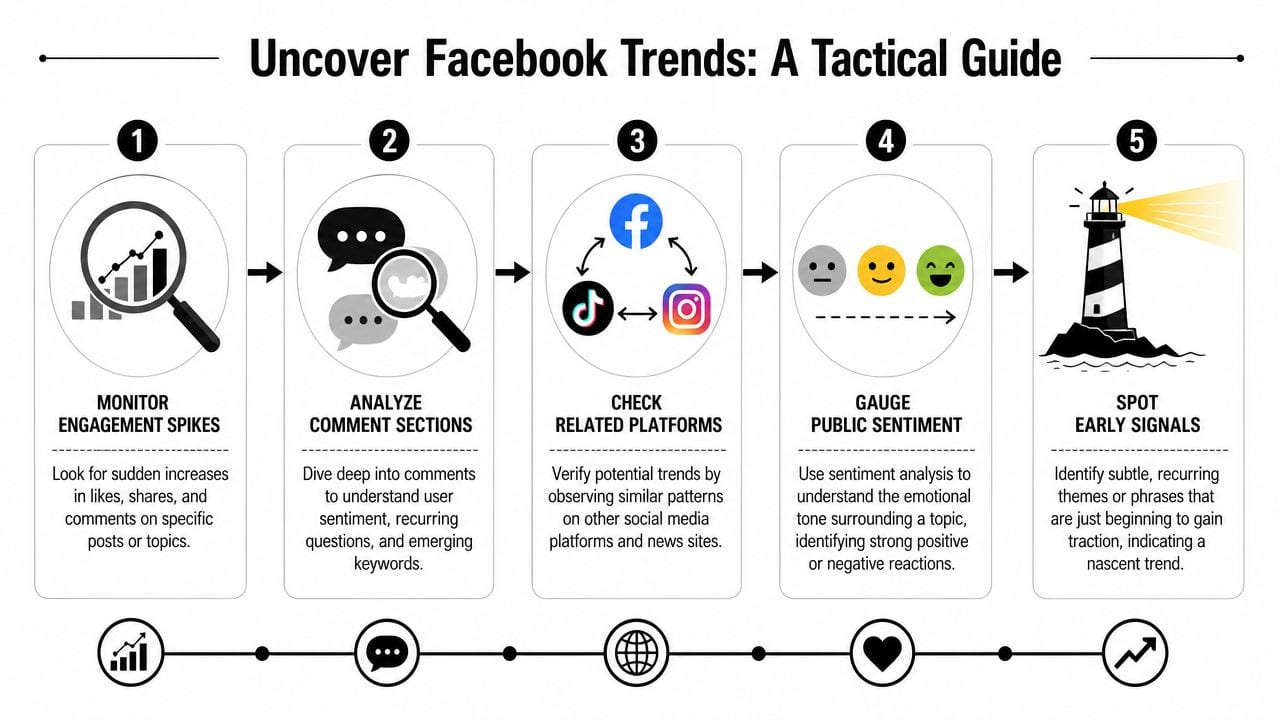
Most trend research fails because it starts with the obvious posts that are already everywhere. By the time a topic looks unmistakably big, you're late. The better move is to watch for directional change.
Facebook is a mature attention market, not an endless scroll free-for-all. Backlinko's summary of Facebook user trends cites an eMarketer estimate that Americans aged 18+ spend an average of 34 minutes per day on Facebook in 2026, with attention concentrated on weekdays between 9 a.m. and 3 p.m. That creates a practical constraint. Your content has to latch onto something people already care about, and it has to do it quickly.
Watch for movement, not just volume
Start inside the environments where your audience talks.
- Facebook Groups: Groups reveal trend quality faster than feed browsing. Watch for the same question appearing in slightly different wording, repeated screenshots, or multiple people debating the same update.
- Competitor comment sections: Don't just inspect top posts. Read the replies. If commenters keep asking for clarification, disagreeing with a claim, or sharing their own examples, you may have found a key angle.
- Reels patterns: Look for recurring hooks, structures, or topical references. A trend often appears as a format before it appears as a keyword.
- Cross-platform confirmation: If the same topic shows up in industry newsletters, niche communities, and short-form video, it's usually stronger than a one-platform spike.
A lot of this work falls under social listening practices. You're collecting signals, not hunting for certainty.
When a topic is real, people don't just like it. They repeat it, reinterpret it, and drag it into adjacent conversations.
Build a lightweight trend validation routine
You don't need a giant dashboard. You need a habit that makes weak ideas obvious before you spend time creating around them.
Use a simple five-check routine:
- Recurrence: Have you seen the topic more than once in unrelated places?
- Audience fit: Would your buyers, students, or followers care about it without extra explanation?
- Emotional pull: Does it trigger curiosity, agreement, frustration, or urgency?
- Content angle: Can you add context, not just echo what's already being said?
- Format match: Is this best as a Reel, a talking-head clip, a graphic breakdown, or a text-led post?
A sentiment pass helps here. If you need tools for that layer, BeyondComments' sentiment tool recommendations are a useful reference for assessing whether a topic carries strong positive or negative reactions before you build content around it.
A quick filtering table can keep your team honest:
| Signal | Weak trend | Strong trend |
|---|---|---|
| Conversation depth | Surface-level reactions | Questions, disagreement, personal examples |
| Relevance | Broad but vague | Tied to your niche or customer pain point |
| Shelf life | One-day novelty | Ongoing discussion with fresh angles |
| Format potential | Hard to visualize | Easy to explain or demonstrate |
The fastest way to waste effort is to confuse visibility with usefulness. Trending on Facebook isn't about finding the loudest topic. It's about identifying the topic you can package into something people want to watch, save, or comment on before their attention moves on.
The quso.ai Workflow From Idea to Video
The most reliable source of trend-ready content usually isn't a blank page. It's your existing long-form material. Webinar recordings, coaching calls, interviews, demos, and podcasts already contain the raw opinions, examples, and explanations you need. The work is finding the right slice fast enough.
Start with material you already have
A common scenario looks like this: a topic starts surfacing in your niche, and you realize you addressed it during a recent webinar or client training. Instead of scripting a new video from scratch, pull the source footage and extract the relevant segment.
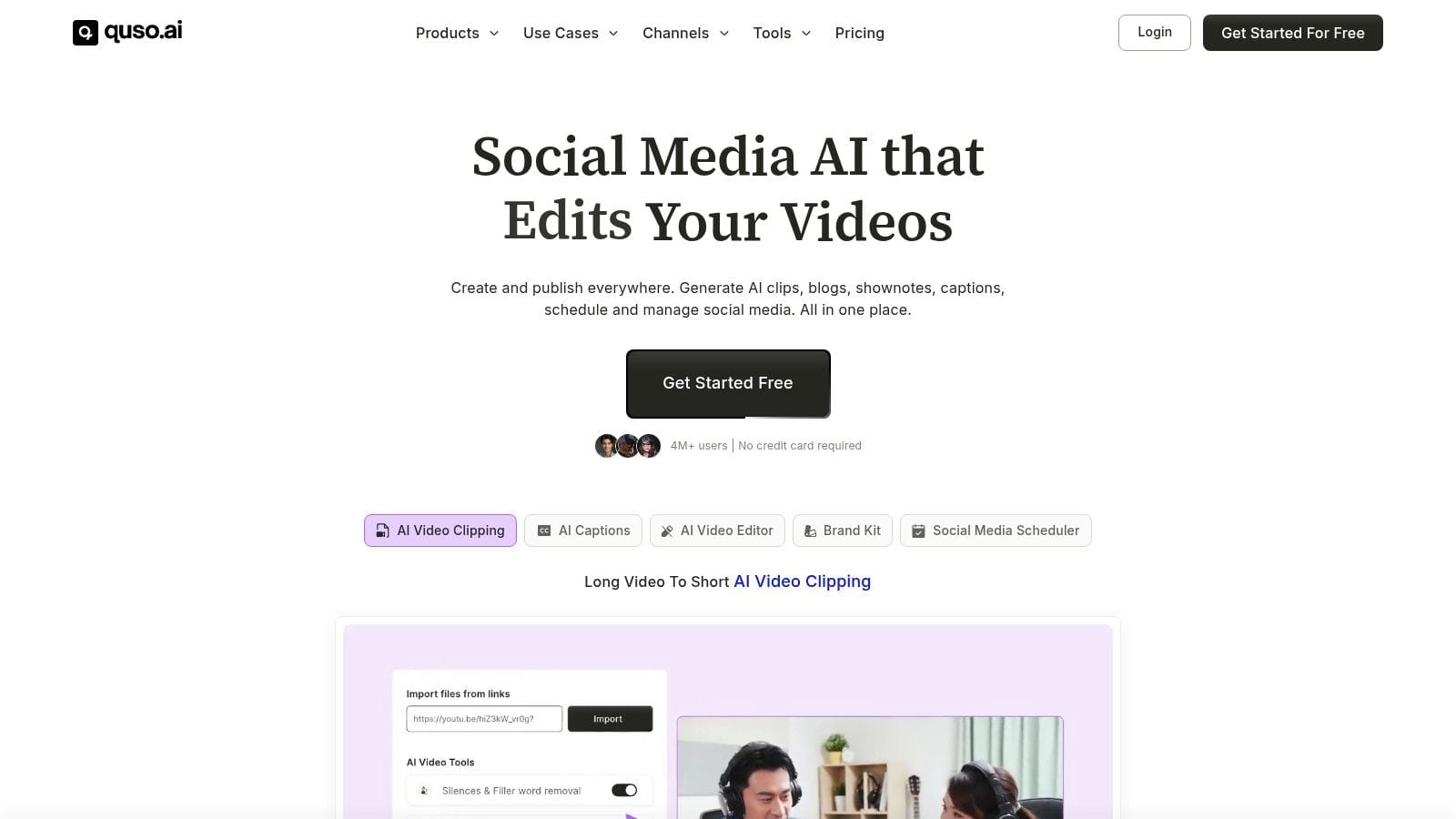
A unified workflow is essential. quso.ai lets teams upload a long video, identify short clips with the AI Clips Generator, refine them in the built-in editor, add captions with the AI Subtitle Generator, and prepare the post without moving between separate tools. That matters when the value of the trend drops each hour you wait.
The actual sequence is straightforward:
- Upload the source asset: Use the webinar, livestream, or training recording that already includes your perspective on the topic.
- Search for the relevant moment: Look for the section where you answered the exact question people are currently discussing.
- Pull a short clip first: Don't start by editing the whole recording. Start with the single strongest takeaway.
Turn one idea into a publishable short
The mistake I see most often is over-editing too early. Teams spend too long polishing transitions and not enough time sharpening the opening line.
For Facebook, the first decision is whether the clip makes sense with no setup. If the answer is no, trim harder or record a short intro that creates context in one sentence.
A practical edit pass looks like this:
Cut to the tension immediately
Start with the disputed claim, surprising lesson, or audience pain point. Skip long intros and branding animations.Remove clutter
Delete filler words, slow setup, and side tangents. Most trend clips improve when you remove explanation rather than add more.Add readable subtitles
Facebook is full of partial attention. Captions help viewers stay with the message when they're scrolling in silence or skimming quickly.Frame for mobile consumption
Reposition the speaker, emphasize facial expressions, and make sure text doesn't compete with key visual areas.
A useful clip doesn't need to feel polished in the traditional sense. It needs to feel immediate, legible, and specific.
Once you have the first cut, review it against one question: would someone who has never heard of you still understand why this matters?
Create the companion assets while context is fresh
The second bottleneck usually appears after the edit. The clip is ready, but the caption, headline, hooks, and alternate versions still need work. That's where teams lose another block of time.
Create those assets while the topic is still fresh in your head. Pull two or three hook options. Write one version that frames the trend as a problem, one that frames it as a myth, and one that frames it as a quick lesson. If you're repurposing from a larger session, also note the related long-form asset you can link in comments or send through follow-up messages.
Here's a walkthrough format worth studying before you build your own repeatable process:
The key trade-off is speed versus originality. If you publish the raw trend take too quickly, you sound like everyone else. If you wait until the asset is perfect, the conversation moves on. The middle ground works best. Pull a sharp clip from material you already trust, make fast edits, and publish while the topic still has active discussion around it.
Optimizing Content for the Facebook Algorithm
Publishing a strong clip isn't enough. The packaging around it often decides whether people stop, watch, and encounter it again. On Facebook, that repeat exposure matters.
The Markup's explanation of trending domain methodology describes mean impressions per user, also called a frequency value, as a core way to think about what gets seen repeatedly. In essence, content gains momentum when engaged users don't just see it once. They see it multiple times. That's why raw follower count can matter less than whether the post sparks enough interaction to stay in circulation.
What frequency changes about your packaging
If repeated exposure matters, your post has to be instantly understandable on first contact and still worth engaging with on the second. That changes how you write copy.
A weak package often has these traits:
- Generic hooks: “Thoughts?” or “New video is up.”
- Delayed payoff: The important point is buried in the third sentence.
- Broad hashtags: Tags that describe the internet, not the topic.
- No comment trigger: Nothing invites reaction, disagreement, or self-identification.
A stronger package does the opposite. It names the issue quickly, stakes out a clear angle, and gives the viewer a reason to respond.
The post structure that usually earns a second look
Use a compact structure that matches how people skim:
| Element | What to do | What to avoid |
|---|---|---|
| Opening line | Lead with the claim, mistake, or tension | Warm-up sentences |
| Body copy | Add one useful insight or context point | Mini blog posts in the caption |
| CTA | Ask for experience, agreement, or examples | Generic “like and follow” asks |
| Hashtags | Keep them tightly relevant to the topic | Tag stuffing |
The strongest hooks on Facebook usually do one of three things:
- Contradict a common assumption
- Name a painful mistake
- Condense a complicated issue into one clean takeaway
Client note: If the first line can be pasted under any post in your niche, it isn't specific enough.
This is also where it helps to understand how Facebook surfaces content over time. You're not only trying to earn a click or a view. You're trying to create enough immediate engagement that the post keeps circulating. That's a different standard.
If you want a deeper platform-specific breakdown, this guide to the Facebook algorithm is useful background. The practical takeaway is simple. Optimize the clip, caption, and call to action as one unit. A trend-ready video with weak copy often underperforms. A sharp hook paired with a clear, relevant clip has a much better chance of being shown again.
Strategic Scheduling and Proactive Engagement
A lot of Facebook content dies after publish because no one is around to help it get traction. Scheduling matters, but it isn't the whole job. The first stretch after posting often determines whether the content gathers conversation or stalls.
Schedule for attention, then work the first hour
Attention on Facebook concentrates in specific windows, and that should shape your publishing routine. If you already know your audience is active during workday scroll sessions, schedule around those periods instead of posting whenever the edit is finished.
The operational benefit of scheduling is simple. It frees you to spend your time where automation can't help much: active conversation. If you want more tactical ideas on sparking reactions and participation, this guide on how to get more Facebook likes includes practical prompts you can adapt without turning your post into engagement bait.
A good publishing routine includes both planned timing and human follow-through:
- Queue the post in advance: Don't rely on memory, especially when trends overlap with client work or meetings.
- Prepare a first comment: Add a question, contrarian angle, or quick clarification you can pin if the post starts moving.
- Block response time: Leave room to answer early comments while the conversation is still forming.
What to do right after publishing
The first hour is usually where momentum gets either supported or wasted.
Try this checklist:
Reply quickly to early commenters
Short replies are fine, but keep them open enough to continue the thread.Pin a useful follow-up
This can be a question, a resource, or a sharper framing of the point in the video.Notice what people latch onto
Sometimes the line you thought was secondary becomes the main debate. That's valuable signal for the next post.Avoid defensive moderation
If the discussion is thoughtful, disagreement helps. Don't flatten the thread unless it turns abusive or off-topic.
Fast responses do more than keep people happy. They help shape the conversation people see when they arrive later.
Teams often over-focus on scheduling technology and under-focus on live participation. The schedule gets the post into the room. Your responses help keep the room talking.
Measuring Performance to Close the Loop
A trend system only improves when you review outcomes by pattern. One post might pop because the timing was right. A repeatable process shows up when the same topic shape, opening angle, or video structure keeps earning attention.
Read outcomes by pattern, not vanity
Likes can tell you that something was pleasant. They rarely tell you why it spread. For trend-based Facebook content, the more useful signals are usually qualitative and behavioral.
Review posts through questions like these:
- Comments: What specific line triggered discussion?
- Shares: Did people pass it along because it was useful, provocative, or identity-reinforcing?
- Watch behavior: Where did viewers stay engaged, and where did the clip lose clarity?
- Reach versus conversation: Did the post travel widely but attract thin interaction, or did it generate dense discussion from a smaller audience?
If you want examples of how marketers think about improving video interaction, Wideo's tips for marketers on video engagement are a useful outside reference, especially for thinking about clarity and presentation.
Feed the insights back into your next trend cycle
The useful lesson usually isn't “post more trends.” It's narrower than that.
Maybe your audience responds when you challenge common advice. Maybe they comment more when you connect a trend to a client mistake. Maybe your webinar clips outperform freshly recorded talking heads because the delivery sounds more grounded and less scripted.
That's the loop worth building. Spot a relevant signal, create quickly, package carefully, publish with intent, then review the response for reusable patterns. Over time, your instinct improves because it stops being instinct alone. It's backed by repeated observation.
If you want one place to handle clipping, editing, captions, scheduling, and analytics without stitching together separate tools, quso.ai is built for that workflow. It fits teams that need to turn long-form content into fast Facebook-ready assets and then track what worked after publishing.