Instagram Reels Best Practices: Master the Algorithm in 2026
Instagram Reels now account for 50% of all time spent on Instagram. That's why mediocre execution gets exposed so quickly. Reels are where attention sits, where discovery happens, and where brands either build momentum or disappear into the scroll.
Most Reels don't fail because the creator picked the wrong niche. They fail because the workflow is weak. The opening is slow, the framing feels recycled from another platform, the captions are an afterthought, and posting depends on spare time instead of a repeatable system. That's fixable.
The gap between a Reel that stalls and one that spreads usually comes down to a few controllable decisions. Hook speed. Edit pace. format. Caption clarity. Posting cadence. Analysis after publishing. The creators who grow consistently aren't guessing. They're running a playbook and improving it every week.
This guide breaks down 10 Instagram Reels best practices that matter in 2026. It's written from the practical side, not the theory side. You'll see what works, what wastes effort, and how to turn these tactics into a workflow your team can maintain. If you want Reels to drive visibility, community, and business results, start here.
📊 quso.ai data: We compared Reels versus in-feed posts across the same accounts. Reels reach 6.1x more accounts than in-feed posts. Format matters far more than Reel length. See the full study: How Long Are Instagram Reels? Limits and What Actually Drives Reach.
Table of Contents
1. Hook Viewers in the First 3 Seconds
The first mistake I see most often is simple. Creators spend the opening setting up context instead of earning attention. On Reels, that usually kills distribution before the message even starts.
Guidance for Reels ads recommends a hook within 0.5 seconds, and broader best-practice advice stresses the first 3 seconds as the key attention window. That means your strongest line, clearest visual, or biggest tension point needs to show up immediately.

A coach can open with “You're losing clients because your Reel starts too slowly.” A fitness creator can start with the final transformation shot, then explain the routine. A product demo should show the problem first, not the logo animation.
Lead with the payoff
Good hooks do one of three things fast:
- Create tension: “This is why your content looks polished but still doesn't convert.”
- Show contrast: before-and-after, mistake-and-fix, myth-and-truth.
- Promise a result: one outcome, not three competing ideas.
Practical rule: If your opening can be removed and the Reel still makes sense, it was probably filler.
A tool like quso.ai offers practical utility. Its AI Clips Generator is useful for pulling strong opening moments from longer recordings, especially webinars, podcasts, and talking-head videos where the best line often sits in the middle. Then use the AI Subtitle Generator to place a sharp text hook directly on the first frame.
Later in the edit, review the pacing and compare it with short-form benchmarks from adjacent platforms like optimal TikTok ad length for fashion. The formats differ, but the attention lesson is similar. Slow starts lose people.
A useful example is the difference between “Today I want to talk about email list growth” and “Most creators ask for the follow too early.” Same topic. Very different opening force.
A quick visual breakdown helps:
2. Keep Videos Between 21-34 Seconds for Optimal Engagement
Video length advice gets oversimplified fast. “Shorter is better” sounds smart, but it's incomplete. Short can help retention, yet too short can strip out the reason to care.
That's why I treat length as a strategic decision, not a universal rule. The main trade-off is between retention and depth. A talking-head insight might work in a compact cut. A tutorial, product walkthrough, or educational breakdown often needs more room to land.
Match length to intent
Current guidance leaves a gap here. Shorter Reels are often recommended, but recent analysis notes that this advice is usually presented without enough context around objective, storytelling depth, or content type, and that's exactly where many creators get stuck (Meld Marketing's discussion of Reel length tradeoffs).
In practice, the 21 to 34 second range is a useful working zone for many business Reels because it gives you enough space for a hook, one clear value point, and a call to action without dragging. It's not a law. It's a productive default.
Try structuring it like this:
- Opening: one clear hook.
- Middle: one lesson, proof point, or demonstration.
- End: one next step.
Beauty creators often do this well with quick transformations. Educators can summarize a single concept cleanly in that range. Consultants can use it for one insight and one action.
Don't cram three lessons into one Reel. One strong idea usually outperforms a rushed list.
quso.ai can save real time by allowing you to pull several candidate clips from a longer recording, then make alternate cuts at different lengths. You don't need to re-record everything. You need tighter edits, cleaner pacing, and enough variation to test whether your audience prefers the compact version or the more developed one.
What doesn't work is choosing a length because someone said a number on social media. Match the runtime to the job the Reel needs to do.
3. Use Captions and Text Overlays to Maximize Reach and Accessibility
A large share of mobile video is watched with the sound off or with audio competing against the viewer's environment. Instagram itself recommends designing Reels so people can follow them without relying only on sound, which is why on-screen text and captions matter for both accessibility and retention (Instagram Creators guidance on Reels accessibility and text).
Captions should do more than repeat dialogue. They should help the viewer process the point faster.
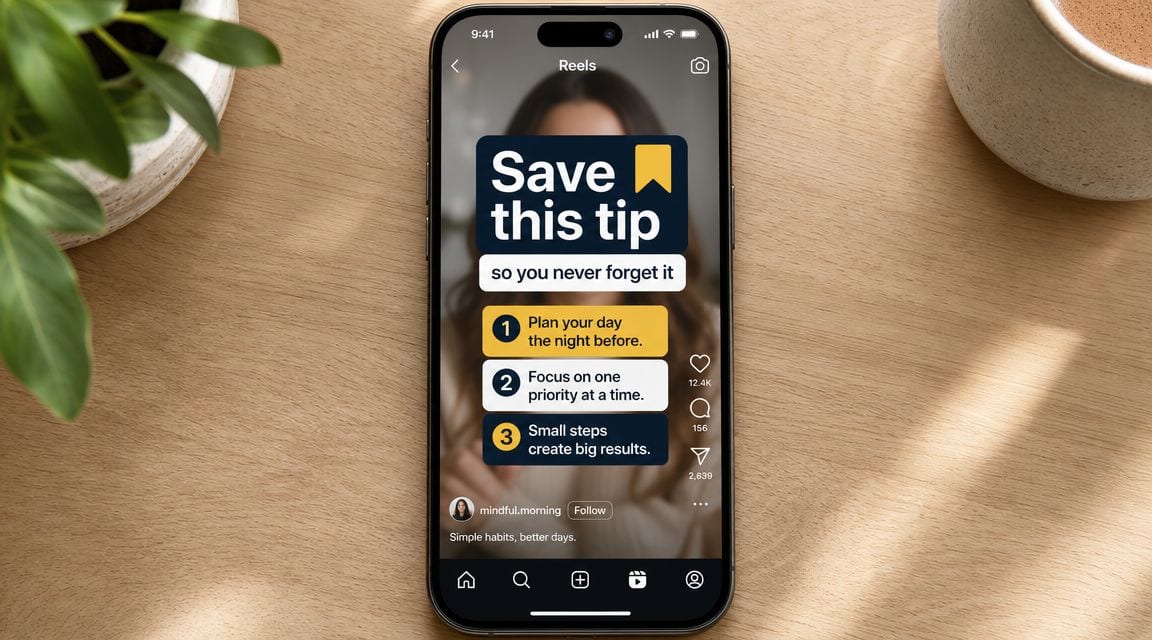
The strongest Reels use text as a viewing guide. The opening line reinforces the hook. A few overlays pull attention to the key takeaway. The closing line makes the next step obvious. That structure helps silent viewers stay with the video, and it also helps viewers with sound on follow the message faster.
Design text for speed, clarity, and screen space
Text fails when it tries to do everything at once. Dense subtitles, low contrast, and poor placement make a Reel harder to watch, not easier.
Use these rules instead:
- Lead with one short hook on screen: state the promise in a few words.
- Show only the key phrases: surface the part worth remembering.
- Keep text clear of the interface: avoid the bottom edge and other crowded areas.
- Use contrast that holds up on mobile: add a text box or outline if the background is busy.
- Match style to hierarchy: headline text should look different from supporting text.
For creators who want tighter control over hierarchy and readability, this guide on adding multiple styled text elements to Instagram Reels is useful. Different text treatments help viewers separate the hook, proof point, and CTA without cluttering the frame.
Execution speed matters here. If captioning and overlay work take too long, publishing cadence usually slips and testing slows down. quso.ai's AI Subtitle Generator helps teams produce a solid first pass quickly, then refine the lines that deserve emphasis instead of formatting every frame from scratch.
That workflow scales better than manual editing alone. Pull a clip, generate captions, tighten the wording, apply consistent text styling, and publish variations. One system handles accessibility, brand consistency, and production speed at the same time.
A real estate Reel should put the standout property features on screen the moment they appear. A coach should name the mistake or framework in text before explaining it. A product demo should label the result, not assume the viewer will infer it.
Text is part of the content. Treat it like strategy, not decoration.
4. Leverage Trending Audio and Music to Maximize Algorithmic Distribution
Trending audio can help distribution, but it's also one of the easiest places to waste effort. Too many creators treat trends as the strategy. They're not. They're packaging.
When the sound is recognizable and current, it can make the Reel feel more native to the platform. That matters. But if the visual idea is weak, the trend won't rescue it. People may notice the audio first, yet they stay for the angle, the edit, and the relevance.
Use trends as packaging, not substance
The right way to use trending audio is to attach it to content that already has a reason to exist. A consultant can pair a trending sound with a sharp on-screen teardown of a common business mistake. A product brand can use a popular clip while showing a satisfying use case. A creator in education can layer the trend under concise visual teaching.
What tends to fail is lazy imitation. Lip-syncing a trend that has no relationship to your niche might get a few passive views, but it rarely builds the right audience. It also makes your account feel inconsistent.
Use a simple filter when evaluating a sound:
- Is it rising now: worth testing while it still feels fresh.
- Does it fit your message: not just your mood.
- Can you add a distinct angle: your niche, your insight, your format.
A fitness creator using a trending audio bed for a form correction video is making the trend serve the lesson. A small business owner using a comedic sound to highlight a customer pain point can do the same. The audio opens the door. The content has to justify the watch.
quso.ai's scheduling and planning workflow can help here because trend adoption is partly an operations problem: if you spot a sound and still need to open three tools to edit, caption, resize, and publish, you'll often miss the moment. A faster system makes trend testing realistic without turning your calendar chaotic.
The rule is simple. Borrow the trend's momentum, but keep your own message unmistakable.
5. Create Content Pillars and Repurpose Long-Form Videos into Multiple Reels
Many teams don't have a creativity problem. They have a production problem. They keep trying to invent a brand-new Reel from scratch every time they post.
That's inefficient, and it usually leads to inconsistent quality. A better approach is to define a few clear content pillars, then mine long-form content for repeatable short-form assets. Podcasts, webinars, interviews, live sessions, tutorials, and client calls often contain more short-form material than people realize.
Build a repeatable extraction system
Start with three to five themes you want your audience to associate with you. For a consultant, that might be client mistakes, frameworks, objections, and quick wins. For a podcaster, it could be strong opinions, guest quotes, tactical clips, and behind-the-scenes process.
Then turn one source file into multiple outputs. That's where a tool like quso.ai's long video to short video workflow becomes practical, not just convenient. It helps teams pull shorter segments from longer recordings without rebuilding every post manually.
Repurposing only works when each clip can stand on its own. A chopped fragment isn't a Reel. A complete micro-idea is.
The trade-off is important. Repurposed content saves time, but lazy clipping feels recycled. You still need to add a hook, tighten the pacing, layer captions, and write a platform-specific CTA.
A podcast host can turn one interview into multiple Reels if each clip answers a clear question, and a coach can reuse a webinar, but one Reel should focus on a mistake, another on a method, and another on a result. That's better than posting five similar cuts that compete with each other.
If you want a broader repurposing mindset, this piece on how to maximize your podcast potential is directionally useful. The point isn't to flood the feed. The point is to create a sustainable system where every long recording feeds your short-form engine.
That's one of the most durable Instagram Reels best practices because it turns content creation from a scramble into a pipeline.
6. Include Clear Calls-to-Action and Strategic Links in BioComments
A Reel that gets attention but doesn't direct it wastes opportunity. Views matter, but only if they lead somewhere useful. That could be a follow, a save, a comment, a booking inquiry, a product page visit, or a DM.
Most weak CTAs fail for one reason. They ask vaguely. “Check the link in bio” doesn't tell people why they should care right now. “Download the checklist in my bio” is clearer. “Comment GUIDE and I'll send it” is clearer still.
Ask for one next step
The cleanest CTA strategy is to match the ask to the Reel's purpose. Educational content often earns saves and follows. Offer-driven content can drive DMs or profile visits. Product Reels can push to a bio link if the transition feels natural.
Use one primary action, then support it with text on screen and in the caption. If you ask viewers to follow, comment, save, and click in one short Reel, the message gets diluted.
A few examples that work better:
- Coach: “Comment PLAN if you want the framework.”
- E-commerce brand: “Tap the link in bio to see this product in use.”
- Consultant: “Send me ‘audit' if you want feedback on your profile.”
- Educator: “Save this so you can use it when you post next.”
A CTA should finish the thought of the Reel, not interrupt it.
Pinned comments can help extend the action path, especially when people ask where to find the resource or offer. Bio links matter because Instagram still limits direct link behavior inside the Reel itself, so the handoff needs to be friction-light. Make sure the destination matches the promise. If the Reel offers a template, don't send people to a generic homepage.
quso.ai's analytics workflow can support this by helping teams compare which Reels drive stronger downstream actions, not just surface engagement. That's the shift from posting content to using content strategically.
7. Optimize Video Format and Dimensions for Full-Screen Vertical Viewing
Bad framing kills good content. A strong idea posted in the wrong format still feels second-rate on Reels.
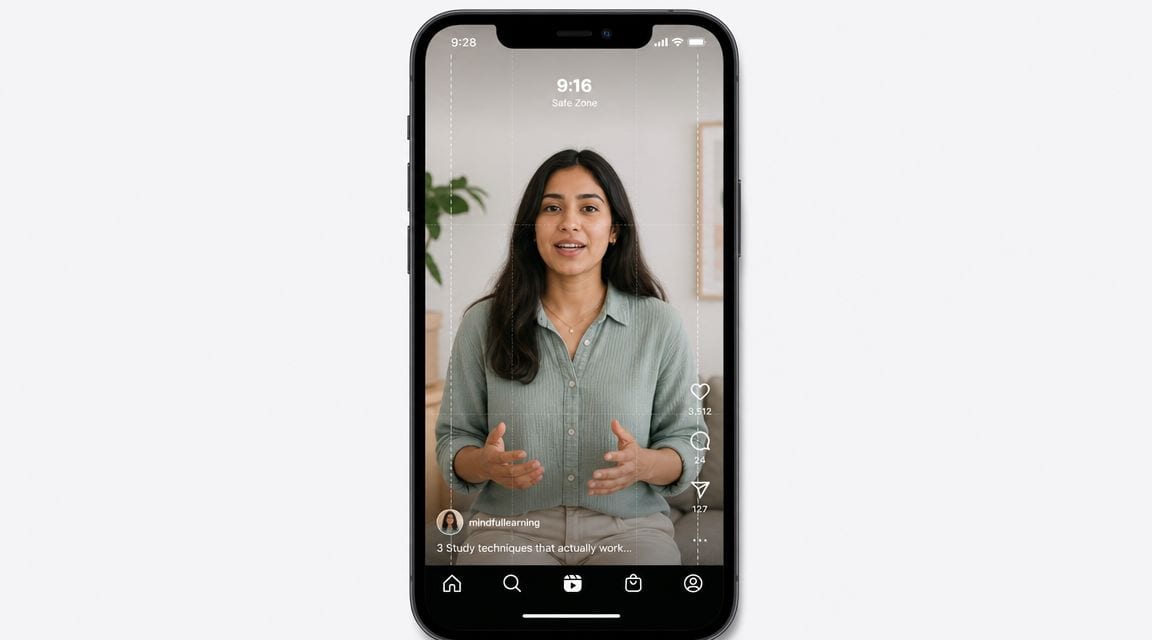
The platform is built for vertical, full-screen viewing. Technical guidance commonly recommends 9:16 at 1080 × 1920 pixels, with 30 FPS often cited for clean playback. That's the baseline creators should treat as normal, not optional.
Native-looking video wins
Black borders, awkward crops, and widescreen remnants immediately signal that the content wasn't made for the feed, and even when the message is solid, that friction shows up in the first seconds of viewing.
Recent guidance also highlights that Reels should be vertical, at least 30 fps, and at least 720p, while practical advice continues to stress safe zones and native vertical filming (Adobe Express on Reels requirements and workflow gaps). The most useful takeaway isn't just the spec. It's the viewing experience. The Reel should feel like it belongs where it appears.
Use these production rules:
- Shoot vertical first: don't plan to “fix it later” unless you have to.
- Keep subjects centered: especially for talking-head clips and demos.
- Respect safe zones: don't bury important text near the edges or under interface elements.
- Fill the frame: avoid letterboxing and dead space.
A real estate walkthrough, recipe video, or face-to-camera lesson all benefit from this. quso.ai's editing and resizing workflow is helpful when repurposing horizontal source footage because it can reframe content into a Reels-friendly layout faster than manual cropping across separate apps.
When people talk about Instagram Reels best practices, this is one of the least glamorous points and one of the most important. Native format removes friction. Friction lowers retention.
8. Post Consistently and Engage Authentically with Your Community
Consistency matters, but not as it's often perceived. Posting often doesn't automatically produce growth. Posting often with a coherent system does.
A useful benchmark comes from Rival IQ, which reports that the top 25% of brands by engagement post about 3.5 times per week, and for many teams that translates into an every-other-day rhythm that's sustainable enough to maintain quality while staying visible.
Consistency needs a system
The core problem isn't deciding to post consistently. It's making that promise operational. If every Reel depends on a same-day idea, edit, caption, approval, and upload, the schedule won't hold.
That's why batch production works. Record several clips in one session. Edit them in a group. Load captions and CTAs while you're already in the workflow. Schedule your Reels ahead of time, then leave space to publish timely trend-based content when it makes sense.
Here's what good consistency looks like:
- Predictable themes: your audience recognizes what you talk about.
- Manageable cadence: frequent enough to stay present, not so heavy that quality slips.
- Active comment response: especially after posting, when conversations are easiest to build.
Authentic engagement matters because comment sections influence how the account feels, not just how the post performs. A coach who answers follow-up questions thoughtfully builds trust. A brand that responds like a real person, not a script, gives people a reason to come back.
quso.ai fits well here because scheduling is only useful when it connects to planning and performance review, and if your team can plan, create, schedule, and check results in one place, consistency becomes realistic. If those tasks live in scattered tools, the schedule usually breaks under normal workload.
The point isn't to be everywhere all the time. It's to show up regularly enough that your audience starts expecting you.
9. Use Data and Analytics to Optimize Content and Iterate for Growth
Good Reels strategy gets sharper when you stop judging content by instinct alone. Some clips feel strong in the edit and underperform. Others look simple and end up pulling the right audience. That's why review matters.
Your job after publishing is to look for patterns. Which hooks hold attention better. Which topics generate saves. Which CTAs lead to profile visits, DMs, or comments that signal purchase intent. That's where growth gets repeatable.
Review patterns, not vanity spikes
Guidance around Reels keeps emphasizing watch time, completion rate, and engagement signals as core indicators of performance, and that's the right lens to use for optimization. One spike can mislead you. A repeated pattern is what deserves action.
Check your highest-performing Reels and compare them across a few variables:
- Opening style: question, claim, visual proof, or direct statement.
- Content type: tutorial, opinion, myth-busting, demo, or story.
- Edit density: slower explanation or faster cuts.
- CTA format: follow, save, comment, DM, or profile visit.
If you need a more structured way to think about this, a practical engagement rate calculator template can help organize the review process. The goal isn't to chase one metric in isolation. It's to understand how different creative choices influence the kind of response you want.
The best-performing Reel isn't always the one with the most views. It's often the one that attracts the right action.
A consultant might find that direct problem statements bring better comments than polished motivational clips. A product brand might learn that use-case demos outperform lifestyle montage edits. A podcaster may discover that short contrarian clips pull better saves than guest introductions.
quso.ai's integrated analytics can make this easier when you're publishing across platforms, because the workflow stays connected. But the principle matters more than the tool. Review, decide, adjust, repeat. That's how Instagram Reels best practices turn into actual performance gains over time.
10. Collaborate with Other Creators and Brands for Expanded Reach
Collaboration is one of the fastest ways to make your Reels relevant to people who haven't seen you before. It works because the content carries built-in context. Someone else's audience already trusts the other voice in the frame.
The mistake is treating collaboration like a pure reach grab. If the fit is weak, the audience can feel it immediately. Shared visibility only helps when the topic, tone, and value overlap.
Choose collaborators with audience overlap
The best partnerships are complementary. A nutrition coach and fitness creator make sense together. A copywriter and business coach can build a useful Reel around conversion mistakes. A real estate agent and interior designer can create visually strong, practical content with natural crossover appeal.
There are several collaboration formats that work well on Reels:
- Interview clips: strong for educators, consultants, and podcasters.
- Dual-perspective takes: one topic, two experts, quick contrast.
- Product plus creator demo: useful for service and e-commerce brands.
- Response content: reacting to a shared question or industry myth.
What usually underperforms is a vague “let's collab” mindset. Specific beats generic. Pitch the idea, the audience fit, and the outcome. “Let's do a Reel on the three home-office upgrades remote founders notice in listings” is far better than “Want to make content together?”
A good collaboration also reduces creative fatigue. You don't have to carry every angle yourself. The other creator brings a voice, a perspective, and usually a faster path to stronger discussion in the comments.
quso.ai can help operationally by making it easier to slot collaborative posts into the broader content calendar and track what kind of partner content performs. That matters because not every collaboration deserves repeating. Keep the formats that bring aligned followers and useful engagement. Drop the ones that create noise without fit.
Instagram Reels: 10 Best Practices Comparison
| Strategy | Implementation complexity | Resource requirements | Expected outcomes | Ideal use cases | Key advantages |
|---|---|---|---|---|---|
| Hook Viewers in the First 3 Seconds | Medium–High, scripting & tight editing | Moderate: camera, editor, A/B tests | Higher watch time and completion rates | Attention-grabbing intros, product demos, repurposed clips | Stops the scroll quickly; boosts distribution |
| Keep Videos Between 21–34 Seconds | Medium, precise editing and pacing | Low–Moderate: editing time, trimming tools | Improved completion rates and rewatchability | Micro-stories, tutorials, short demos | Optimal length for retention and algorithmic favor |
| Use Captions and Text Overlays | Low–Medium, captioning & placement | Low: subtitle tools, design assets | Increased accessibility, comprehension, and discoverability | Sound-off viewers, multilingual audiences, educators | Boosts SEO/accessibility and visual emphasis |
| Leverage Trending Audio and Music | Medium, trend tracking & creative fit | Low–Moderate: audio library, monitoring tools | Short-term algorithmic boost and wider discoverability | Viral attempts, timely campaigns, entertainment | Rapid reach expansion via trend signals |
| Create Content Pillars & Repurpose Long-Form | Medium, strategic planning & templates | Low long-term; needs long-form source & clipping tools | Higher output with lower marginal effort; consistent pipeline | Podcasters, YouTubers, marketing teams | Scales content production; maximizes ROI on long-form |
| Include Clear CTAs and Strategic Links | Low–Medium, CTA crafting & testing | Low: link tools, tracking, comment pinning | Increased clicks, leads, and measurable conversions | Coaches, e‑commerce, lead generation, course sellers | Converts viewers into actions and trackable outcomes |
| Optimize Video Format and Dimensions | Low, shoot/reframe to 9:16 | Low–Moderate: editing software, reframing tools | Better retention, perceived quality, and platform fit | All Reel creators, agencies repurposing horizontal videos | Full-screen immersion; fewer compression/UI issues |
| Post Consistently and Engage Authentically | High, sustained cadence & community work | Moderate–High: time, scheduling, moderation tools/team | Stronger reach, audience loyalty, and compounding growth | Brands, creators scaling audience, community-focused accounts | Trains audience habits; boosts early-engagement velocity |
| Use Data and Analytics to Optimize Content | Medium, tracking, analysis, A/B testing | Moderate: analytics tools, time to analyze | Informed decisions, iterative performance improvements | Serious creators, agencies, marketers measuring ROI | Eliminates guesswork; enables repeatable improvements |
| Collaborate with Other Creators and Brands | Medium, partner selection & coordination | Low–Moderate: outreach, co‑production, scheduling | Expanded reach, fresh audiences, shared content load | Growing creators, complementary niches, brands | Immediate audience access; shared credibility and effort |
Turn Best Practices into Your Daily Workflow
Most advice about Instagram Reels best practices breaks down at the execution stage. The tactics sound fine on paper, but the process behind them is messy. One tool for clipping. Another for captions. Another for scheduling. Another for analytics. That setup makes consistency harder than it needs to be.
The creators and teams who stay visible usually do one thing well. They reduce friction between idea, edit, publish, and review. That's the ultimate advantage. Not hustle for its own sake. Not chasing every trend. A system.
A workable Reels workflow looks like this. Start with one long-form source or one batch recording session. Pull several clip candidates. Choose the ones with the clearest hooks. Edit for vertical viewing. Add captions and a few deliberate text overlays. Pair each Reel with a specific CTA. Schedule them across the week. Then review the results and feed those lessons into the next batch.
That's also why “create once, publish everywhere” is useful when it's done carefully. One webinar, podcast, interview, or training video can support multiple Reels if each clip is reframed as a complete short-form idea. You're not recycling for the sake of volume. You're extracting value from work you already did.
The operational side matters more as the calendar fills up. Coaches, educators, podcasters, marketers, and small teams rarely struggle because they lack ideas. They struggle because they can't maintain quality at speed. That's where a connected platform can help. quso.ai is one relevant option because it brings clipping, captioning, editing, scheduling, and analytics into a single workflow, and for teams publishing frequently that kind of setup makes these best practices easier to execute consistently.
If you take one thing from this guide, let it be this. Reels growth doesn't come from a single trick. It comes from stacking small, correct decisions in the same repeatable order. Better hooks. Cleaner edits. Native formatting. Clear CTAs. Consistent posting. Regular analysis. That's the playbook.
Use these best practices as a workflow, not a checklist. That's when Reels start compounding. And if you're also building a broader short-form system, tools in the wider ecosystem such as the ShortGenius AI video ad maker show how much faster production can move when creation and execution are tightly connected.
If you want a faster way to apply this playbook, try quso.ai to turn long videos into Reels, add captions, schedule posts, and manage your short-form workflow from one dashboard.