Master the Instagram Reels Algorithm 2026

The Instagram Reels algorithm is a prediction system. It decides which videos to show more people by estimating which Reels users are most likely to watch, rewatch, share, save, and engage with, while also filtering for technical quality and overall viewing experience. Mastering it matters because small creative choices at the hook, edit, caption, and frame level change whether a Reel gets tested wider or dies early.
Most creators still misread the system. They treat it like a posting-frequency game, a hashtag game, or a trend-chasing game. In practice, the algorithm is much more boring and much more useful than that. It rewards content that keeps attention and gives viewers a reason to act.
That’s why reverse-engineering it works better than chasing rumors. And the advice here isn’t guesswork. It’s grounded in analysis of 170K+ posts across 1,100+ creators, which gives a clear view of what performs best on the platform right now, as noted on quso.ai.
Table of Contents
- What Is the Instagram Reels Algorithm in 2026?
- How Instagram Ranks Reels The Key Signals
- Actionable Tactics to Feed the Algorithm
- Your High-Performance Reels Workflow
- Instagram Reels Algorithm Myths Debunked
- Frequently Asked Questions About the Reels Algorithm
What Is the Instagram Reels Algorithm in 2026?
The Instagram Reels algorithm is a recommendation system that predicts which short videos each user is most likely to keep watching and interact with. It isn’t one simple rule. It’s a stack of signals that help Instagram decide what deserves another round of distribution.
The important part is this. You don’t need the exact formula to work with it. You need to understand what the platform is trying to optimize: attention, satisfaction, and continued session time.
A good Reel tells Instagram three things quickly:
- People stop scrolling for it
- People stay with it long enough to get value
- People do something after watching, such as sharing, saving, or commenting
Working rule: Don’t try to outsmart the system. Make content that earns a stronger first test.
This matters more for Reels than for feed posts because Reels are built for discovery. The platform can show your video to people who don’t know you yet, but only if the content gives the system confidence.
If you want the broader context around how recommendations work across surfaces, this breakdown of the Instagram algorithm is useful. For Reels specifically, the practical move is to stop treating the algorithm like magic and start treating it like a feedback loop.
How Instagram Ranks Reels The Key Signals
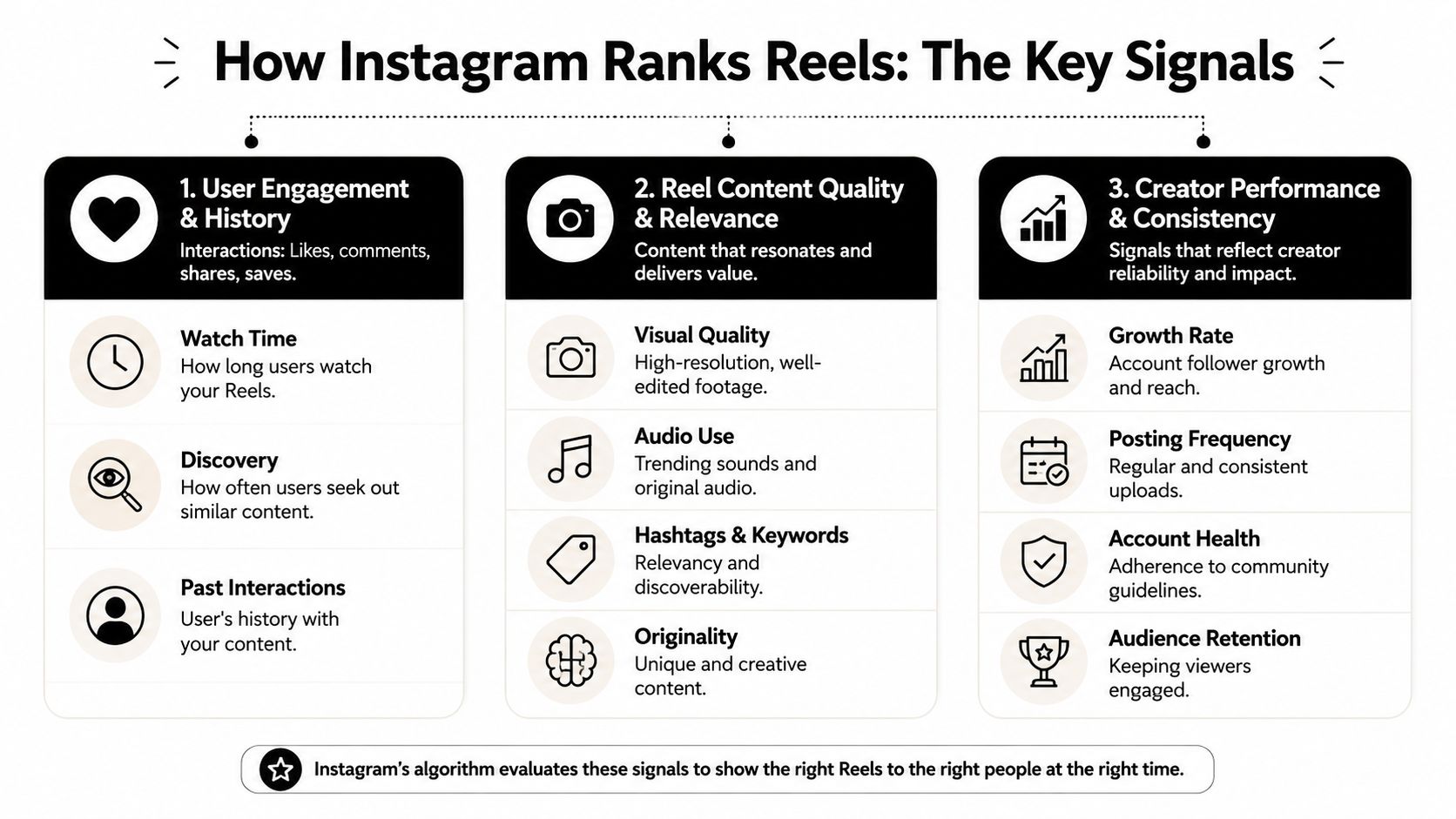
Instagram doesn’t rank Reels on one metric. It combines viewer behavior, content understanding, and account-level trust signals. That sounds abstract until you organize it into the three buckets that actually matter.
User engagement and viewing history
The first bucket is behavior. Instagram watches what users already do and uses that to predict what they’ll do next.
If someone regularly watches a certain topic, shares similar clips, or has interacted with your account before, your next Reel has a better shot with that person. This is why niche consistency works. It gives the system cleaner signals about who should see your content.
What to pay attention to:
- Watch behavior: Whether viewers stick around or bounce quickly
- Interaction depth: Shares, saves, comments, and profile taps
- Relationship history: Prior engagement with your account or similar creators
This is also why broad, unfocused content usually underperforms. The algorithm struggles when the topic signal is muddy.
Content quality and topical relevance
The second bucket is the Reel itself. Instagram can infer a lot from your visuals, spoken words, text overlays, caption, and audio choice.
That doesn’t mean you need flashy production. It means your content has to be understandable, clean, and relevant. Low-resolution uploads, cluttered frames, and recycled-looking edits give the system less confidence.
A few practical implications:
| Signal area | What helps | What hurts |
|---|---|---|
| Visual clarity | Clear framing, readable text, clean crop | Blurry footage, awkward borders, clutter |
| Context | Strong keywords in spoken or on-screen text | Vague openings, no topic clarity |
| Audio | Clean voiceover, relevant sound choice | Distracting sound or silent dead air |
For discovery, keywords matter beyond hashtags. If you still rely on generic tags to carry reach, you’re leaving too much to chance. This guide to Instagram hashtags is useful, but for Reels, hashtags should support relevance, not replace it.
Creator trust and publishing consistency
The third bucket is the account. Instagram wants to recommend content from creators who post reliably, stay within platform guidelines, and produce work people tend to finish.
That doesn’t mean big accounts always win. It means trusted accounts get cleaner distribution opportunities.
A healthy account with a clear topic and repeatable format usually beats a chaotic account posting random ideas, even if the second account has better intentions.
The trade-off is simple. Consistency matters, but consistency without quality just teaches the algorithm that your audience scrolls away. Reliable publishing works only when the format is also working.
Actionable Tactics to Feed the Algorithm
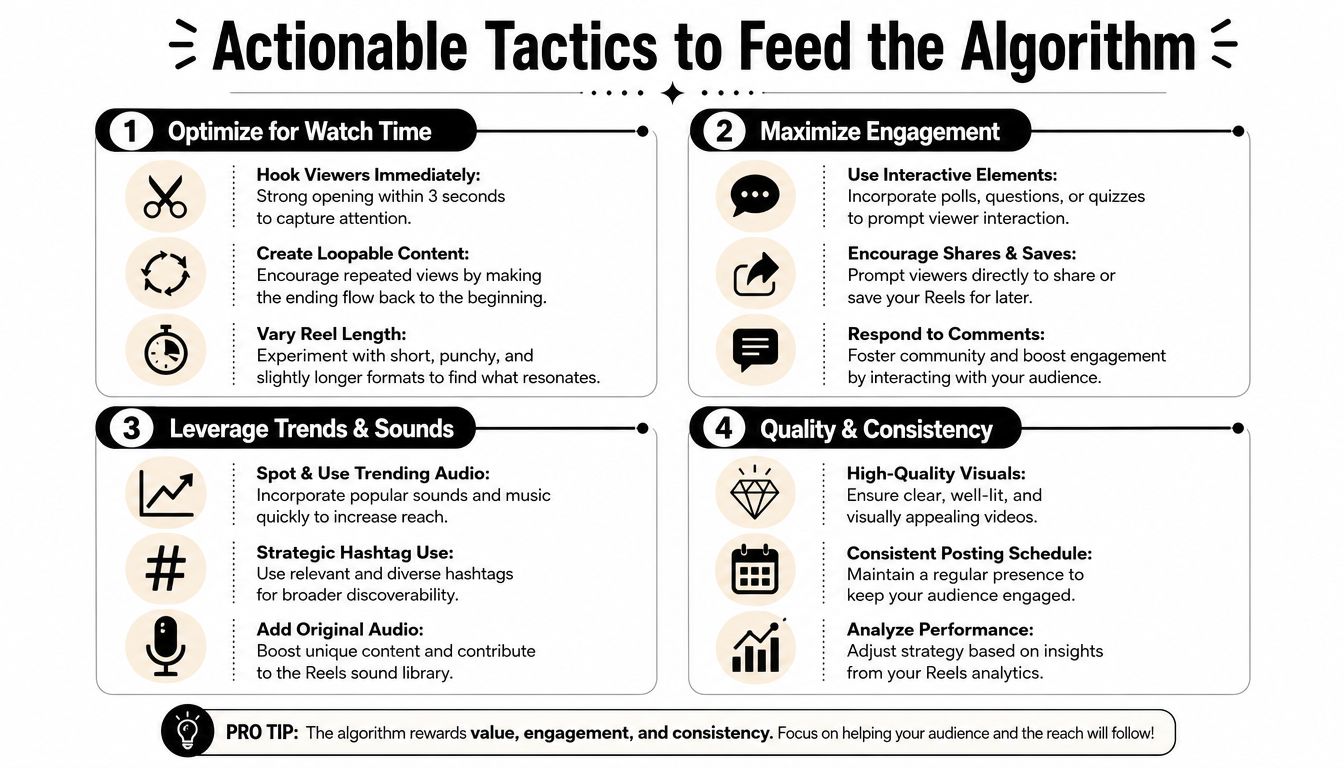
Understanding the system is useful. Building for it is what changes results.
Hook viewers in the first moments
Your opening has one job. Stop the scroll.
That usually means one of three things works best:
- A sharp claim: State the payoff immediately
- A visible outcome: Show the result before the explanation
- A tension point: Start in the middle of the problem
Bad hooks waste time. Long greetings, logo stings, and context-heavy intros ask viewers to be patient before they’ve decided you’re worth it.
Practical rule: If the first line can be cut without hurting the video, it should be cut.
For B2B and educational creators, the strongest hooks are often painfully direct. “Your Reel isn’t failing because of hashtags.” That kind of line gives the audience a reason to keep watching.
Use audio captions and on-screen text correctly
Audio helps with momentum. Captions help with comprehension. On-screen text helps the algorithm and the viewer understand the topic fast.
But there’s a trade-off. Too much text can overwhelm the frame. Too little text can make a silent viewer leave before they understand the point.
Use captions for spoken words, then add a short headline layer that frames the idea. Keep the headline concise and place it where the interface won’t cover it.
The practical mistake many teams miss is safe zones. Instagram overlays interface elements on top of the video, especially near the bottom and along the edges. If your captions, CTA text, or product demo details sit too low, viewers won’t see the important part. Keep your key text and visuals away from the outer edges and lower UI-heavy portion of the screen. Center-weighted layouts usually survive better across feed, Reel view, and reposts.
If you want extra examples of current formatting patterns, Seedance published a useful Instagram Reels guide with creative references worth studying.
Build for shares and saves not passive likes
Likes are easy. Shares and saves require usefulness or emotional relevance.
That changes how you script. Instead of ending with “follow for more,” end with a reason to keep or pass along the content.
Try prompts like:
- Save this: For checklists, frameworks, scripts, and tutorials
- Send this: For relatable mistakes, team lessons, or niche hot takes
- Comment with context: When the audience may need a follow-up answer
The mistake is forcing engagement bait. Viewers can feel it. A stronger move is to make the Reel naturally worth revisiting.
Get the technical details right
Technical quality isn’t glamorous, but it absolutely affects distribution.
Check these before posting:
- Frame correctly: Vertical format, no awkward borders
- Keep visuals clean: Good lighting, readable text, stable crop
- Avoid recycled-looking exports: Especially visible watermarks from other apps
- Match pacing to idea density: Fast enough to hold attention, slow enough to understand
One more operator note. Don’t obsess over making every Reel polished. Clean beats polished. Clear beats cinematic. Native-feeling content usually performs better than over-edited content that looks detached from the platform.
Your High-Performance Reels Workflow
A common pitfall with Reels is treating each post like a separate creative event. That burns time and leads to inconsistent quality. A better system is a pipeline.
To visualize the process, use this workflow as your model.
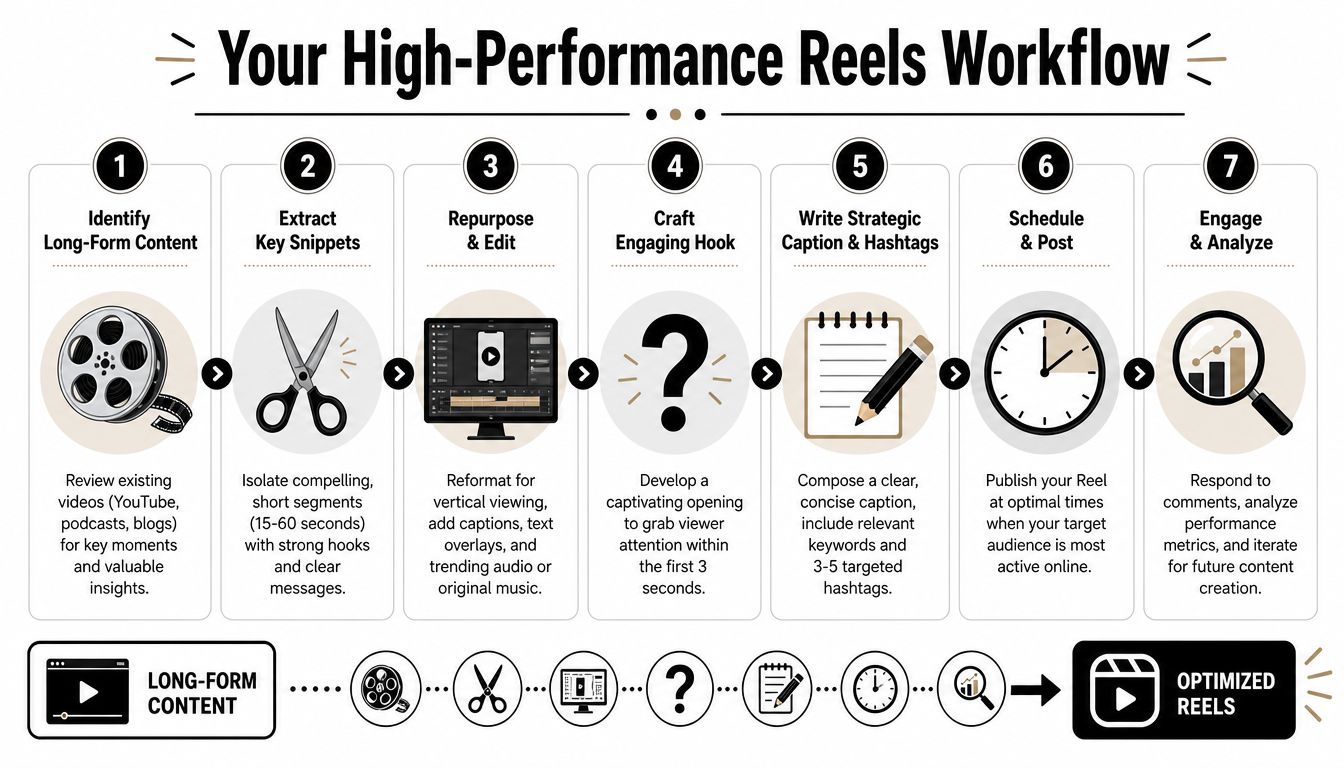
Start with long-form assets
The easiest way to feed the Reels machine is to start with content that already contains ideas. Podcasts, webinars, demos, interviews, customer calls, livestreams, and training sessions all work.
Look for moments with:
- A strong opinion
- A clear tactical lesson
- A surprising mistake
- A concise story with a payoff
Many B2B teams find an advantage here. One useful long-form recording can produce multiple Reels without inventing new topics every day.
A clean review process matters too. Track which clips lead to comments, profile visits, and follow-up conversations, then compare themes over time using your social media analytics workflow.
Here’s a useful walkthrough to pair with the process:
Turn one source into multiple Reel candidates
Once you have the source material, break production into repeatable steps.
-
Pull clips with one idea each
Don’t cram three lessons into one Reel. One clear takeaway travels better. -
Rewrite the opening for short-form
Great webinar intros usually make bad Reel intros. Replace setup with payoff. -
Reframe for vertical viewing
Crop around the speaker, demo, or object that matters. Remove dead space. -
Add captions and a headline
Make the point readable without sound. Keep key text in safe zones. -
Write a caption that extends the idea
The Reel should stand alone. The caption should deepen it, not explain what the video already said.
Build batches, not singles. One recording session should feed your editing queue for the week.
Schedule review and iterate
Scheduling isn’t just a convenience feature. It protects consistency and gives you room to review before publishing.
When you batch Reels, you can spot weak hooks, repeated angles, and formatting mistakes before they go live. That’s a better use of time than posting reactively every day.
The teams that improve fastest usually follow this loop:
- Publish consistently
- Review retention and engagement patterns
- Identify winning hooks and topics
- Recut future clips around those patterns
If you want to tighten the production side, repurposing video content is the habit that makes the whole system sustainable.
Instagram Reels Algorithm Myths Debunked
A lot of bad advice survives because it sounds actionable. Most of it leads creators to do more work for worse outputs.

Here are the myths worth dropping.
You must post multiple times a day
No, you need enough repetitions to learn what works. Flooding your account with weak Reels doesn’t help if the hooks are soft and the topics are inconsistent.
Deleting a bad Reel permanently hurts your account
A weak Reel is usually just a weak Reel. The bigger issue is what you learn from it. If the framing, pacing, or topic missed, fix the next one instead of turning deletion into a superstition.
Only trending dances or entertainment formats can go viral
Educational, opinion-led, and niche business content can perform extremely well when it’s packaged for short attention spans. The algorithm doesn’t require dancing. It requires viewer response.
Hashtags don’t matter at all
They’re not the main event, but they still help with context and discovery. The mistake is expecting hashtags to rescue a Reel that viewers don’t want to finish.
Stop looking for one trick. Most Reels underperform because the idea, hook, and packaging don’t line up.
Frequently Asked Questions About the Reels Algorithm
How long should my Reels be in 2026?
Use the shortest length that fully delivers the idea. For discovery, shorter usually gives you a better chance at strong completion and replay behavior. If the concept needs more time, earn that time with pacing and structure.
Does Instagram punish watermarks from other apps?
Visible recycled branding is a bad bet. Even when the content itself is good, it can look reused and lower the chance of recommendation. Export clean versions whenever possible.
How quickly does a Reel get picked up by the algorithm?
Some Reels get traction fast. Others build more slowly. What matters is whether the early audience gives the platform good enough signals to keep distributing it.
What’s the best time to post a Reel?
The best posting time is the time your audience is most likely to respond quickly. Start with your account’s active audience patterns, then test consistently instead of following generic internet lists.
How many hashtags should I use? Use only the hashtags that describe the topic, audience, or format. A short set of relevant tags usually works better than stuffing the caption with generic terms. If you want to manage timing and consistency, a dedicated social media scheduling tool helps keep testing organized.
If you’re turning webinars, podcasts, interviews, or demos into a steady Reel pipeline, quso.ai is worth a look. It’s built for repurposing long-form video into short clips, adding captions, and scheduling posts without turning your weekly content process into a manual editing sprint.