How to Grow Social Media Presence: 2026 Playbook
Most advice about how to grow social media presence is stuck on one idea: post more. That advice sounds productive, but in practice it breaks teams, drains creators, and lowers quality fast. More posts don't fix weak positioning, poor format choices, or a workflow that depends on you showing up every day with a blank page.
The sustainable version looks different. You build one strong piece of core content, turn it into multiple native assets, schedule distribution, stay present in the comments, and review performance on a fixed cadence. That is how creators keep momentum without making social media their entire job.
Table of Contents
Beyond Burnout The New Rules of Social Media Growth
Posting more is not a growth strategy. It is often a production habit that hides a weak system.
The old playbook rewarded volume because feeds were less crowded and audience expectations were lower. That environment is gone. Platforms now sort for relevance, watch time, saves, shares, comments, and format fit. Activity still matters, but raw output without structure usually creates fatigue before it creates traction.
The durable model is create once, publish everywhere. In practice, that means building around a strong source asset, then turning it into multiple pieces designed for different viewing behaviors across platforms. A webinar can become short clips for Reels and TikTok, a carousel for Instagram and LinkedIn, a thread for X, a summary post for Facebook, and a polished article for your site. The idea stays consistent. The presentation changes.
That shift matters because social growth is no longer about winning one feed. It is about showing up repeatedly with the same core message in the formats people already consume on each platform. Teams that ignore that reality usually end up in daily content triage, chasing trends, rewriting the same point five times, and still missing posting windows.
Practical rule: If growth depends on creating from scratch every day, the system is too fragile to scale.
The accounts that keep compounding are rarely the busiest. They tend to have a tighter workflow, sharper editorial judgment, and a repurposing process they can repeat every week without draining the team. That is a primary advantage of using AI well. quso.ai helps turn one recorded asset into usable platform-specific outputs, which makes a multi-channel strategy realistic for small teams and busy creators instead of aspirational.
For a broader view of how that operating model is evolving, see these social media marketing trends for 2025.
Define Your Destination and Your Audience
More posting does not fix a fuzzy strategy. It usually hides it.

Teams say they want growth, then measure everything and prioritize nothing. That creates a familiar cycle. Content gets approved based on instinct, platforms get treated the same, and results stay hard to explain. A working growth system starts by deciding what social media needs to do for the business, then defining who each piece of content is for.
Set goals that change decisions
A useful goal forces trade-offs. Discovery content needs reach, speed, and clear hooks. Lead generation needs stronger calls to action, tighter problem framing, and a path to subscribe, book, or inquire. Community building needs prompts, follow-up, and content designed to start conversations instead of collecting empty views.
Use this filter before anything goes on the calendar:
Business outcome: Build awareness, generate qualified inquiries, drive signups, or strengthen trust with current buyers.
Audience action: Comment, save, share, subscribe, click, reply, or book.
Channel role: Assign each platform a job. One may bring in new people. Another may build authority. Another may convert attention into pipeline.
This sounds simple. It is also where weak strategies break. A founder may want brand awareness on LinkedIn, inbound leads from Instagram, and customer retention through email. Fine. But each goal changes the type of content you need, the publishing cadence you can sustain, and the way you measure success. If every platform is expected to do everything, the team ends up producing a lot of content with no clear signal about what is working.
As noted earlier, your audience is usually split across several platforms. That is exactly why the destination has to stay stable even as formats change.
Build an audience profile you can actually use
Demographic personas rarely help with day-to-day content decisions. Behavioral insight does. Good social strategy starts with the tension your audience already feels before they open the app. What are they trying to solve, avoid, compare, or justify? What kind of claim makes them stop scrolling because it matches the problem in their head?
A practical audience profile should answer these questions:
| Question | Impact on Content |
|---|---|
| What problem are they trying to solve right now? | Determines hooks, topics, and urgency |
| What do they already believe? | Shows which objections and assumptions to address |
| Where do they spend time online? | Helps assign platform roles and distribution priority |
| What format do they respond to? | Shapes whether the idea should be a clip, carousel, thread, or post |
| What would make them trust you? | Guides proof, examples, and positioning |
The trade-off here is real. The narrower the audience definition, the easier it becomes to write content that feels specific and persuasive. Narrow it too far, though, and you can box yourself into repetitive messaging. The fix is to anchor on one clear audience problem and rotate the angle. Teach it, show it, challenge it, answer objections around it, and document results tied to it.
For coaches and consultants, pain points usually outperform vague motivation. For educators, clarity and search intent often beat trend-chasing. For product brands, proof, use cases, and demonstrations tend to do more work than abstract brand language.
If your team is building a repeatable workflow, this is also the point where tooling matters. A clear audience profile makes repurposing sharper because each variation can target a different objection, platform behavior, or stage of trust. Tools such as content repurposing tools for multi-platform workflows help teams keep that message consistent without rewriting the same idea from scratch all week.
Write for the conversation already happening in your audience's mind. That is what makes content feel timely instead of generic.
Define the destination before you touch the calendar. Otherwise you will stay busy, publish often, and learn very little.
Build Your Content Repurposing Engine
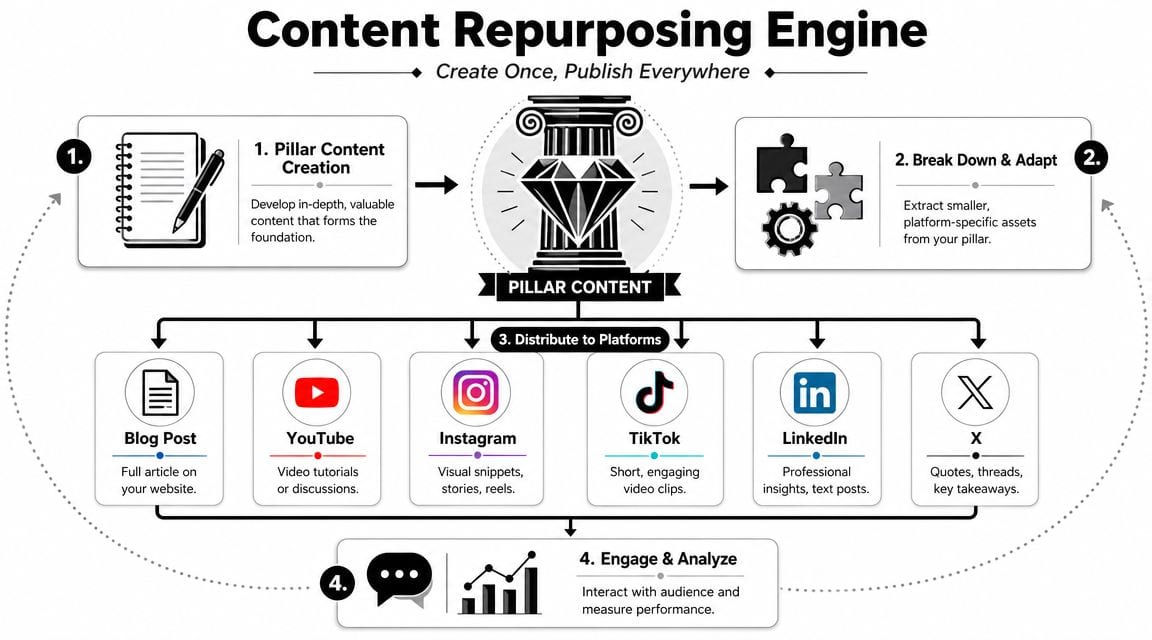
A social strategy becomes sustainable when content starts with a source asset, not a posting prompt. The strongest source asset is usually pillar content. A webinar, podcast, tutorial, interview, keynote, workshop, or long-form video with enough substance to break into smaller ideas.
Start with pillar content
Take a common scenario. A business coach records a webinar answering client questions about pricing, boundaries, and sales calls. That single recording contains stories, objections, frameworks, memorable lines, and audience language. In other words, it contains raw material.
From one source asset, you can extract:
Short video clips for TikTok, Instagram Reels, YouTube Shorts, and LinkedIn video.
Text posts or threads built from one key point, one objection, or one quote.
Carousel slides that teach a framework step by step.
A blog post that turns the session into searchable long-form content.
Email content that drives people back to the full video, offer, or site.
The mistake many teams make is treating repurposing like resizing. Resize isn't strategy. Repurposing means identifying the strongest moments, then rewriting them for the way people consume content on each platform.
A useful workflow needs clear stages.
Turn one asset into a publishing system
Here is the version that works in practice:
Record for depth first: Make the webinar, podcast, or tutorial useful enough that several ideas can stand alone later.
Review for segments: Pull out clean moments. Contrarian opinions, tight explanations, audience questions, and stories usually travel well.
Match output to platform behavior: A clip might work on short-form video platforms, while the same idea becomes a carousel or text post elsewhere.
Write supporting copy: Strong posts need framing. Add the hook, caption, title, CTA, and thumbnail logic around the extracted asset.
Queue distribution: Put everything into a calendar so content goes out without daily scrambling.
Here is a simple example from one webinar:
| Source moment | Repurposed asset | Best use |
|---|---|---|
| Story about a bad sales call | Short captioned clip | Reels, TikTok, Shorts |
| Three-step pricing framework | Carousel | Instagram, LinkedIn |
| Strong contrarian quote | Text post | X, LinkedIn |
| Audience Q&A segment | FAQ post | Facebook, Stories, LinkedIn |
| Full transcript | Blog or newsletter | Website, email |
That is the engine. One recording becomes a distribution system instead of a one-time event.
Later in the process, a short tutorial can help when you're comparing content repurposing tools for creators and teams.
A lot of teams also need to see the workflow visually before it clicks:
Use tools to remove production friction
This is the point where AI becomes practical, not gimmicky. The right tools cut repetitive production work. They don't replace strategy. They handle extraction, editing, subtitling, formatting, caption drafting, and scheduling so the team can focus on message and decisions.
For busy creators, an integrated system matters more than a stack of disconnected apps. quso.ai is one example. It combines clip generation, subtitles, blog and show-note creation, content planning, scheduling, and analytics in one dashboard. For a creator publishing from long-form video, that setup makes the create-once-publish-everywhere workflow executable instead of aspirational.
Repurposing works when the source content is strong and the editing decisions are native to the platform. It fails when teams automate weak ideas.
Master Platform-Specific Content Tactics
Repurposing isn't permission to post the exact same asset everywhere. Each platform rewards a different kind of attention. Some favor speed, some reward clarity, some surface search-driven content, and some amplify conversation.
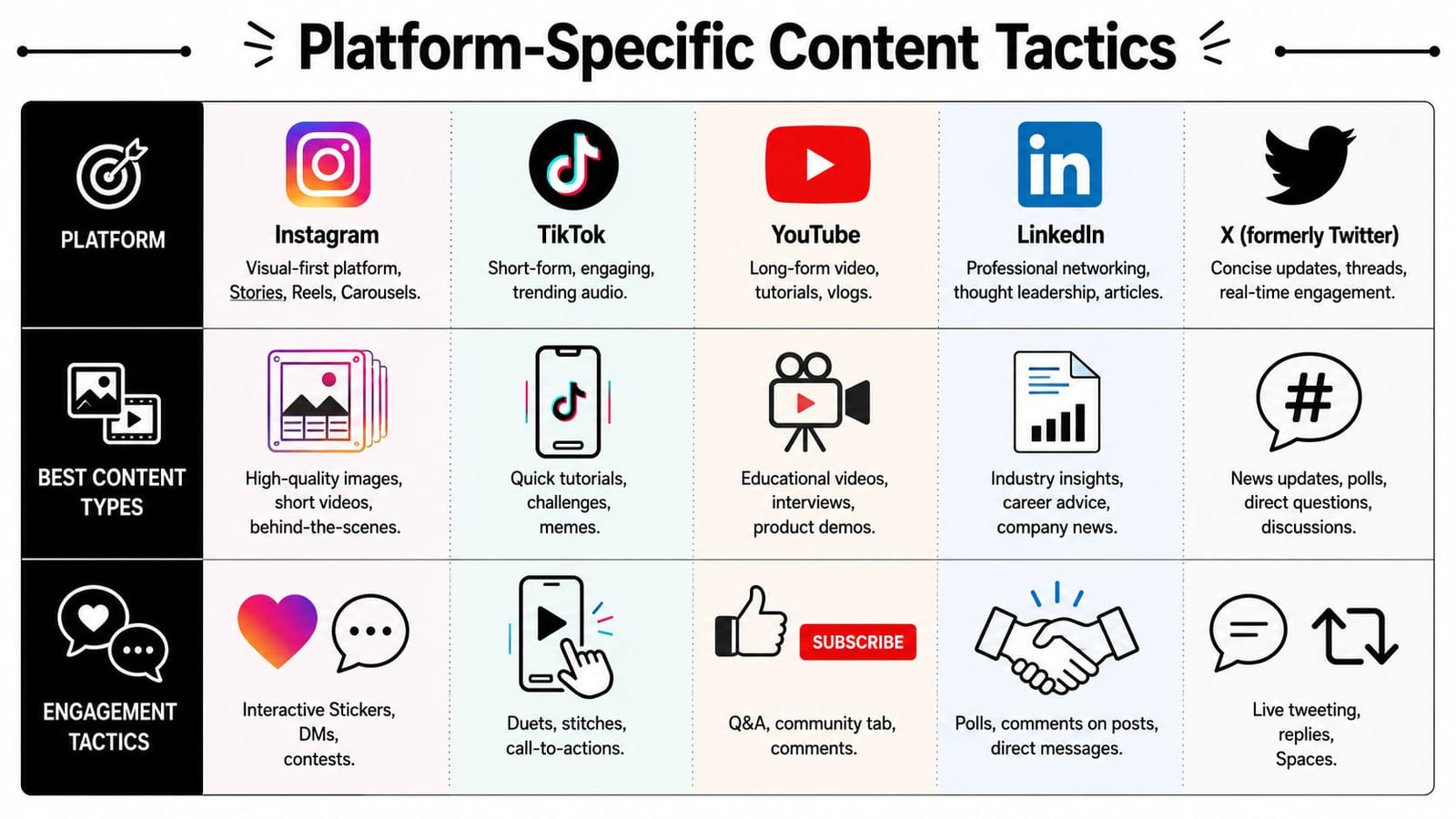
Hootsuite's benchmark data makes the point clearly. Carousels perform best on Instagram at 4.2% engagement, videos lead on LinkedIn at 3.9%, and albums perform best on Facebook at 2.9%, according to Hootsuite's social media benchmarks. The lesson is simple. Format-platform fit matters more than blind consistency.
What native content looks like on each platform
A practical way to think about platform fit is this:
TikTok: Fast payoff, conversational delivery, strong first-second hook. Raw beats polished if the idea lands.
Instagram: Carousels for teaching, Reels for reach, Stories for proximity and day-to-day touchpoints.
YouTube: Long-form builds authority. Shorts widen reach and test angles quickly.
LinkedIn: Clear professional insights, sharper framing, and video or document-style teaching often work well.
X: Strong one-liners, threads, reactions, live commentary, and opinionated takes.
Pinterest: Searchable evergreen visuals, idea pins, and topic-led design assets.
Facebook: Community-led discussion, albums, groups, and shareable practical content.
Not every brand needs equal effort on every channel. What matters is assigning each one a job. One platform can be your discovery engine. Another can hold your deepest trust-building content. Another can nurture your existing audience.
Adapt message angle, not just file format
The same source idea should often be framed differently depending on where it appears.
A webinar lesson on client onboarding might become:
an energetic short clip on TikTok,
a structured carousel on Instagram,
a professional "mistakes I see teams make" post on LinkedIn,
and a thread on X built around lessons learned.
That's not redundancy. That's adaptation.
A simple comparison helps:
| Platform | What users usually want | Better repurpose choice |
|---|---|---|
| TikTok | Quick value or entertainment | Short clip with a sharp hook |
| Save-worthy visuals | Carousel or Reel | |
| Insight with professional relevance | Native video or text post | |
| YouTube | Depth and searchability | Full video or Shorts |
| X | Brevity and perspective | Thread or concise take |
| Evergreen discovery | Visual summary graphic | |
| Community interaction | Album, question post, or video |
Instagram is also more local and discovery-driven than many marketers realize. If location matters for your brand, event, or storefront, this guide on mastering Instagram location search is worth reviewing because it explains how place-based discovery can support visibility without relying only on hashtags.
Native content doesn't mean reinventing the idea. It means respecting how people use the platform.
The fastest way to stall growth is to treat every network like the same room. They're not. The user mindset changes, so your packaging has to change with it.
Automate Your Publishing Cadence
Consistency matters, but consistency built on willpower doesn't last. Teams fall behind because posting becomes a daily operational task instead of a scheduled production process.
That matters more now because social media isn't an optional side channel anymore. By 2025, social media ad spend was projected to reach $276.72 billion, up 10.9% year over year, and 83% of marketers said social media had become their primary customer acquisition channel, as noted by Statista's social network industry overview. When budgets and acquisition expectations move in that direction, gaps in publishing start to hurt.
Build a realistic content rhythm
The goal isn't to post as often as possible. The goal is to post as reliably as your system can support without lowering quality.
A workable cadence usually has three layers:
Core scheduled posts: Your planned educational, promotional, and authority content.
Responsive content: Quick reactions, trend participation, timely commentary, or audience replies.
Community activity: Commenting, DMs, reposting audience wins, and interaction that doesn't require a new post.
Many teams frequently overcommit. They promise daily originality across every platform, then burn out by week two. A smaller rhythm you can maintain beats an ambitious one you keep restarting.
Batch first then schedule
Batching changes everything. Record several clips in one sitting. Write captions in one session. Design carousels in one block. Then load the content into a scheduler.
That approach gives you three advantages:
It protects quality because you're making decisions in context.
It reduces context switching.
It creates space for actual engagement after content is published.
Sprout and Hootsuite both point toward the same operational lesson in the earlier benchmark discussion. More posting isn't always better, and follower growth should be measured in context rather than by raw likes alone. So build a calendar you can evaluate, not just survive.
If you need a tool specifically for this operational layer, a social media post scheduler helps centralize timing, approvals, and cross-platform publishing so consistency doesn't depend on memory.
Turn Followers into a Thriving Community
Audience growth without interaction creates a feed, not a community. Real momentum comes when people feel seen, when they expect a response, and when they start contributing their own voice to the brand.
Research cited in the digital marketing study shows that 58% of consumers discover new businesses via social media, and that user-generated content drives 28% more engagement than branded content plus 4x higher click-through rates, according to the peer-reviewed analysis and linked findings. That isn't a minor detail. It means community activity and proof are part of growth, not a side benefit after growth.
Create repeatable engagement habits
The most effective community management is boring in a good way. It runs on habits.
A solid response system often looks like this:
Answer fast when the post is fresh: Early comment activity helps keep the conversation moving.
Reward thoughtful responses: Don't just say thanks. Add context, ask a follow-up, or reference a point they made.
Use DMs intentionally: Move qualified conversations into private messages when the person signals interest or asks a specific question.
Bring audience language back into content: If followers keep asking the same thing, turn that into the next post.
One of the cleanest ways to deepen trust is to treat comments as source material. The audience tells you what confuses them, what they want, and what language they use. Good strategists listen there more than they brainstorm in isolation.
A healthy comment section is often the earliest sign that your positioning is getting sharper.
Use social proof as content not decoration
User-generated content works because it lowers the distance between your brand and the audience. A polished brand post says what you believe. A customer, student, listener, or client post shows how that belief lands in everyday life.
For service brands and educators, that can include:
screenshots of wins or feedback,
reposted audience takeaways,
before-and-after process stories,
short testimonial clips,
Q&A sessions built from real audience questions.
For product brands, it can mean customer photos, unboxings, use cases, or creator-led demonstrations.
The important part is context. Don't dump praise onto the feed with no explanation. Frame it. Why did this result happen? What should the audience learn from it? How does it connect to your method, philosophy, or offer?
Community grows when followers stop feeling like spectators. Polls, Q&As, live sessions, prompts, and reposted audience contributions all help move them from passive consumption into participation.
Analyze Your Data and Iterate for Growth
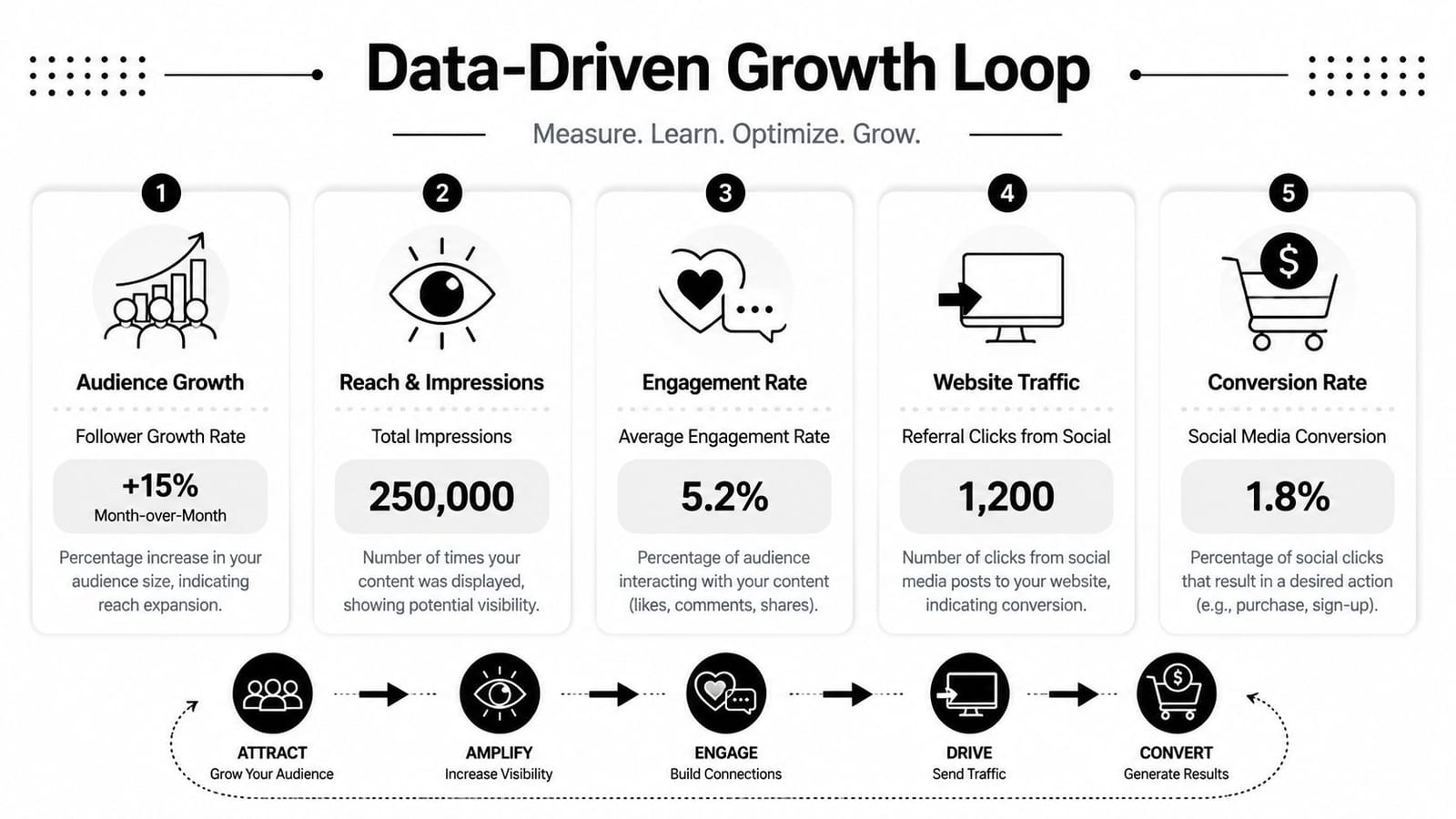
Growth gets easier when you stop asking, "Did this post do well?" and start asking, "What does this result tell us to do next?" Analytics matter because they close the loop between publishing and decision-making.
Track signals that help you decide
The most useful metrics are the ones that change behavior. In practice, that usually means:
Follower growth rate: Sprout Social defines it as gained followers divided by starting followers in its metric guidance referenced in the earlier benchmark research.
Engagement rate: A stronger signal than raw likes because it helps compare posts and formats.
Reach or impressions: Useful for visibility patterns, especially when testing hooks or new formats.
Click-through rate: Important when the post is supposed to move people to a site, offer, or signup.
Conversion signals: Inquiries, bookings, replies, signups, or sales depending on your goal.
Looking at one metric in isolation creates bad decisions. A post can get broad reach and weak conversion. Another can get modest reach and strong qualified traffic. Those are different wins.
Run a simple monthly audit
Once a month, review your content by format, topic, and platform. You don't need a complex dashboard to start. You need a repeatable review.
Ask:
Which topics generated the strongest response quality?
Which format performed best on each platform?
Which posts drove clicks, inquiries, or direct conversations?
Which content should be updated, reposted, or expanded?
Analytics becomes editorial planning. You aren't just reporting. You're deciding what to make more of, what to retire, and what to test next.
If you want a practical companion resource focused on measurement and subscriber-oriented thinking, Narrareach's subscriber growth guide adds useful perspective on reading performance without getting lost in vanity metrics.
Frequently Asked Growth Questions
How long does it take to see real growth
Longer than most creators want, and faster than most think once the system is right. Random posting can drag on for months with little signal. A focused workflow with clear positioning, repurposed pillar content, consistent publishing, and active engagement usually creates clearer feedback much sooner. A key milestone isn't a follower number. It's when you can identify what content reliably earns attention and response.
Do you need paid ads
Not always. Organic content can do a lot of the heavy lifting if your message is sharp and your workflow is consistent. Paid support makes more sense when you already know which offers, audiences, and content angles are working. Amplification works best after organic learning, not instead of it.
What's the biggest mistake new creators make
They confuse activity with strategy. Posting often without a content engine, a defined audience, or a clear platform role creates motion without progress.
How do you grow if you can't post constantly
Many common recommendations often fall short. A more durable approach is to build a wider discovery system through channels like YouTube, podcasts, and blogs, especially for experts and educators where trust matters more than post volume, as discussed in Sprout Social's guidance on building social media presence.
How do you find your voice
Start with your real point of view, not a borrowed tone. Voice gets clearer when you repeat the same core beliefs across multiple posts and formats. If your content sounds generic, your position probably is too. Strong voice comes from saying something specific often enough that people start recognizing the pattern.
If you want to make this workflow practical, quso.ai helps turn long-form content into clips, subtitles, posts, blogs, scheduled publishing, and cross-platform analysis from one system. For creators and teams trying to grow without burning out, that kind of setup makes the process easier to run every week.