Achieve 1000 Followers on Tik Tok: Your 2026 Plan
You've probably done this already. You post a TikTok, check it an hour later, and see a handful of views, maybe a like or two, then nothing. The next day you try a different format. Then a trend. Then a talking-head clip. Then a carousel of ideas copied from someone bigger in your niche. The result is usually the same: random output, random results.
That's why most creators stall before they reach 1000 followers on TikTok. They don't have a growth problem first. They have a system problem. Their profile doesn't make a clear promise, their content jumps between topics, and their workflow depends on motivation instead of process.
A better approach is to build a simple content machine that keeps producing relevant videos, learns from performance, and gets easier to run over time. That matters much more than chasing one lucky post. If your goal is to get to 1000 followers and keep going after that, you need a setup you can repeat when life gets busy, when views dip, and when one video unexpectedly works.
Table of Contents
- Why 1000 Followers Is Your First Big Milestone
- Make your profile answer one question fast
- Choose content pillars before you post
Why 1000 Followers Is Your First Big Milestone
A lot of creators talk about 1000 followers like it's just a nice round number. It isn't. It's the first point where your account becomes more useful.
Once you reach 1,000 followers, TikTok enables LIVE, which adds features like live events, Q&A, and gifts, according to this overview of the benefits of reaching 1000 followers on TikTok. That changes the job of your account. You're no longer limited to short, edited posts. You can answer objections in real time, build trust faster, and create a stronger loop between content and community.
That threshold matters even more because TikTok's scale is huge. One projection cited in the same source puts the platform at 1.99 billion monthly active users and says people spend about 95 minutes per day on the app. That's a lot of attention concentrated inside one platform. Hitting 1000 followers doesn't mean you've “made it,” but it does mean you've earned access to a more flexible set of tools inside an attention-rich environment.
Practical rule: Treat 1000 followers as an operational milestone, not a vanity milestone.
That shift changes how you should work. Don't ask, “How do I get more followers fast?” Ask, “What system helps me publish clear, repeatable content until the platform understands who to show me to?”
If you want another grounded look at that first push, LesFM has a useful breakdown on how video creators can get TikTok followers. For a broader growth framework, this guide on how to grow your TikTok followers is also worth reviewing alongside your content plan.
Build a Follow-Worthy Profile and Niche
Most creators try to fix weak growth with more posting. That usually backfires. If someone lands on your profile after seeing a good video and can't tell what you do, why you matter, or whether you'll post that kind of content again, they won't follow.
Make your profile answer one question fast
The question is simple: What will I get if I follow you?
Your profile should answer it in a few seconds. That means tightening five basics before you worry about volume.
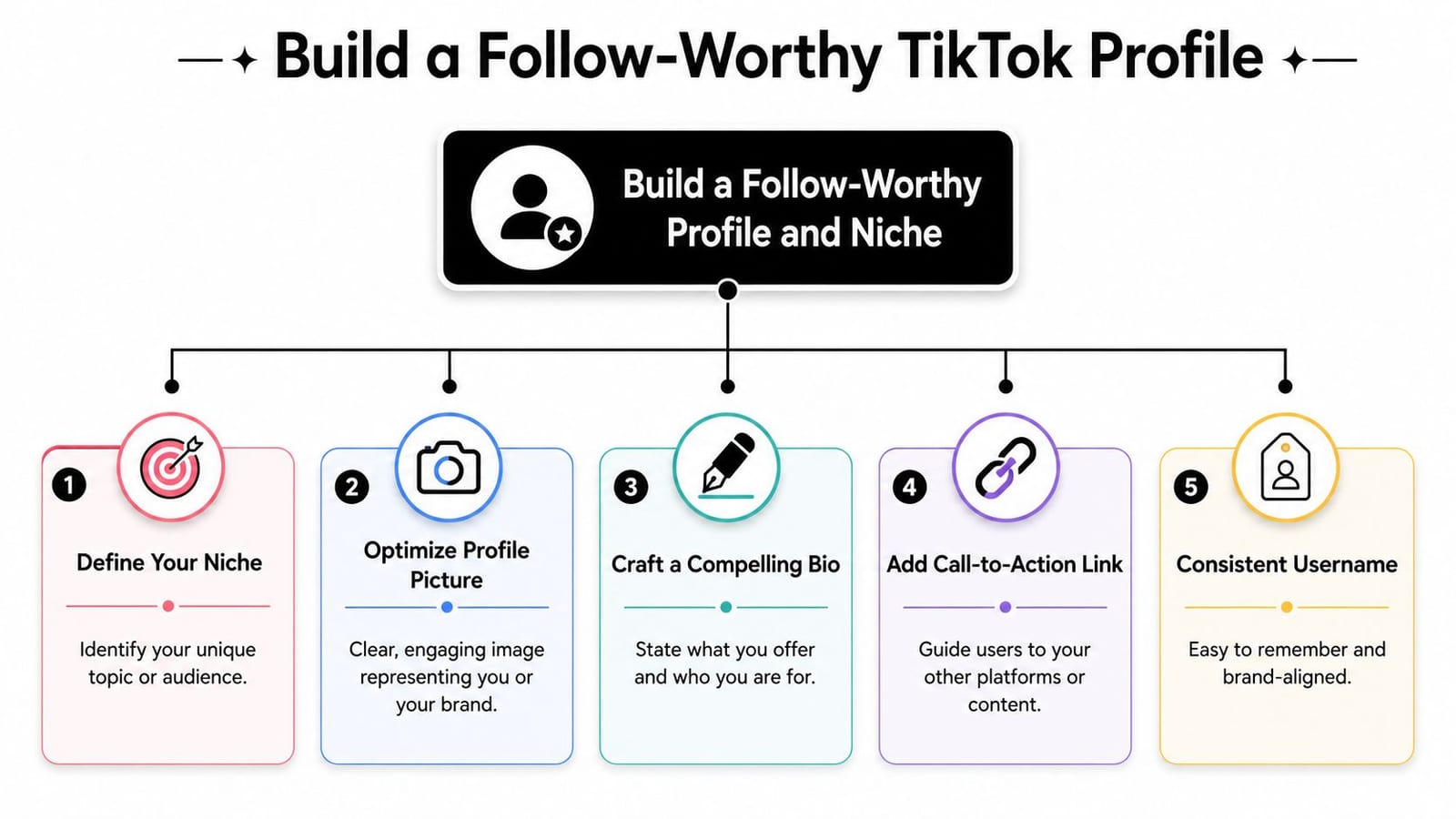
- Username: Keep it easy to remember, easy to search, and consistent with your presence elsewhere.
- Profile photo: Use a clear image that reads well on mobile. If you're the brand, show your face. If the brand is bigger than the founder, use a clean logo.
- Bio: State who you help, what you talk about, and what kind of content people should expect.
- Call to action: Give visitors one next step. Follow for daily breakdowns. Watch the pinned series. Visit your link.
- Pinned posts: Use these as your trailer. Pin the best proof of what your account delivers.
If writing the bio is slowing you down, an AI TikTok bio generator can help you draft options quickly, then you can refine them to sound like you.
A strong profile doesn't try to sound impressive. It reduces hesitation.
Choose content pillars before you post
Your niche doesn't need to be tiny. It needs to be clear.
A practical way to do this is to define three or four content pillars. These are the repeatable themes your audience can expect. They also give TikTok cleaner signals about what your account is about.
For example, a business coach might use:
- Client mistakes people can fix today
- Short teaching clips on one concept
- Behind-the-scenes workflow showing how they work
- Myth-busting takes that challenge common advice
A fitness creator could use:
- Form corrections
- Simple meal ideas
- Beginner routines
- Mindset and consistency
The mistake is making pillars too broad. “Lifestyle” is not a pillar. “Daily systems for busy founders” is. “Marketing” is not a pillar. “Short-form content strategy for coaches” is.
Your profile and niche should work together. The profile makes a promise. The pillars prove you can keep it.
Create a Repeatable Content Engine That Works
The fastest way to burn out on TikTok is to build your strategy around daily improvisation. Every day starts with the same question: what should I post? That question drains time, lowers quality, and makes your account inconsistent.
A stronger system starts with a different target. Buffer's TikTok growth experiment argued that creators should optimize for retention and repeatable discovery, not follower count alone, while emphasizing a niche strategy, strong hooks, TikTok SEO, and at times posting more than once per day in a discovery-driven environment, as described in Buffer's TikTok experiment.
Stop building your strategy around trends
Trends can help. They just can't carry the whole business.
If every post depends on a trending sound or a reactive format, you're outsourcing your strategy to whatever the app is serving that day. That often creates spikes without identity. People might watch one post, but they don't get a reason to follow because the next video could be about something completely different.
A better engine has three parts:
- Hook library: Keep a running note of opening lines that fit your niche.
- Pillar-based ideas: Generate multiple angles under each pillar instead of one-off topics.
- Production workflow: Batch recording, editing, captioning, and scheduling in separate blocks.
Here's what that looks like in practice. Record several raw videos in one sitting. Edit them in a separate block. Write captions later. Schedule once you've reviewed the week. That division reduces decision fatigue and helps you stay consistent when your calendar gets messy.

Turn one idea into multiple TikToks
Small creators gain an advantage. One useful long-form asset can become a week or more of short-form content.
Say you record a webinar, podcast episode, Zoom training, client workshop, or even a long talking-head video. Instead of posting one clip and moving on, break it into multiple angles:
- A problem-first clip with a direct hook
- A mistake-focused clip built around one false assumption
- A step-by-step clip from the same source material
- A contrarian clip using the strongest opinion
- A reply-style clip that answers the obvious follow-up question
That's the difference between content creation and content extraction. You don't need a new idea every time. You need a better way to package existing expertise.
One option for this workflow is quso.ai, which can turn long-form video into short clips, generate captions and hashtags, and help teams repurpose content for TikTok within one social workflow. Used well, a tool like that doesn't replace strategy. It makes a good strategy easier to execute consistently.
If you can only create when inspiration shows up, you don't have a system yet.
A simple weekly schedule makes this easier to sustain.
| Day | Content Pillar Focus | Video Idea Example |
|---|---|---|
| Monday | Core education | One common mistake beginners make in your niche |
| Tuesday | Myth-busting | A belief your audience has that's hurting results |
| Wednesday | Behind the scenes | How you plan, work, or solve a real problem |
| Thursday | Tactical tutorial | One small process people can copy today |
| Friday | Opinion or story | A lesson from experience with a clear takeaway |
| Saturday | Community response | Answer a comment or respond to a frequent question |
| Sunday | Repurposed highlight | Best clip from a longer video or live session |
This kind of engine works because it's boring in the right way. It reduces randomness. It gives you a stable output rhythm. It also creates enough repetition for TikTok to classify your account more reliably.
Master TikTok SEO and Your Posting Strategy
Good content still needs help getting found. On TikTok, packaging matters. If your video is about one thing but your caption, spoken words, and on-screen text point in different directions, discoverability gets weaker.
Package each video for discovery
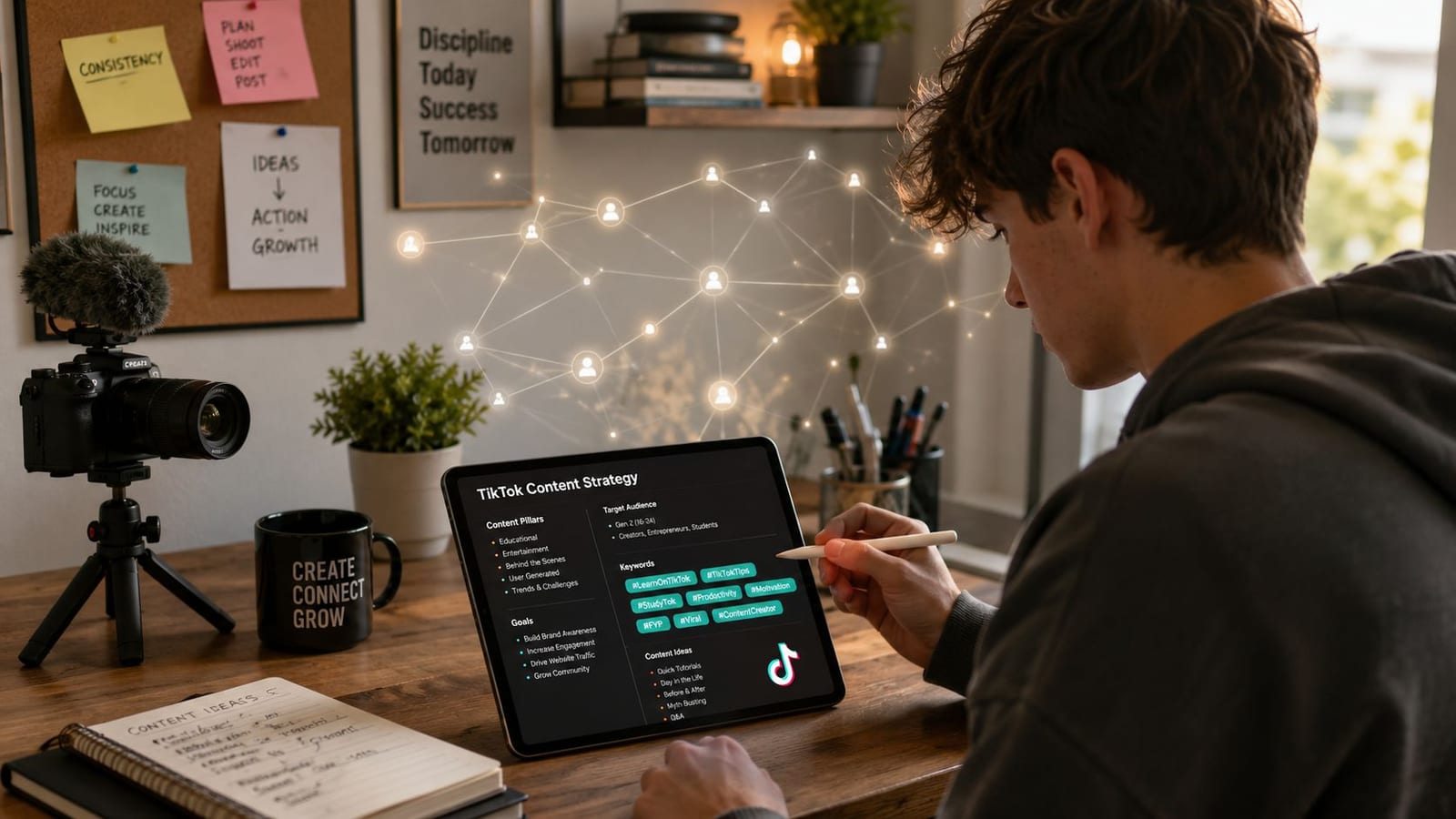
TikTok SEO isn't complicated, but it does require alignment. Pick one main topic for each post and make that topic visible in the places TikTok can read and users can understand.
Use the keyword in:
- Spoken dialogue if you're talking on camera
- On-screen text near the opening
- Caption copy in natural language
- Hashtags that reinforce the topic rather than distract from it
If your video is about pricing coaching offers, don't hide that behind a vague caption like “some thoughts today.” Say what the video is about. Clear beats clever most of the time.
A practical hashtag mix usually includes:
- A broad category tag tied to your niche
- A niche-specific tag that narrows the audience
- A topic-specific tag tied to the exact subject of the video
That keeps the metadata relevant without turning the caption into a cluttered list.
For a more detailed breakdown of discoverability mechanics, this guide to TikTok SEO is useful if you want to refine captions, keywords, and search intent.
Pick a schedule you can actually keep
Creators lose momentum because they choose a schedule that looks ambitious on paper and impossible in real life.
If you can sustain daily posting without quality dropping, fine. If not, a smaller schedule you keep every week is better than a high-volume burst followed by silence. What matters is that your posting rhythm matches your production capacity.
This is also where budget matters. If you're hiring editors, designers, or support, your content calendar has to fit what you can maintain. Teams thinking through workload and resourcing can borrow ideas from broader strategies for social media budgeting, especially if TikTok is one channel inside a larger content operation.
Use trending sounds carefully. They can help your video feel native to the platform, but they shouldn't override your niche. If the sound adds context, energy, or familiarity, use it. If it pulls the video away from your core topic, skip it.
This walkthrough is a useful companion if you want to see posting and optimization ideas in action:
Working rule: Consistency wins when it survives your actual week, not your ideal week.
Spark Growth with Smart Engagement and Collaboration
Some accounts post decent videos for months and still feel invisible. Often the missing piece is simple. They publish, then disappear.
TikTok rewards participation. People do too. The creators who grow into strong communities usually act like members of a niche, not just broadcasters inside it.
Accounts in the 1,000 to 10,000 follower range are often treated as nano-influencers, and some 2026 summaries report average engagement around 12%, according to Charle Agency's TikTok statistics roundup. That's one reason early-stage creators shouldn't obsess over looking big. Smaller accounts can still be very strong at interaction quality.
Use a daily interaction routine
A simple routine works better than random networking.
Spend a short block each day doing three things:
- Reply to your own comments with substance, not just emojis
- Leave thoughtful comments on accounts in your niche
- Save patterns from audience questions that could become new videos
Thoughtful means specific. If another creator posts a tip about client onboarding, don't comment “great advice.” Add a real reaction, a nuance, or an example from your own experience. Good comments often attract profile visits from the right people.
One useful habit is turning comments into content. When someone asks a question you know others are thinking too, answer it publicly in a new post. That gives you relevant ideas straight from the audience and builds the sense that your account is active and responsive.
Replying to comments isn't admin work. It's audience research.
Collaborate without forcing it
You don't need formal partnerships to collaborate. TikTok already gives you formats for this through Stitch and Duet.
Use them when:
- Another creator makes a point you can expand on
- You want to offer a respectful counterpoint
- A trending conversation intersects directly with your niche
- A customer, peer, or partner creates something worth responding to
The key is relevance. If you're a career coach and you duet a random viral joke just because it's popular, the extra reach is usually low quality. If you stitch a hiring manager's take and explain what candidates should do differently, the audience fit is much better.
Your visual identity also plays a role here. A polished profile image and consistent personal branding can improve how people perceive your account when they discover you through comments or collabs. If that's part of your strategy, Secta Labs has a practical read on AI headshots for social media engagement.
The main goal at this stage isn't to look famous. It's to become familiar to the right audience.
Analyze Your Performance to Grow Beyond 1K
Most creators check TikTok analytics emotionally. They look for confirmation that a video did well or disappointment that it didn't. That habit doesn't help much.
A better review process looks for signals you can use in the next batch of content. Toptal's TikTok growth guidance recommends defining KPIs in advance and tracking views, average watch time, engagement, and conversion to follows so you can identify which videos drive follower growth, as outlined in this TikTok growth strategy guide.
Track the metrics that explain follower growth
Don't stare at follower count alone. It's lagging information.
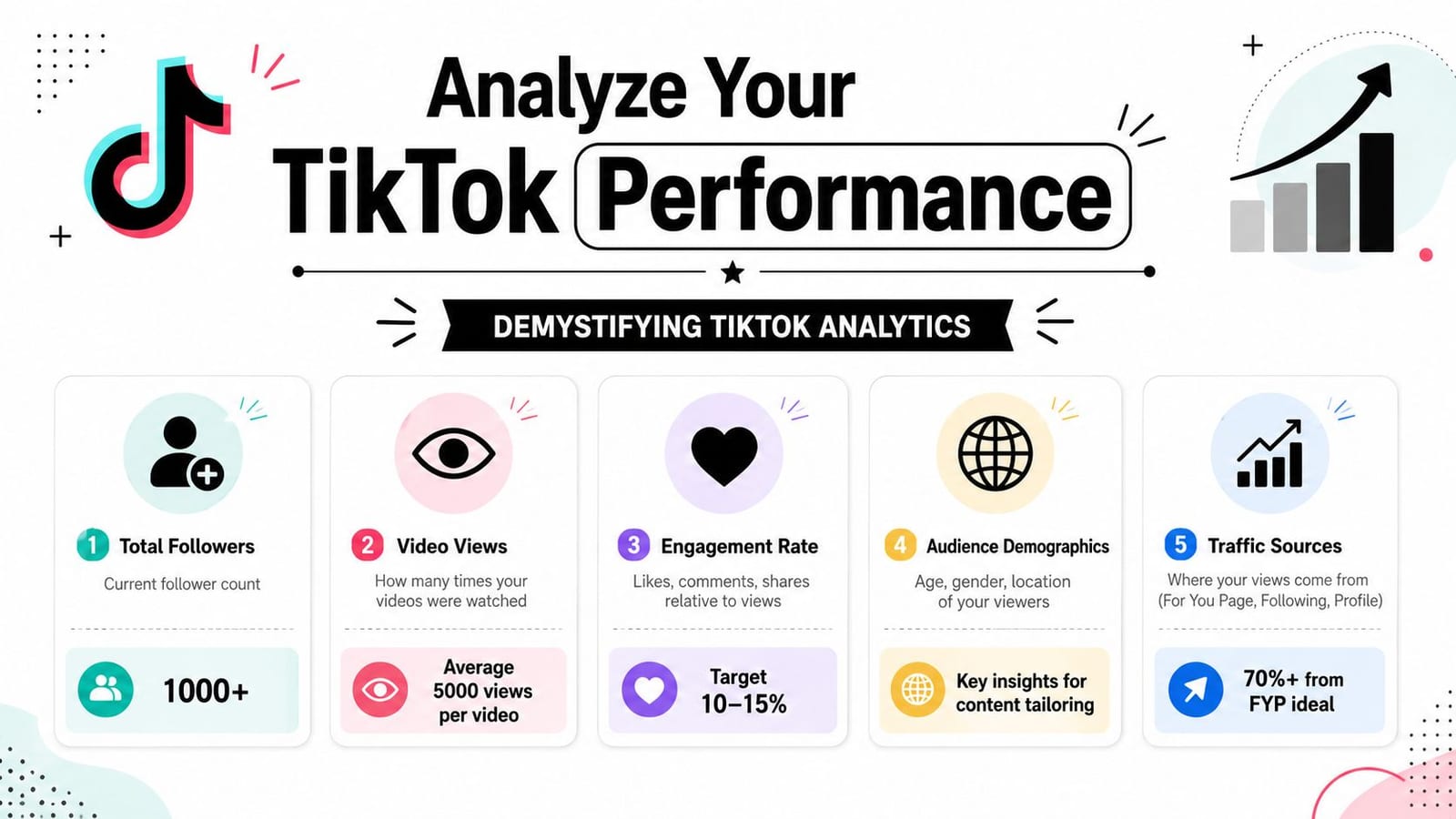
Pay attention to:
- Views to see which topics earn distribution
- Average watch time to judge whether the hook and structure hold attention
- Engagement to understand what sparks response
- Conversion to follows to spot which posts turn viewers into audience
These metrics do different jobs. A video can get views and still fail to convert because it attracted the wrong audience. Another might get fewer views but produce more follows because the topic is tightly aligned with your niche.
Run a weekly review that changes your next posts
Keep this review short and practical.
Ask:
- Which topic got the best watch time?
- Which format got the most comments or saves?
- Which video drove the most profile interest or follows?
- What should be repeated, cut, or reframed next week?
If one pillar consistently underperforms, don't scrap the whole niche immediately. First change the hook, length, framing, or example style. If one format keeps producing follows, build a small series around it. This is how a content system improves. Not through guesswork, and not through copying random trends, but through repeated feedback loops.
The creators who grow past 1K usually stop treating each post like a referendum on their talent. They treat each post like input.
If you want a simpler way to run that system, quso.ai can help you turn long videos into short TikTok clips, organize repurposing, generate captions and hashtags, and keep publishing from one workflow instead of juggling separate tools.