AI Twitch clip generator for streams where you talk
Creating an account is free. See pricing for your country.
Free plan: 75 credits a month, about 75 minutes of video. 720p with a watermark, no card.
The short answer
An AI Twitch clip generator scans a stream's VOD and proposes short vertical clips with captions for TikTok, Shorts and Reels. quso.ai does this from a pasted Twitch VOD link or an uploaded file, and it finds clips in what you say, so it works best on Just Chatting, commentary and podcast-style streams. For silent gameplay highlights, Eklipse or Twitch's own Clips do better.
Updated
A four-hour stream holds maybe a dozen moments worth posting. Finding them is slow. You scrub the VOD the next morning, half-remembering where the good bits were. Twitch already lets you clip as you go, and its clips post straight to TikTok, but a clip tops out at 60 seconds and you only get the moments that you or a viewer remembered to clip while the stream was still running.
An AI clip generator works the other way round: it reads the whole VOD and proposes clips you can then accept or drop. quso.ai reads the transcript, which makes it a good fit for streams that are mostly talk and a poor one for streams that are mostly game. This page says which is which, so you can pick the right tool before spending credits on a five-hour VOD.
From VOD to vertical clips
Six steps. The decision that matters most is in the first: import the whole VOD, or only the part where you talk, because credits are charged per minute of video.
Step 1
Paste the VOD link
Paste the link to the past broadcast and quso.ai imports the VOD directly. Twitch keeps past broadcasts for 7 days, or 60 for Partners and Prime or Turbo users, so do this soon after the stream. Don't wait. quso.ai takes videos up to 5 hours.
The link brings in the whole broadcast, and credits follow its length. If the stream ran four hours and only the first hour was Just Chatting, download the VOD from your Video Producer, cut that hour, and upload it instead. It costs 60 credits instead of 240, and it is where most of the clips are anyway.
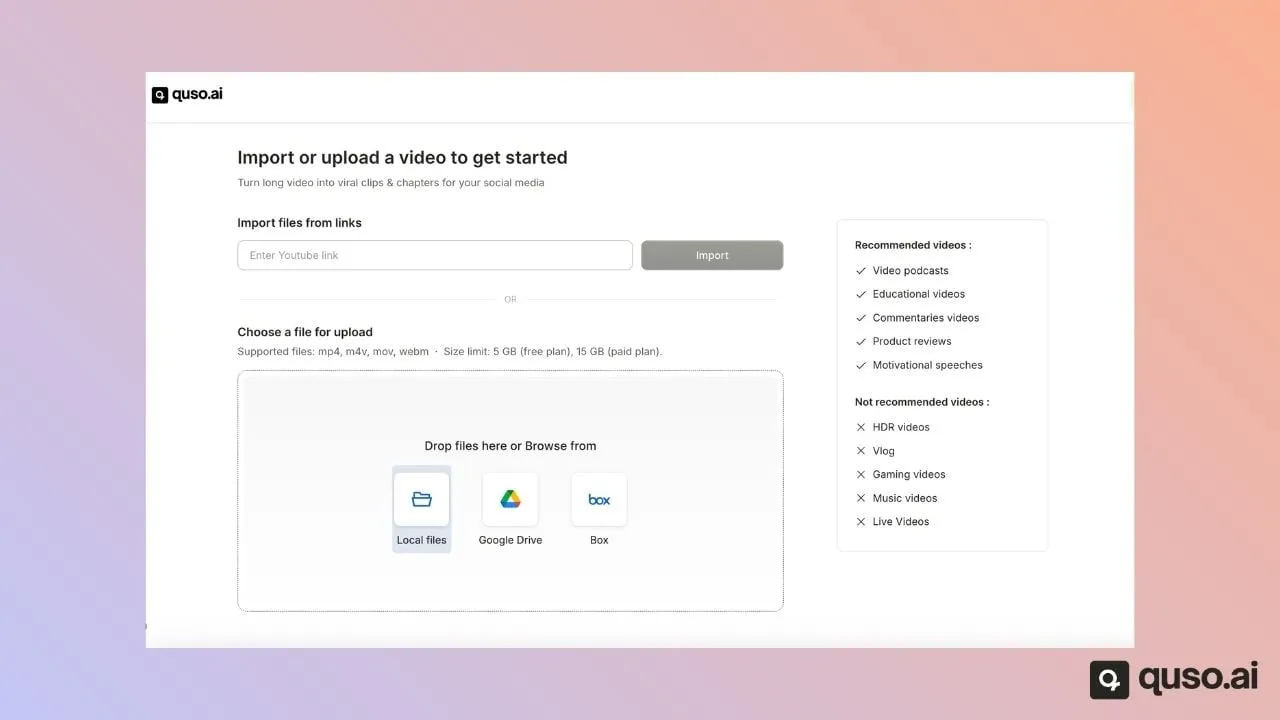
quso's own upload screen recommends commentary videos and lists gaming and live videos as not recommended. That is the honest scope of this tool. Step 2
Set the language, then CutMagic
Choose the language you stream in. Get this wrong and you get no clips. Then leave CutMagic switched on. It detects the screen and your face in each scene and is what gives you a facecam-and-gameplay vertical layout later. It can't be added after processing. Leave it on.
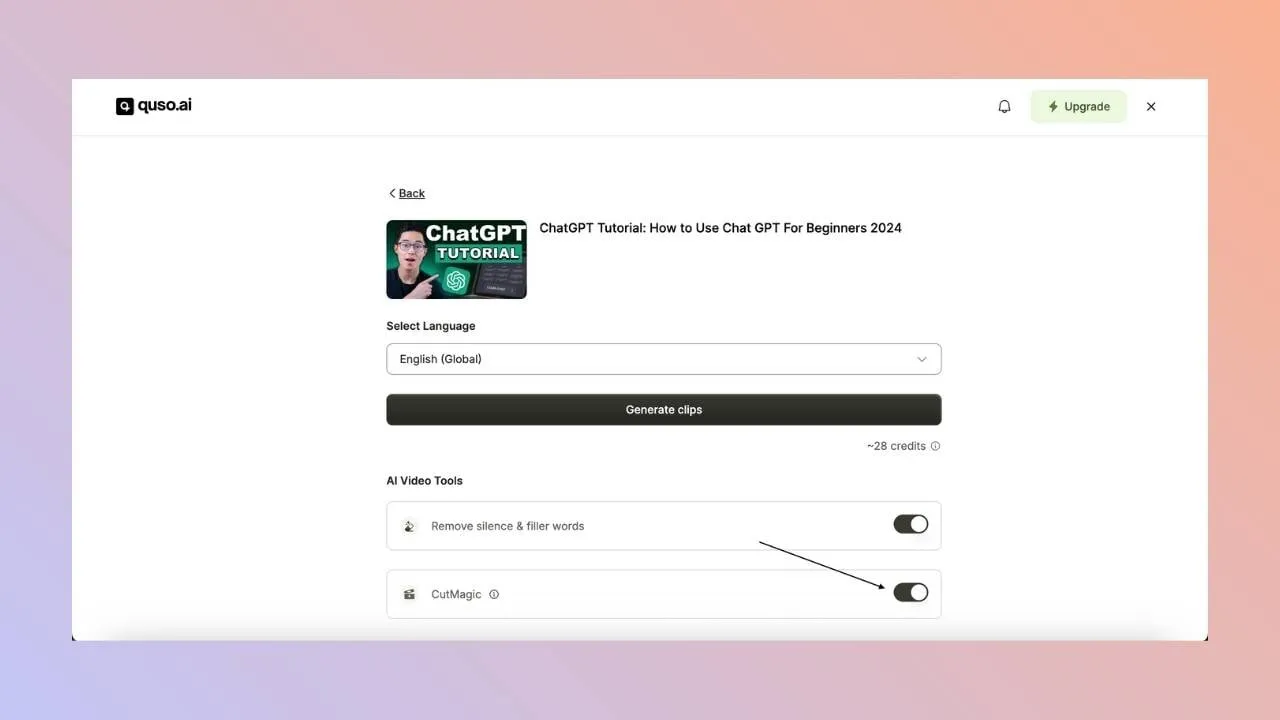
The credit estimate shows before anything is charged. Step 3
Read the ranked list
Clips come back ranked by score. Each has a title and timestamps. On a stream, expect the good ones to be the moments where you reacted out loud: the story you told chat, the rant, the laugh. A play you made in silence won't be in the list. That's expected.
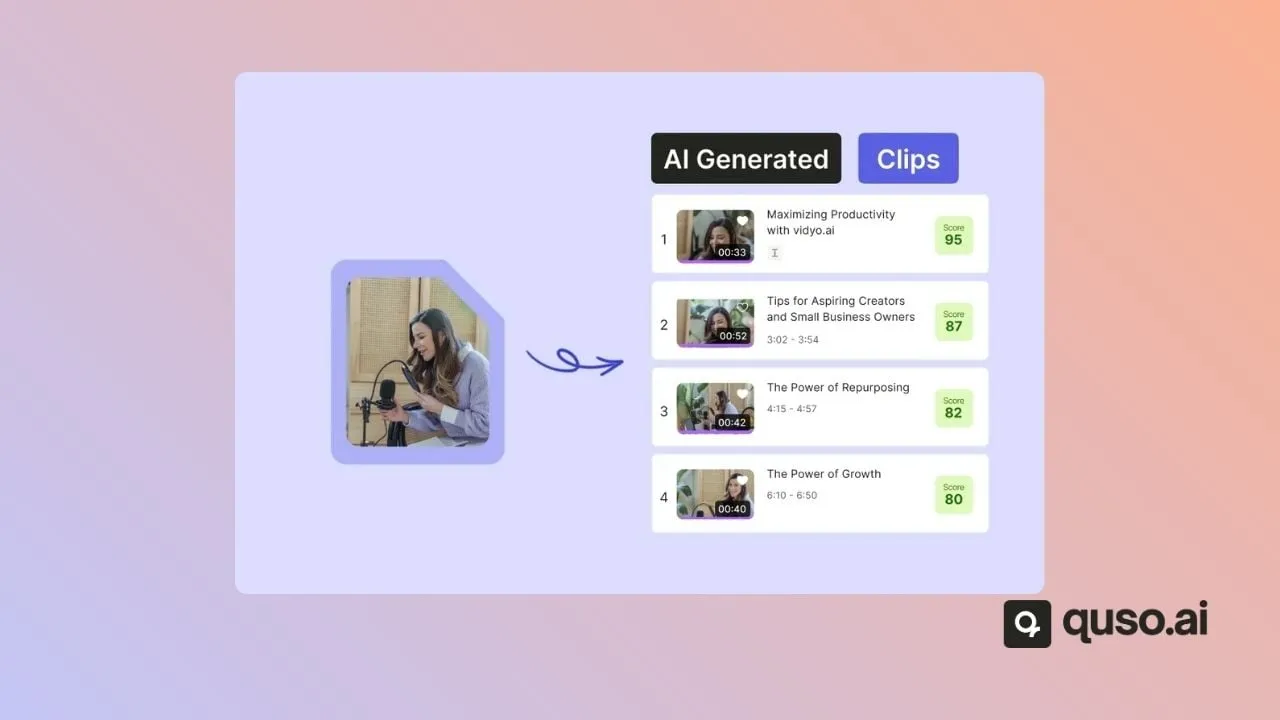
How the ranked list is laid out (help-center illustration). Step 4
Pick the layout for each scene
For a stream with a facecam, choose Screen + Speaker (game on top, you below) or Screen + Speaker (Bubble). For a co-stream or a podcast on Twitch, the two-, three- and four-speaker layouts split the frame between people. Use Crop on each element to frame the facecam tightly and keep alerts or chat out of shot, then check the first and last second of the clip, because a layout that looks right mid-scene can catch the edge of a scene change at either end.
The CutMagic layout menu, scene by scene (help-center recording). Step 5
Fix the captions
Stream slang, game names and usernames are where speech recognition slips. Check them. Each caption line is editable in the Subtitles tab, and the style and animation change in the same panel.
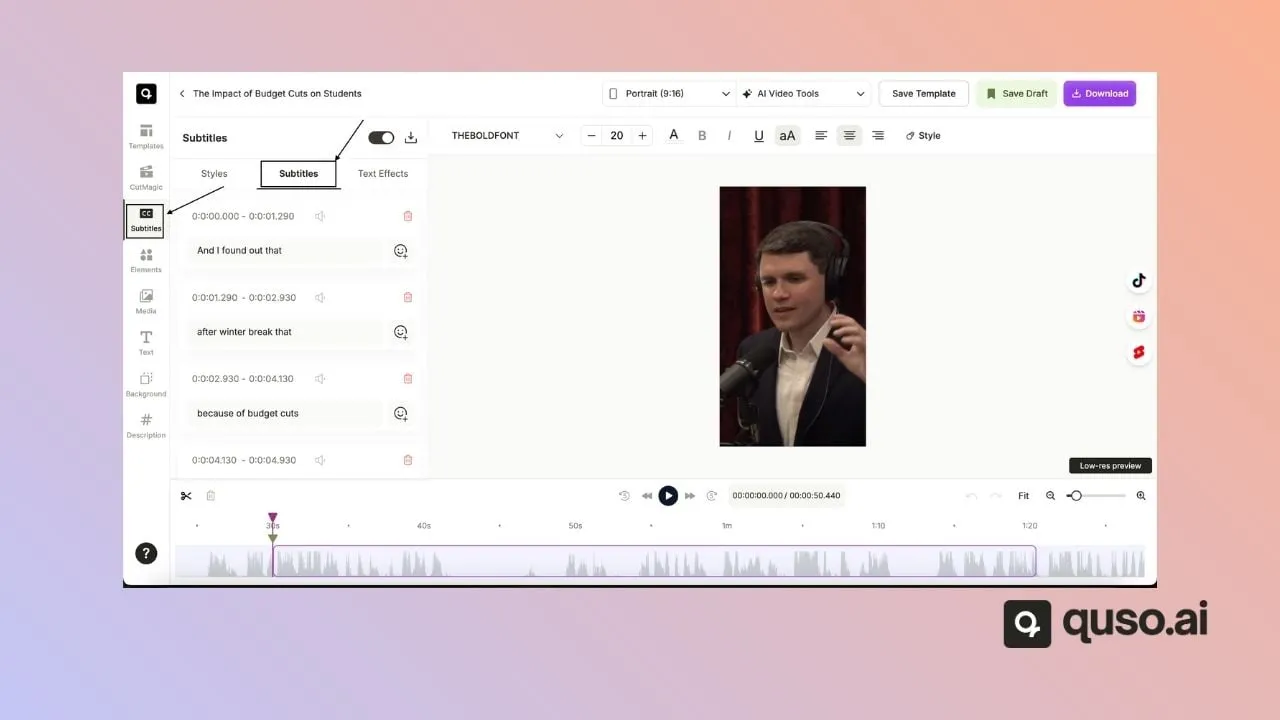
Caption lines with timings, editable one by one. Step 6
Post to TikTok, or schedule everywhere
Every plan publishes to TikTok, the free one included. Essential and Growth schedule the same clip to YouTube Shorts, Instagram, Facebook, LinkedIn, X and Pinterest, each with its own description and time. Or download the MP4s and post them yourself. Nothing posts until you say so.
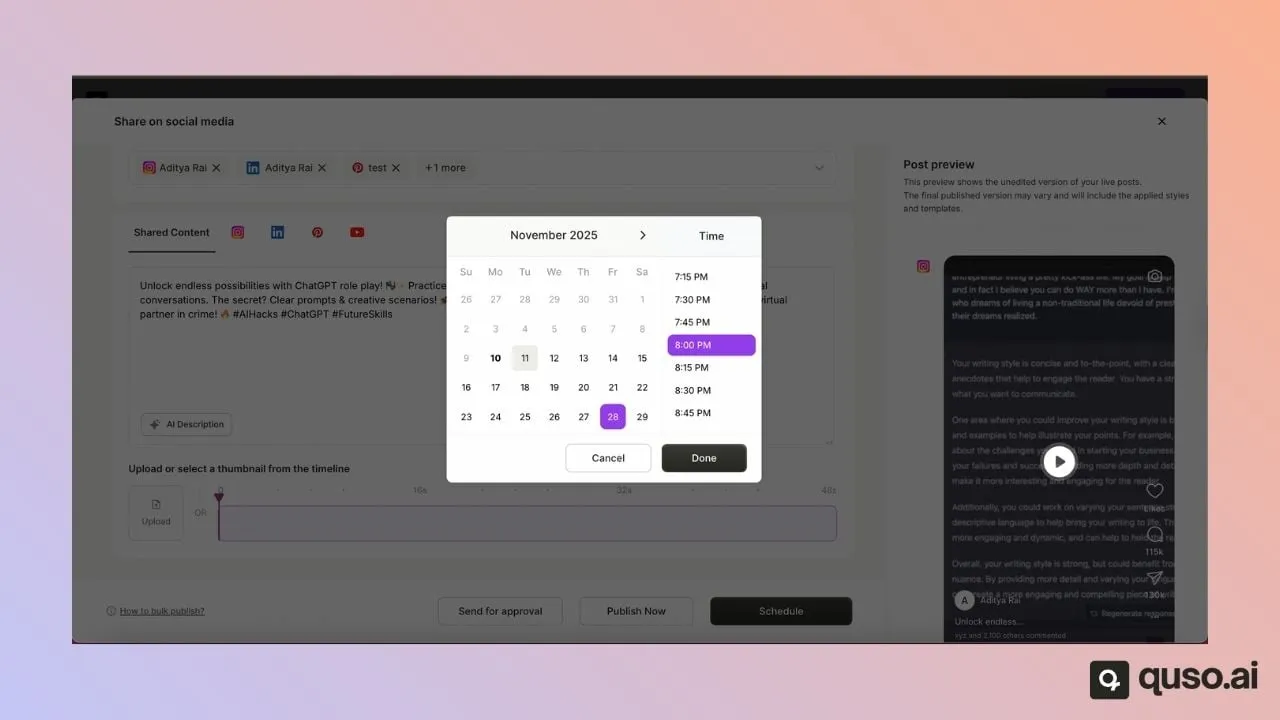
One clip, several platforms, a chosen time.
What comes out
Vertical clips with burned-in captions, longer 16:9 chapters, and an editable transcript of the stream. The recording below shows the editor reframing a talking clip to 9:16 with captions; a stream clip with a gameplay layout works the same way.
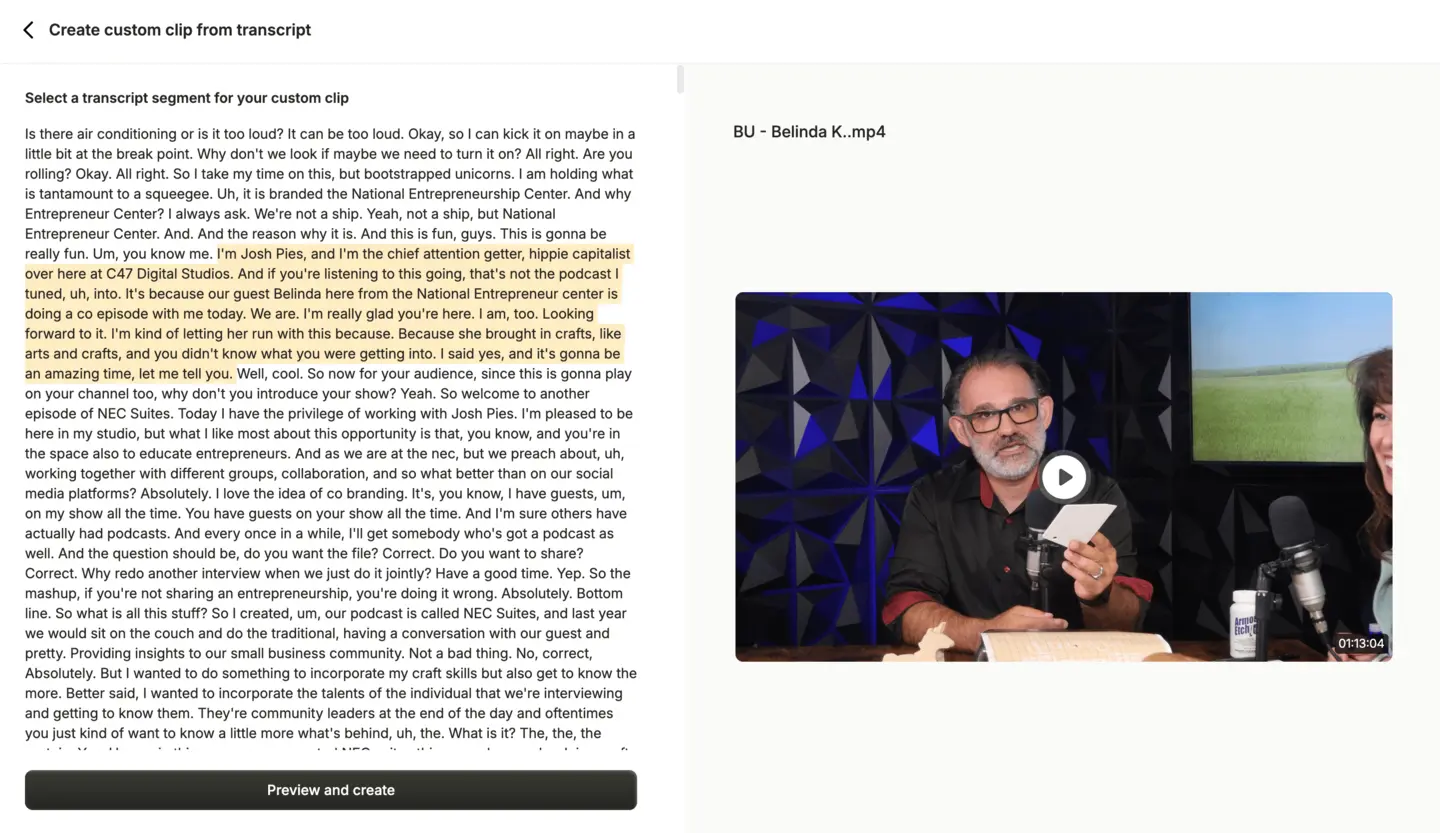
Vertical clips
Mostly 30 to 60 seconds: the median AI clip across 1.77 million in quso's 2026 benchmark ran 40.6 seconds. Free renders are 720p with a quso.ai watermark; paid renders are 1080p without it.
Chapters
Longer 16:9 segments. Good for a full story or a match recap on YouTube.
A transcript
Every word of the stream, editable. Custom clips are cut from it. Search it for the line chat kept repeating back at you for the rest of the night, select those words, and that moment becomes a clip of its own without any scrubbing.
Five things that go wrong
The best moment was silent
A clutch round with no commentary has nothing in the transcript to find. Clip those live with Twitch's Clip button or say "Twitch, Clip That", and use quso.ai for the parts of the stream where you were talking.
The VOD is gone
Twitch deletes past broadcasts after 7 days unless you are a Partner or a Prime or Turbo user (60 days), and only if Past Broadcast storage was switched on before the stream. Turn it on, and import or download the VOD the same week.
The stream eats a month of credits
A full 4-hour VOD costs 240 credits. That is more than three times the free plan. Trim to the talk-heavy segment first, because the clips mostly come from there anyway and every minute you leave out of the upload is a credit you keep for next week's stream.
The overlay crowds the frame
Alerts, chat boxes and webcam borders end up in a 9:16 crop. Crop each element in the layout. If you plan to clip a lot, it is worth setting up a cleaner OBS scene for the segments you expect to clip, with the facecam large and the chat box out of the way.
Music in the background
Licensed music playing under your stream ends up in the clip, and a post that carries it can be muted or taken down for copyright. Cut or replace those sections before you post.
How quso.ai compares with the Twitch clip tools that rank
Twitch's own help page ranks first for "twitch clip maker", and Eklipse and StreamLadder rank beside quso.ai. All three are built for gaming streams in ways quso.ai is not, and the table says so.
| quso.ai | Eklipse | StreamLadder | Twitch Clips | |
|---|---|---|---|---|
| Free plan | 75 credits a month (about 75 minutes); 720p with a watermark | 3 clips per stream | Free editor; basic editing never adds a watermark; AI clipper not included | Free, built in |
| Cheapest paid plan, monthly billing | Lite, $29/month: 100 credits, 1080p | Prices not published on its site | Starter, $15/month; AI clipper (ClipGPT) from Creator, $27/month | No paid tier for Clips |
| How it finds moments | From the transcript: what is said on stream | Game events (kills, wins), audio spikes and chat sentiment | Chat interactions, reactions and highlights, ranked by virality | You clip by hand; Auto Clips (speech-to-text and chat) is an invite-only test |
| Getting the stream in | Paste the Twitch VOD link, or upload the file | Connects to your channel and monitors automatically | Paste a Twitch or Kick VOD link | Already there |
| Kick | No | Yes (a Premium feature) | Yes | Not applicable |
| Facecam + gameplay vertical | CutMagic Screen + Speaker layouts; free on your first 3 videos | Auto-reframe with subject tracking | Detects and frames facecams automatically | Stacked layout, generated automatically |
| Posting | TikTok on every plan; 7 platforms from Essential, $39/month | Publishes to TikTok, YouTube Shorts, Instagram Reels and X | Posts and schedules to TikTok, YouTube, Instagram and Facebook from Starter | Posts to TikTok, YouTube, Instagram and Snapchat |
| Longest input | 5 hours | No limit stated on stream length | 10 GB upload for ClipGPT | Clips up to 60 seconds |
Checked on October 21, 2026 on each vendor's own pages. Prices are monthly billing in USD.
Where the others win
- Gameplay highlights: Eklipse reads game events across more than 1,000 games, plus audio spikes and chat. quso.ai only hears what you say, so for a stream that's mostly game, Eklipse is the better tool.
- No pasting, no uploads: Eklipse watches your channel and clips each stream on its own, so a daily streamer gets clips every morning without doing anything. With quso.ai you bring in each VOD yourself.
- Kick: Eklipse and StreamLadder both support Kick. quso.ai doesn't.
- Free and already there: Twitch Clips cost nothing, make the portrait Stacked version for you, and post straight to TikTok. For one great moment you saw live, they're the quickest route.
- Streamer extras: StreamLadder bundles emote tools and a stream schedule maker. quso.ai has nothing Twitch-specific.
Sources: Twitch: how to use Clips, Twitch: Auto Clips, Twitch: on-demand content, Eklipse, Eklipse Premium, StreamLadder, StreamLadder ClipGPT, StreamLadder plans.
What a stream costs in credits
One credit is one minute of uploaded video, rounded up. Streams are long, so this decides the plan faster than any feature does. Upload the talk-heavy segment. Skip the rest.
| Plan | Price | Credits a month | What that covers |
|---|---|---|---|
| Free | $0 | 75 | One hour of Just Chatting a month. 720p with a watermark, TikTok publishing, CutMagic on your first 3 videos. |
| Lite | $29/month | 100 | About an hour and a half of stream a month. 1080p, no watermark, TikTok publishing. |
| Essential | $39/month | 300 | Five hours a month: one talk-heavy hour from each weekly stream, with room left. Adds scheduling to YouTube Shorts and 5 more platforms. |
| Growth | $49/month | 600 | Ten hours a month, enough for two trimmed streams a week. Adds a brand kit with your logo, colours and fonts. |
If you stream daily and want every hour clipped automatically, the per-minute model gets expensive, and a channel-monitoring tool fits better. If you stream a few times a week and talk a lot, Essential covers it. Full plan details are on the pricing page.
Questions people ask
- How do I clip on Twitch?
- On Twitch itself, press the Clip button on a live stream or a VOD, or say "Twitch, Clip That" while you're live. A Twitch clip runs up to 60 seconds, and Twitch makes a portrait version automatically. To get many clips out of a whole stream at once, paste the VOD link into an AI clip generator such as quso.ai and review what it proposes.
- How do I turn Twitch clips into TikToks?
- Twitch can post a clip straight to TikTok, YouTube, Instagram or Snapchat, with a Stacked layout that puts your facecam above the gameplay. For longer cuts with editable captions, import the VOD into quso.ai, pick the Screen + Speaker layout for each scene, and publish to TikTok. TikTok publishing works on every plan, including the free one.
- Is there a free AI Twitch clip generator?
- Yes, several. Twitch's own Clips cost nothing, and its Auto Clips feature is in an invite-only test. Eklipse's free plan gives 3 clips per stream. quso.ai's free plan gives 75 credits a month (about 75 minutes of video) with a watermark on 720p clips. StreamLadder's editor is free, and its AI clipper, ClipGPT, has a 7-day free trial.
- Does quso.ai work for gaming streams?
- Partly. It depends on how much you talk. quso.ai finds clips from what is said on stream, so it does well on segments where you talk: Just Chatting, reactions, commentary, a podcast you stream on Twitch. It doesn't watch the game. A silent clutch play or a win screen with no commentary won't be found, and quso's own upload screen lists gaming videos as not recommended. For gameplay moments, Eklipse detects in-game events. Twitch Clips work too.
- Can I import a Twitch VOD by link?
- Yes. Paste the past broadcast's link and quso.ai imports the VOD directly; Twitch sits alongside YouTube, Vimeo, X, Facebook, Rumble, Loom, LinkedIn and Zoom as a link source. The link brings in the whole broadcast, so if you only want one segment, download the VOD from your Video Producer, cut it, and upload the file. Twitch deletes past broadcasts after 7 days, or 60 days for Partners and Prime or Turbo users, so import or download before then.
- How long a stream can I upload, and what does it cost?
- Up to 5 hours. Uploads cap at 5 GB on the free plan and 15 GB on paid plans. One credit is one minute of video, so a full 4-hour stream costs 240 credits. That's more than the free plan's 75 and most of Essential's 300 ($39/month). Uploading only the talk-heavy hour costs 60 credits.
- Does quso.ai support Kick?
- No. Kick isn't one of quso.ai's import sources. You can still download the VOD and upload the file, or use Eklipse or StreamLadder, which both support Kick.
- Can I keep my facecam and gameplay in the vertical clip?
- Yes, with CutMagic's Screen + Speaker layout, which puts the screen on top and the person below, or the Bubble variant, which shows the speaker in a circle. CutMagic detects screens and faces and picks a layout per scene, and you can crop each element to frame your facecam exactly. It's built for screen recordings, so expect to adjust the crop on a busy stream overlay. The free plan includes CutMagic on your first 3 videos.
Keep reading
- quso.ai's import sources — Twitch, Vimeo, Loom, Zoom and the rest of the links you can paste.
- What stream highlights are — The glossary entry, with how streamers use them.
- How to promote a live stream — Where clips fit in getting people to the next stream.
- More live-stream viewers on YouTube — For streams that go out on YouTube as well as Twitch.
- Short-form benchmarks 2026 — 1.77 million AI clips: lengths, counts per video, and which ones get exported.
- quso.ai vs StreamLadder — A longer side-by-side.
- Podcast clip generator — The same workflow for a podcast you record or stream.